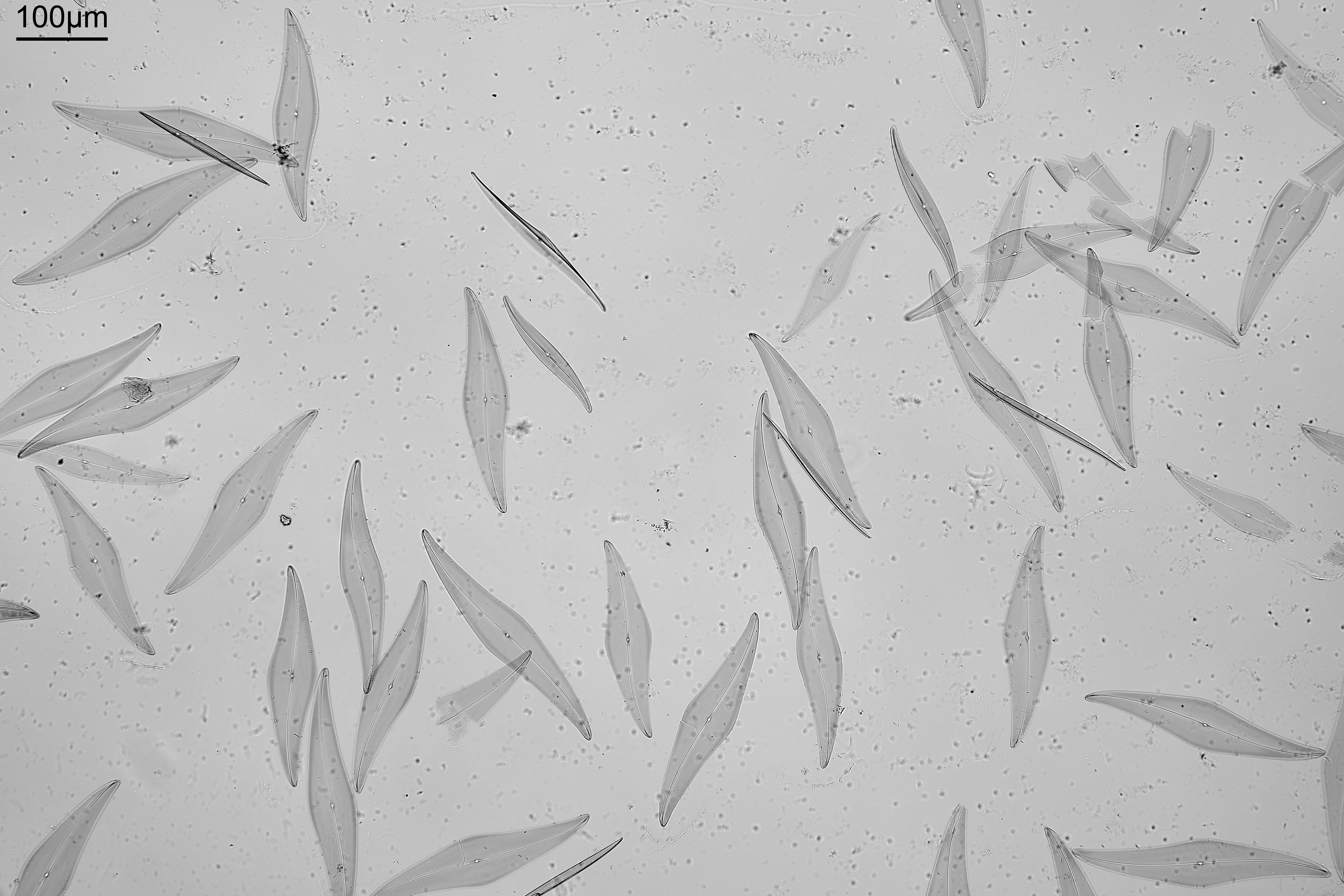
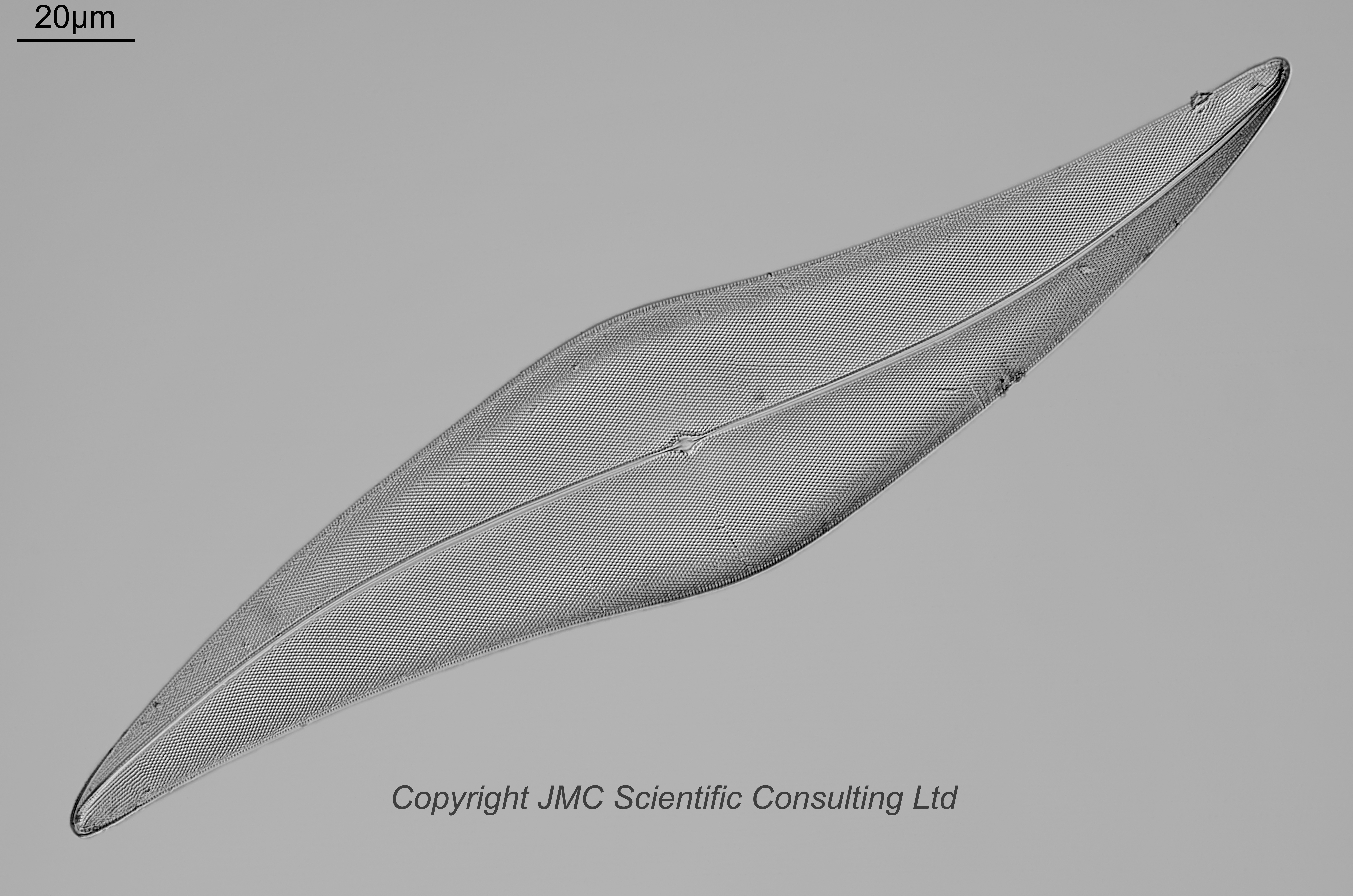
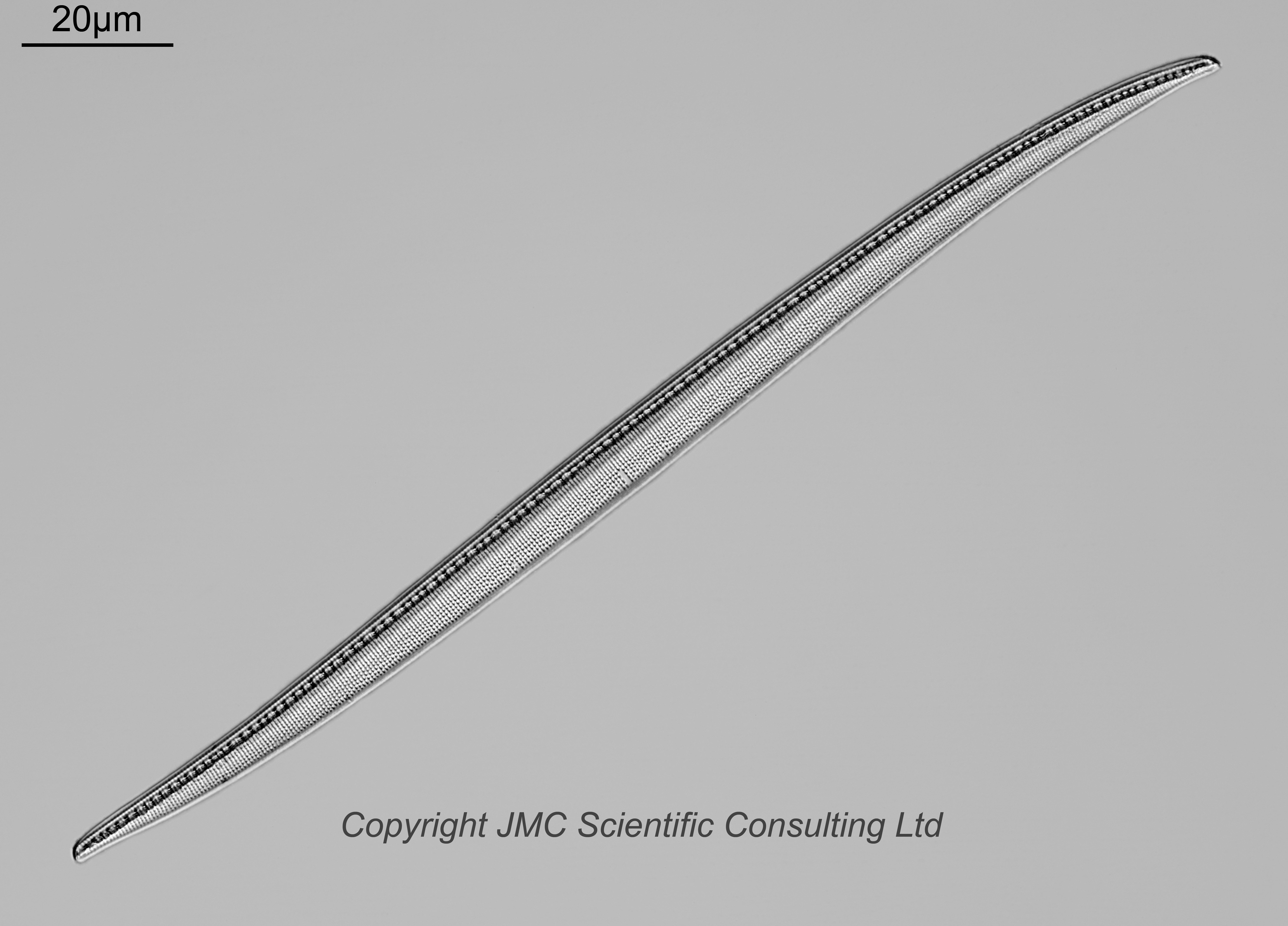
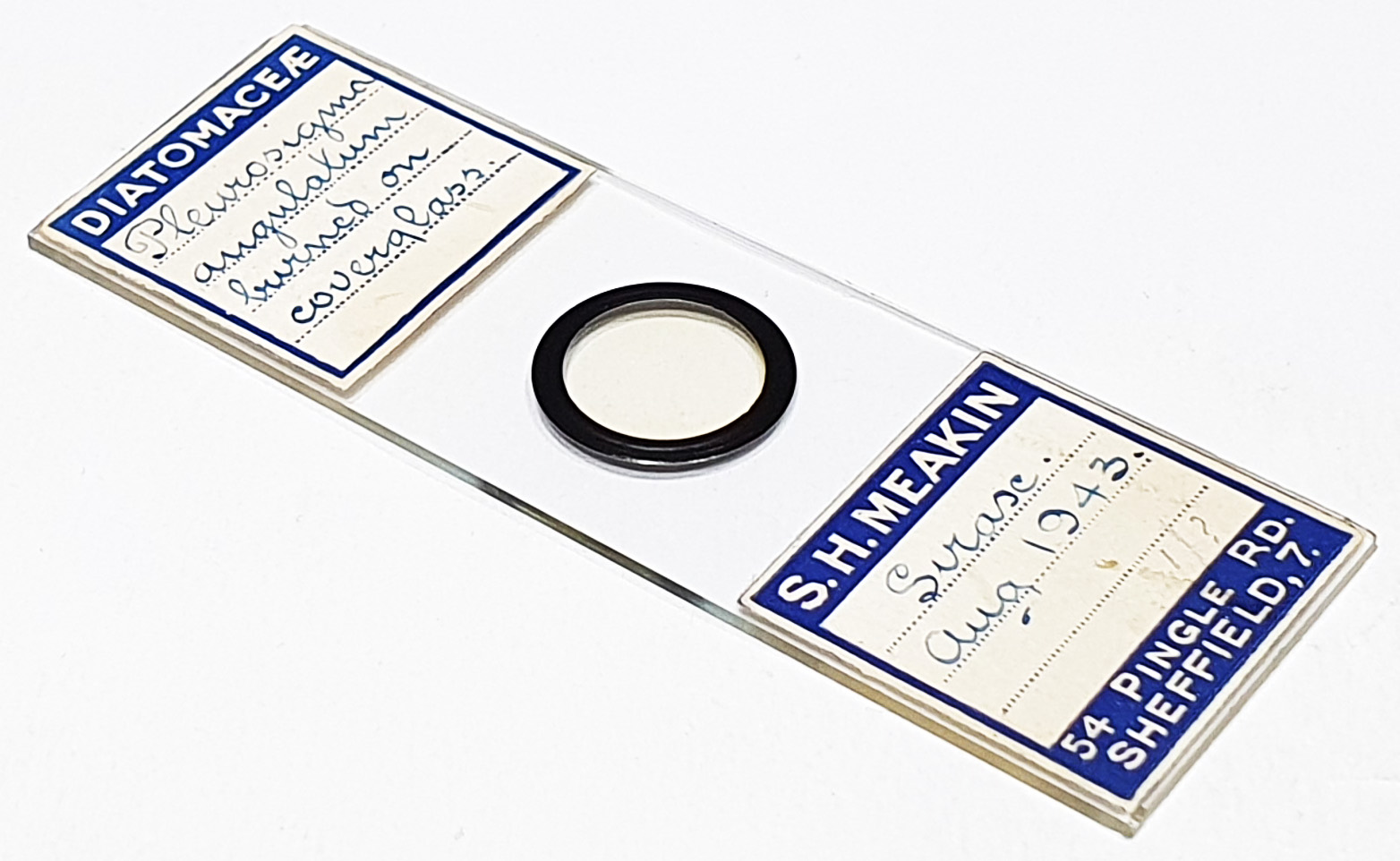
Bit of a mouthful, the title of this page. Slide described as Pleurosigma angulatum burned on coverglass. Mounted in Sirax and dated August 1943. Prepared by Samuel Henry Meakin. Some Nitzschia species present as well, as well as a few other diatoms. Olympus BHB microscope using 450nm LED light. I selected a P. angulatum, and a Nitzschia sp. (maybe N. sigma) for imaging. 63x Leitz Pl Apo 1.4 objective, oil immersion. Olympus Aplanat Achromat condenser, oil immersion, oblique lighting. 2.5x Nikon CF PL photoeyepiece. Monochrome converted Nikon d850 camera. Image stacks prepared in Zerene (Pmax).
Pleurosigma angulatum (J.T.Quekett) W.Smith 1852. Published in: Smith, W. (1852). Notes on the Diatomaceae with descriptions of British species included in the genus Pleurosigma. Annals and Magazine of Natural History, Series 2 9: 1-12, 2 pls. Page 7, Plate 1, Fig. 7, 8 [as var. beta], 9 [as var. gamma].
Nitzschia sigma (Kützing) W.Smith 1853. Published in: Smith, W. (1853). A synopsis of the British Diatomaceae; with remarks on their structure, function and distribution; and instructions for collecting and preserving specimens. The plates by Tuffen West. In two volumes. Vol. I. pp. [i]-xxxiii, 1-89, pls I-XXXI. London: John van Voorst, Paternoster Row. Page 39, Plate XIII [13], Figure 108.
I’ve just imaged another slide by Meakin where the diatoms had been burned onto the coverslip (see here). On this one the diatoms looked the same across the coverslip and I suspect the Sirax mountant is doing that. On the other slide it was truly dry, while that is not the case here. Oddly enough on this slide the contrast was not as high as I had expected for Sirax. I am wondering if the ‘burning on’ is a factor here? This type of mounting is little known so there aren’t that many definitive answers here as to exactly what it does to the diatoms, however it remains an interesting mounting technique nonetheless.