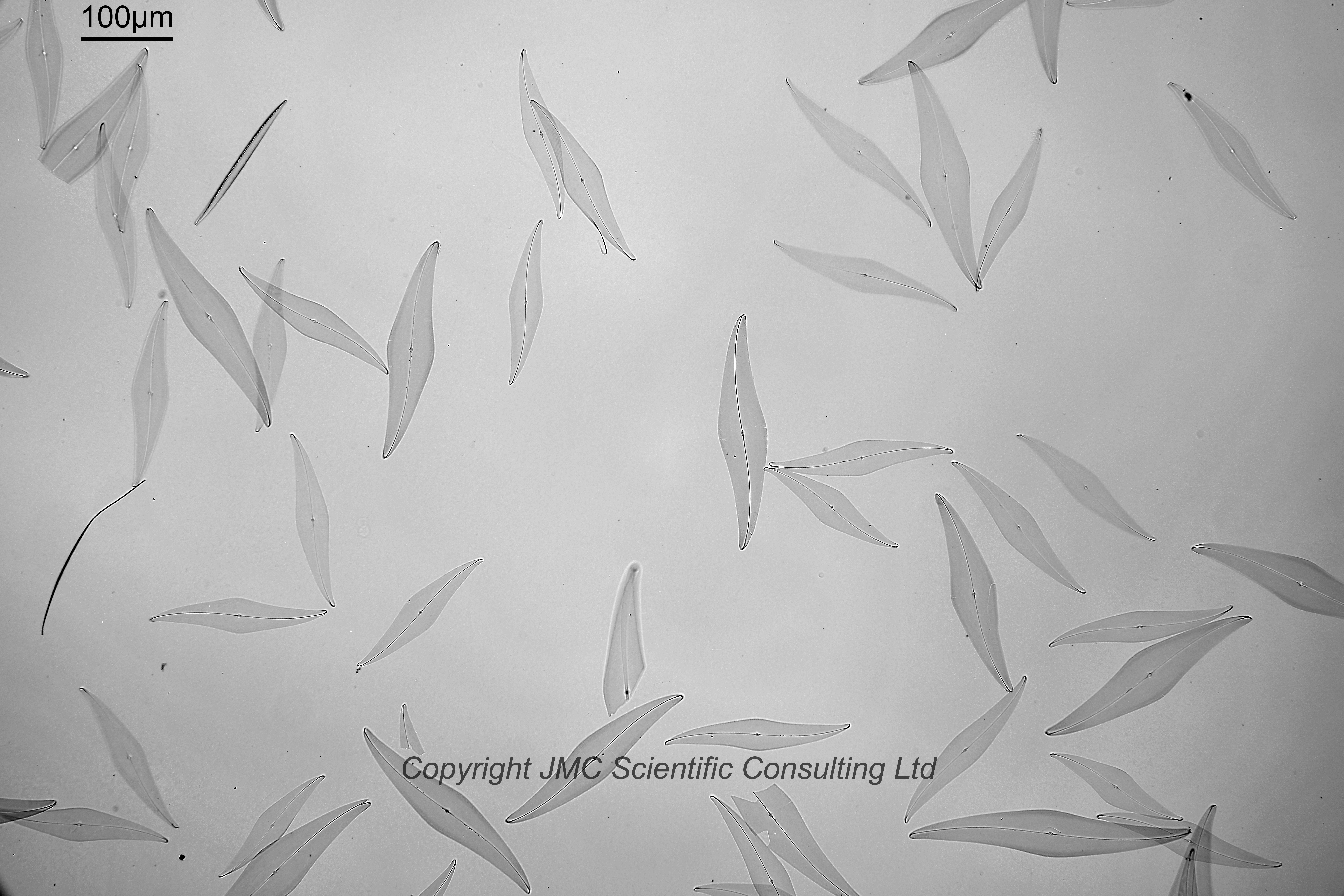
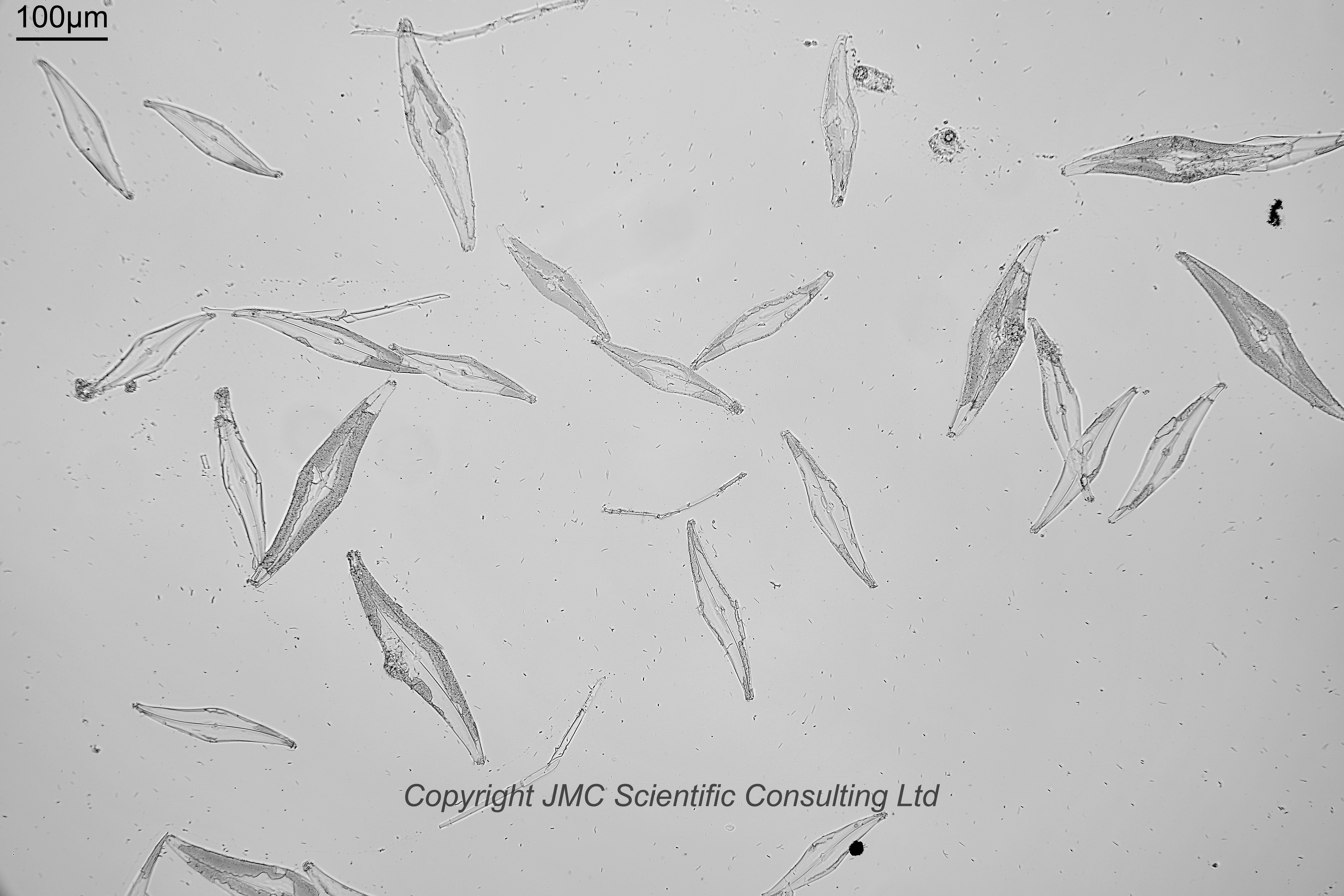
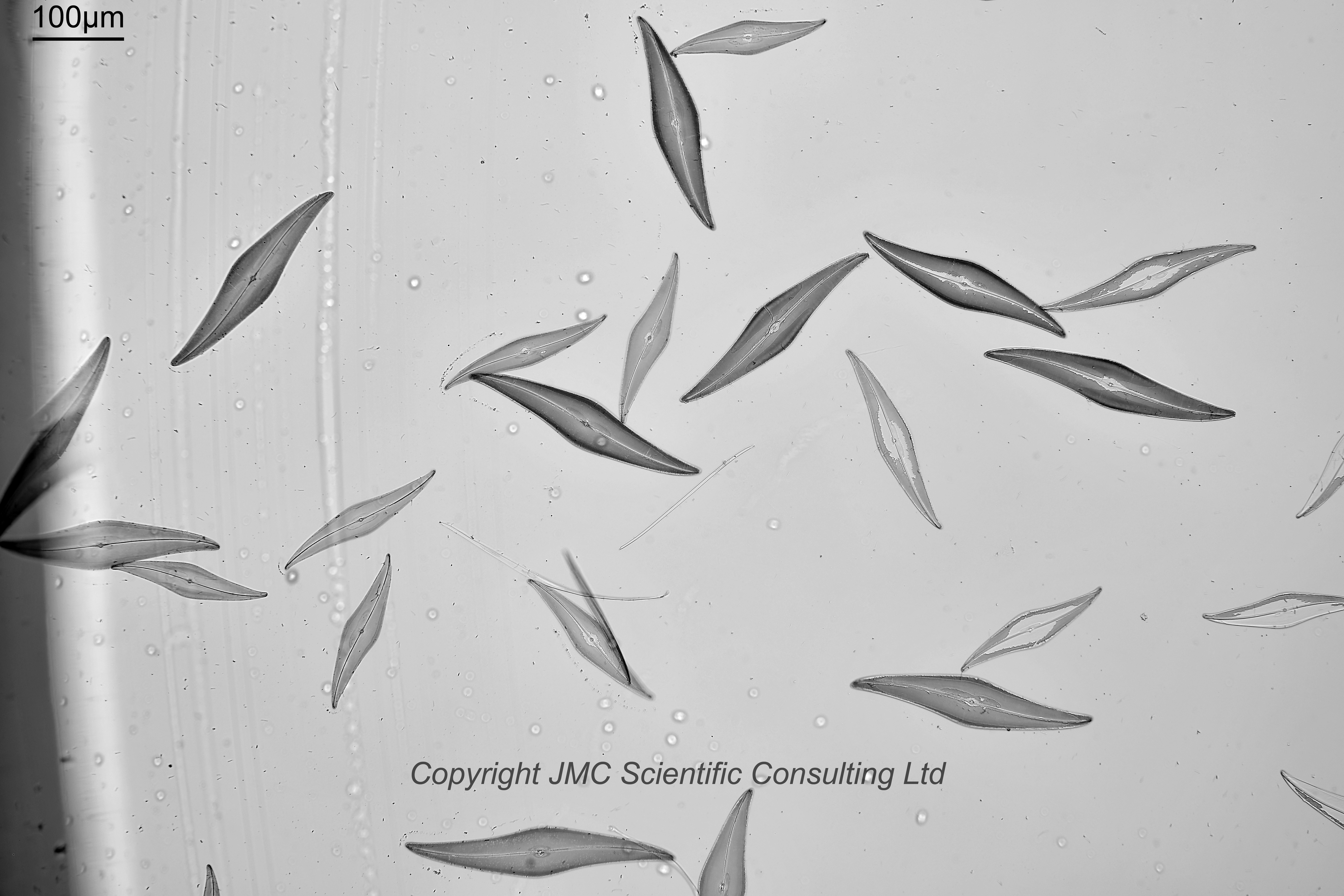
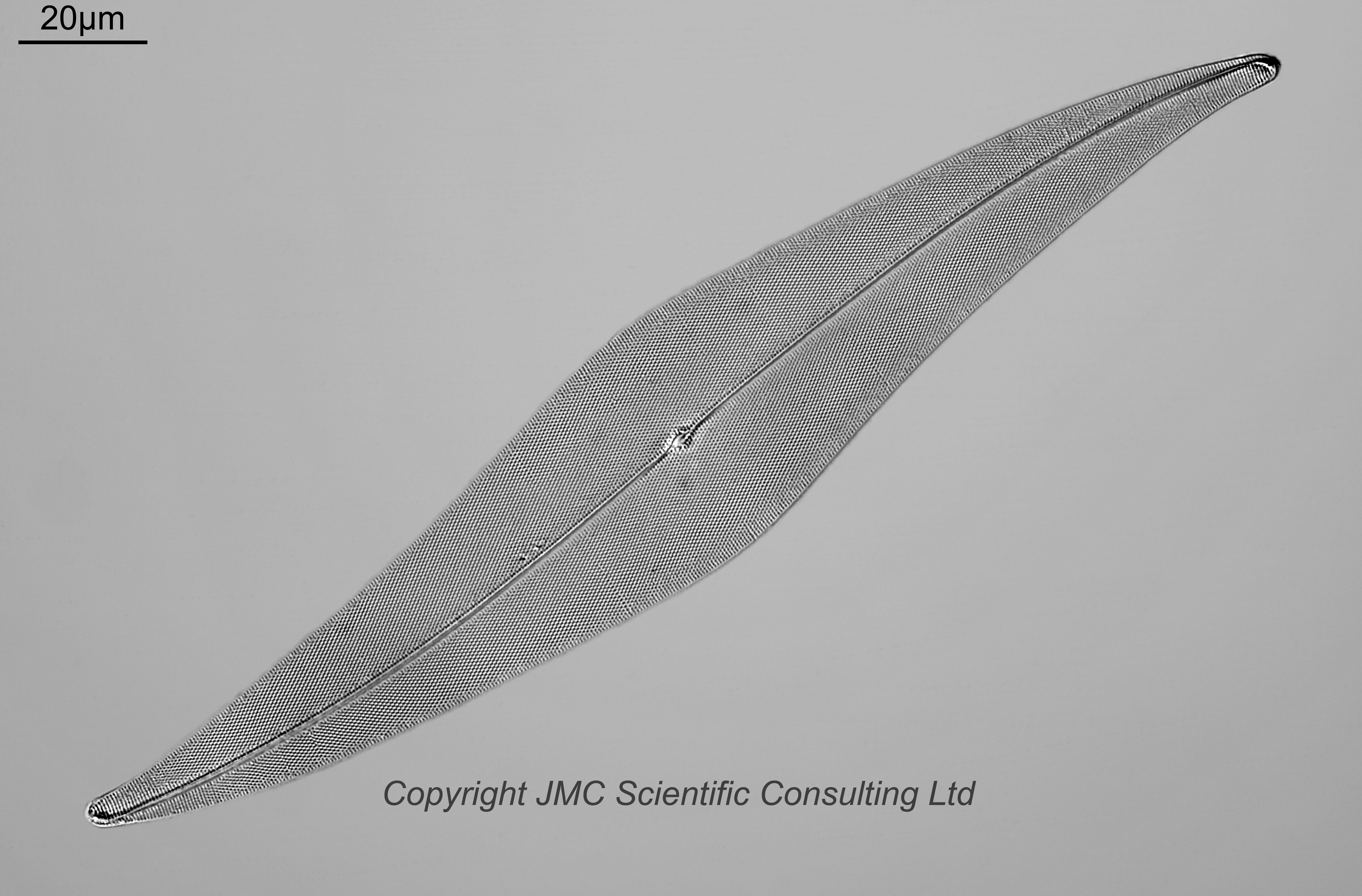
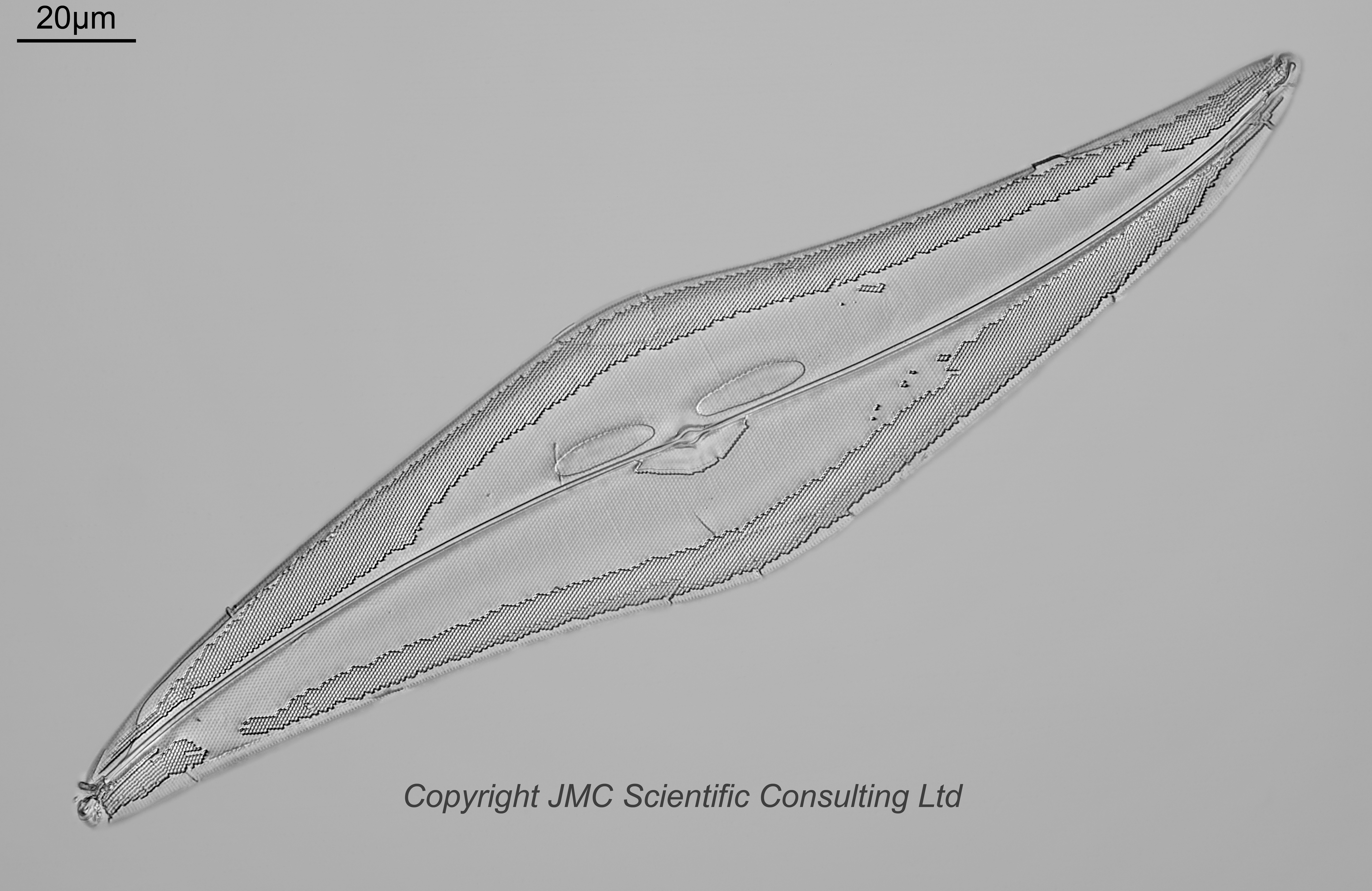
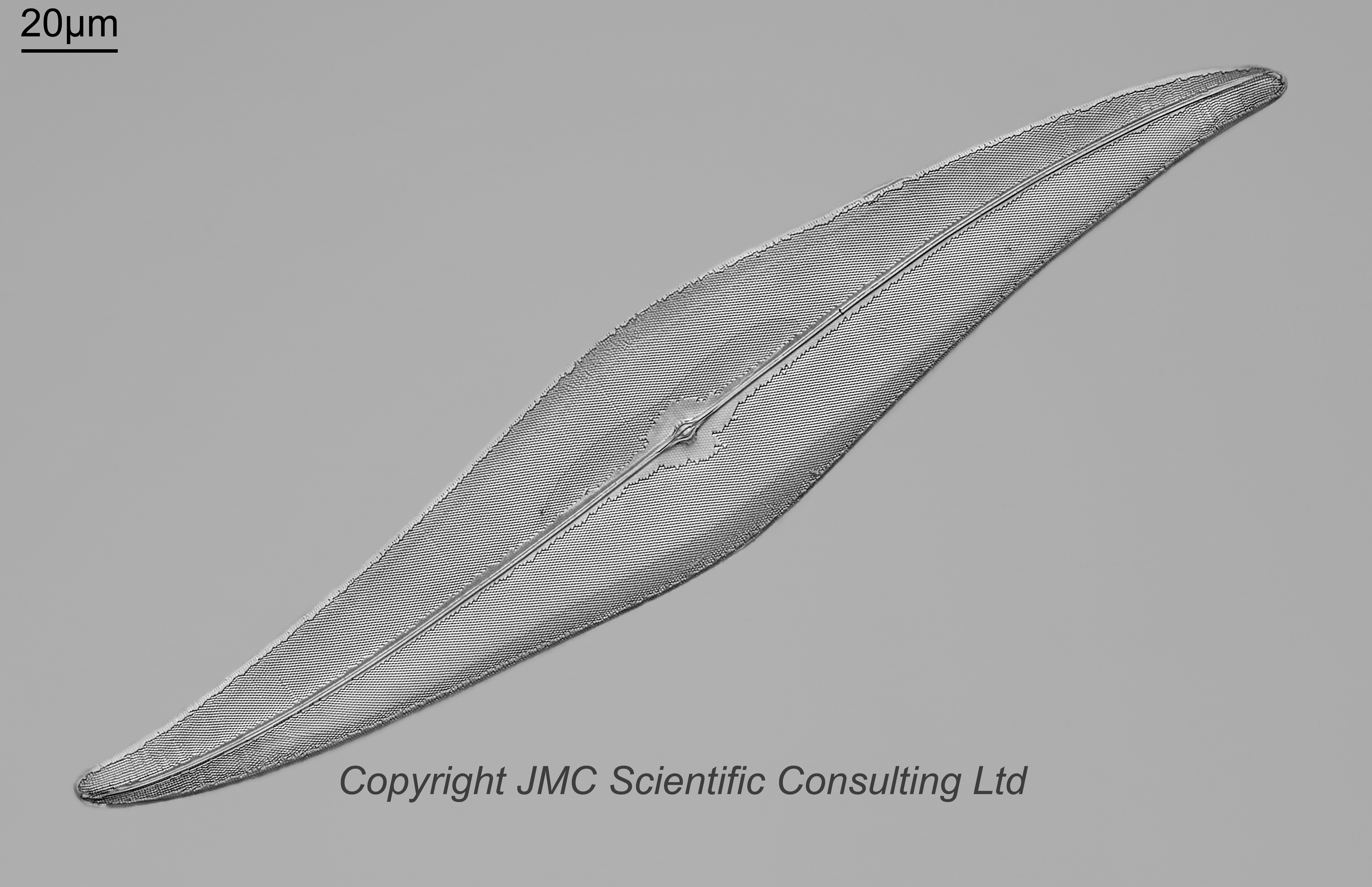
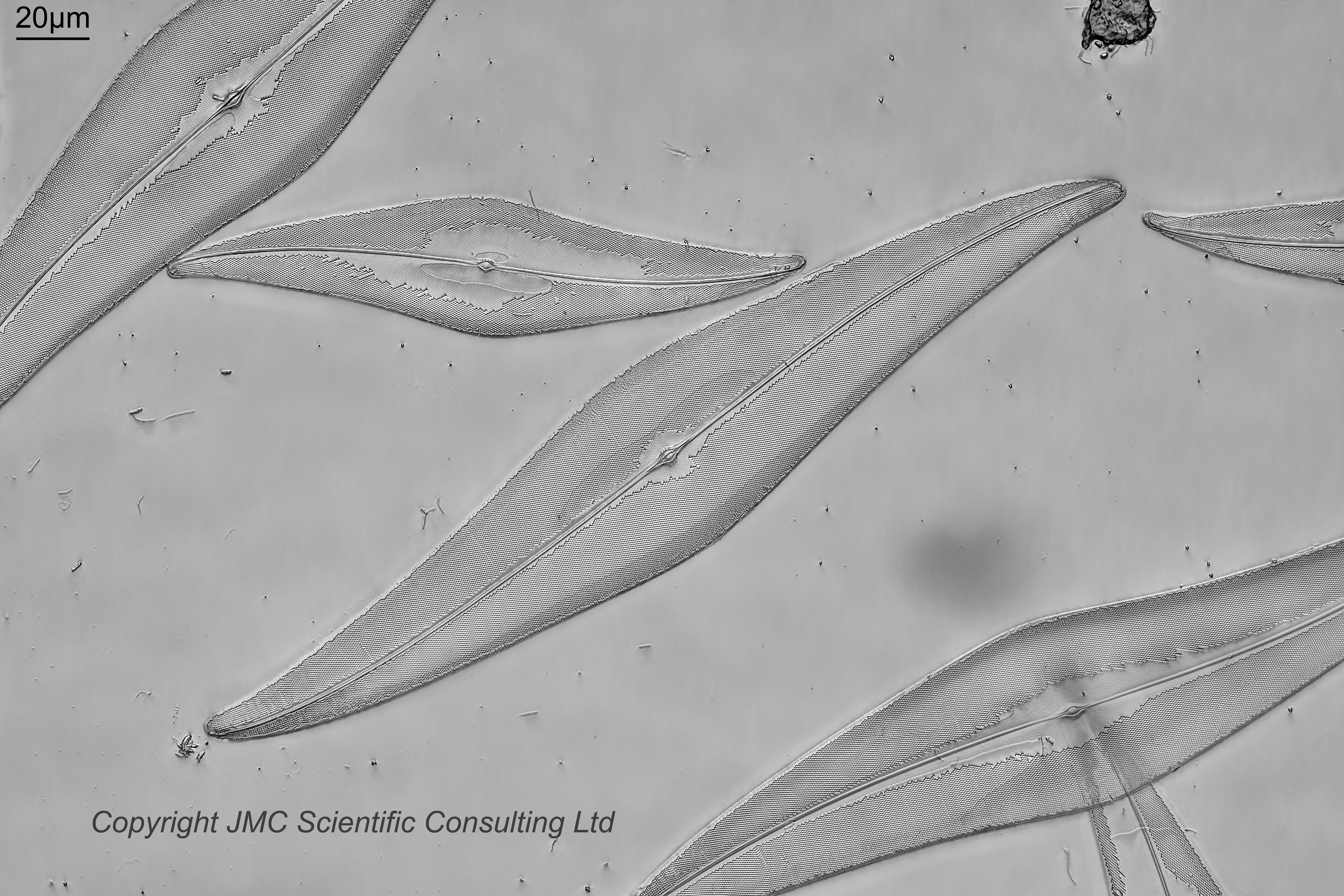
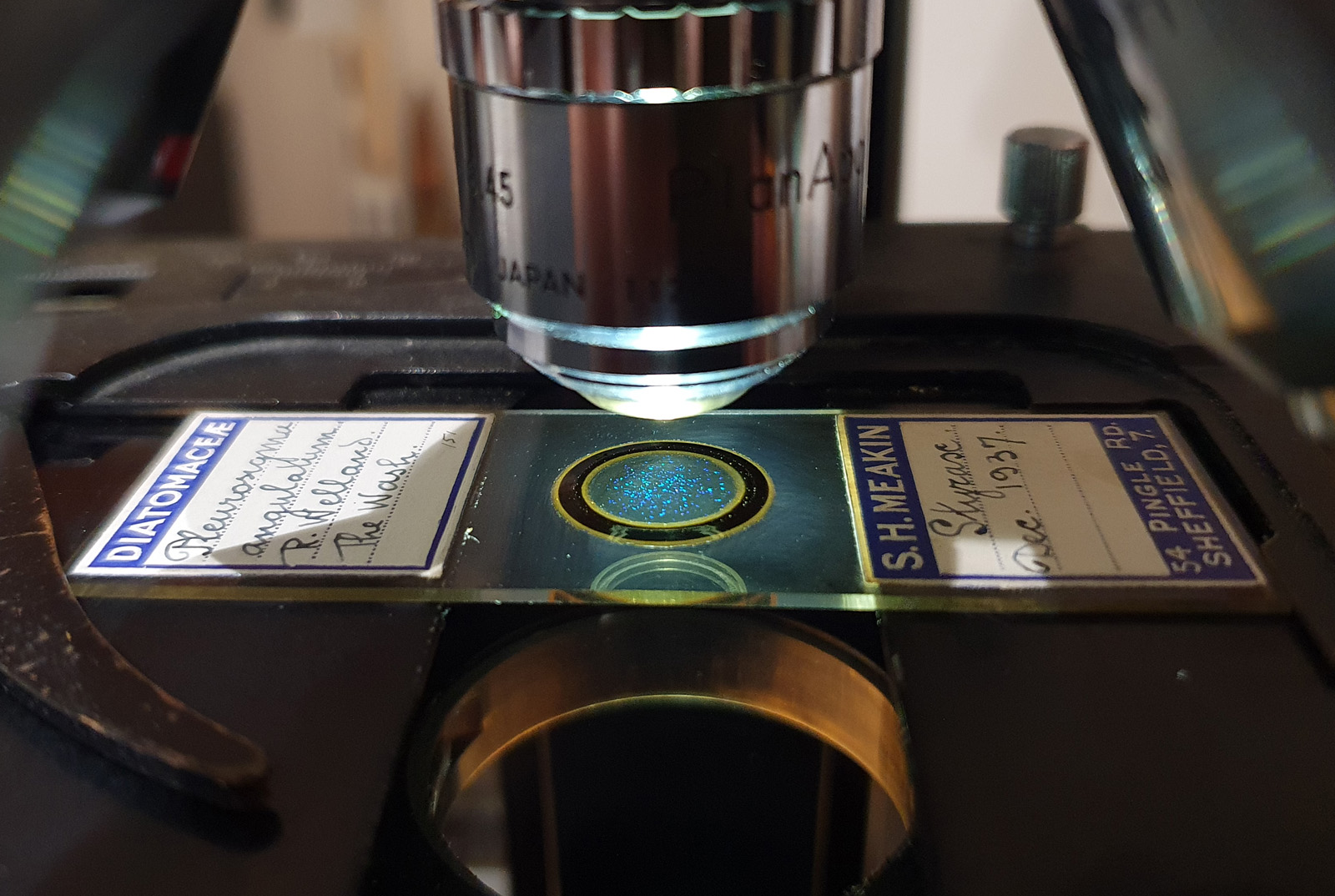
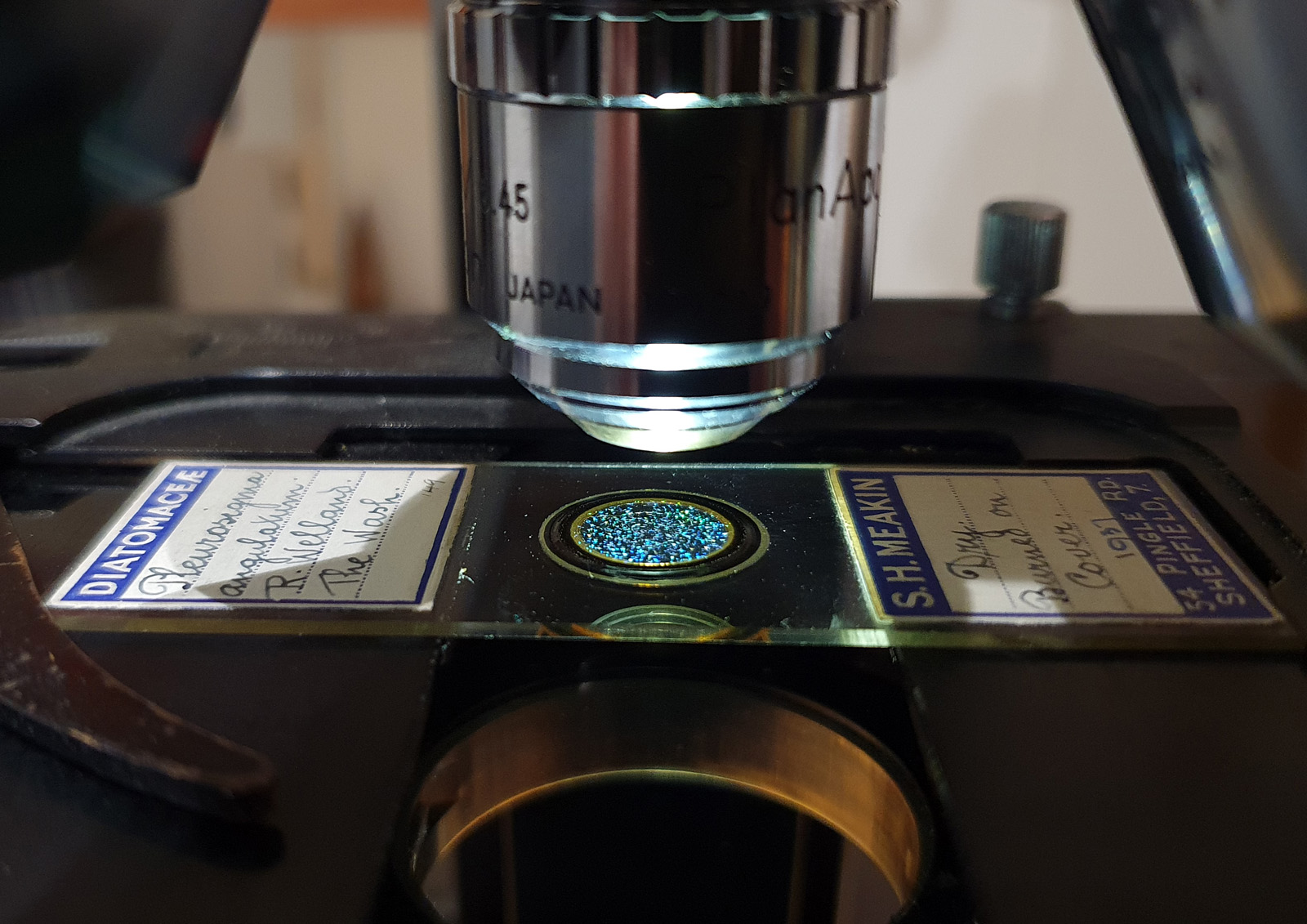
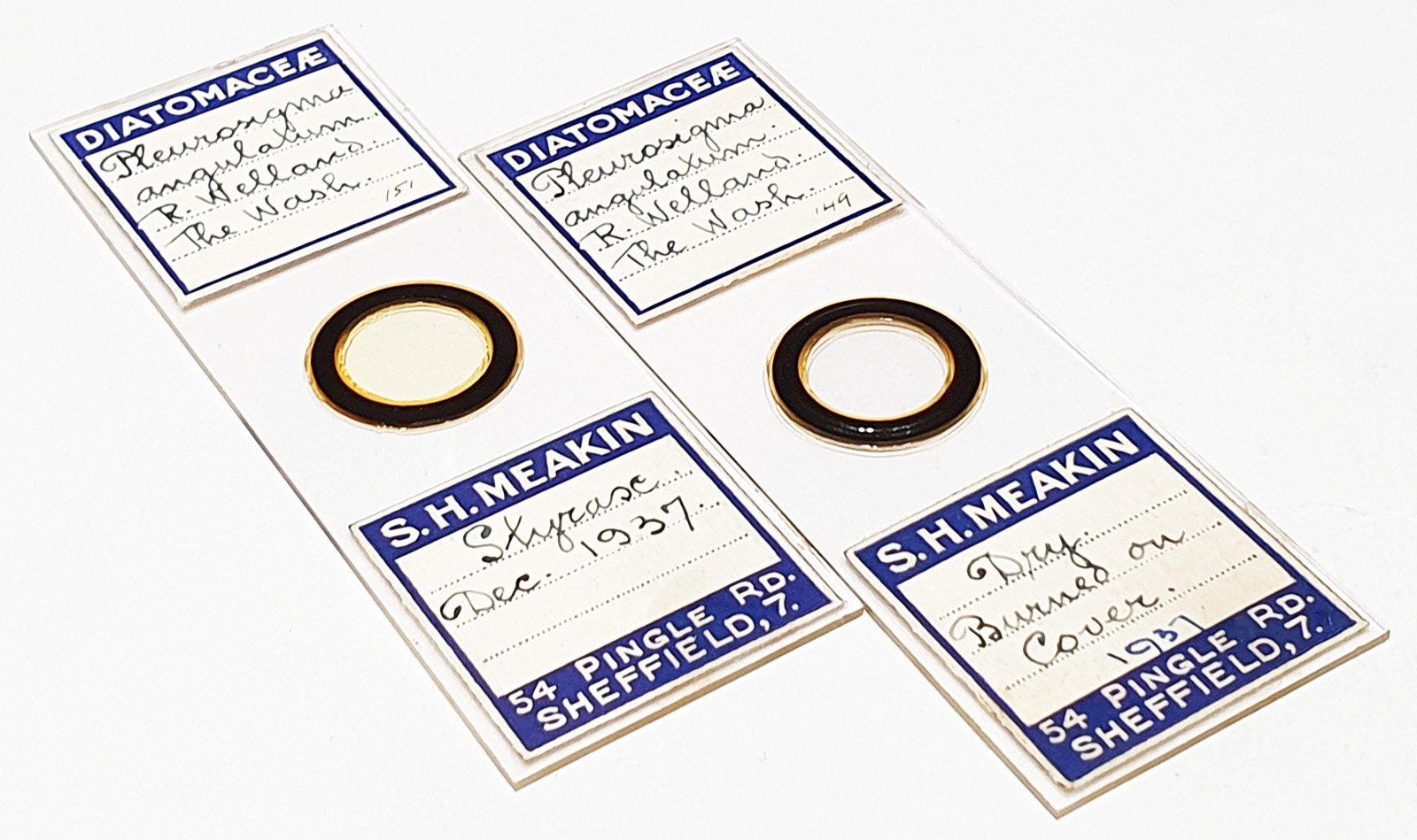
A pair of slides of Pleurosigma angulatum from the River Welland, The Wash. Dated 1937 and prepared by Samuel Henry Meakin. One is mounted in Styrax and the other is “Dry. Burned on cover” (more on this in a minute). Olympus BHB microscope using 450nm LED light. 63x Leitz Pl Apo 1.4 objective, oil immersion (40x Leitz Pl Apo NA 1.00 objective for the images close to the edge of the dry mount due to the coverslip ring). Olympus Aplanat Achromat condenser, oil immersion, oblique lighting. 2.5x Nikon CF PL photoeyepiece. Monochrome converted Nikon d850 camera. Image stacks prepared in Zerene (Pmax).
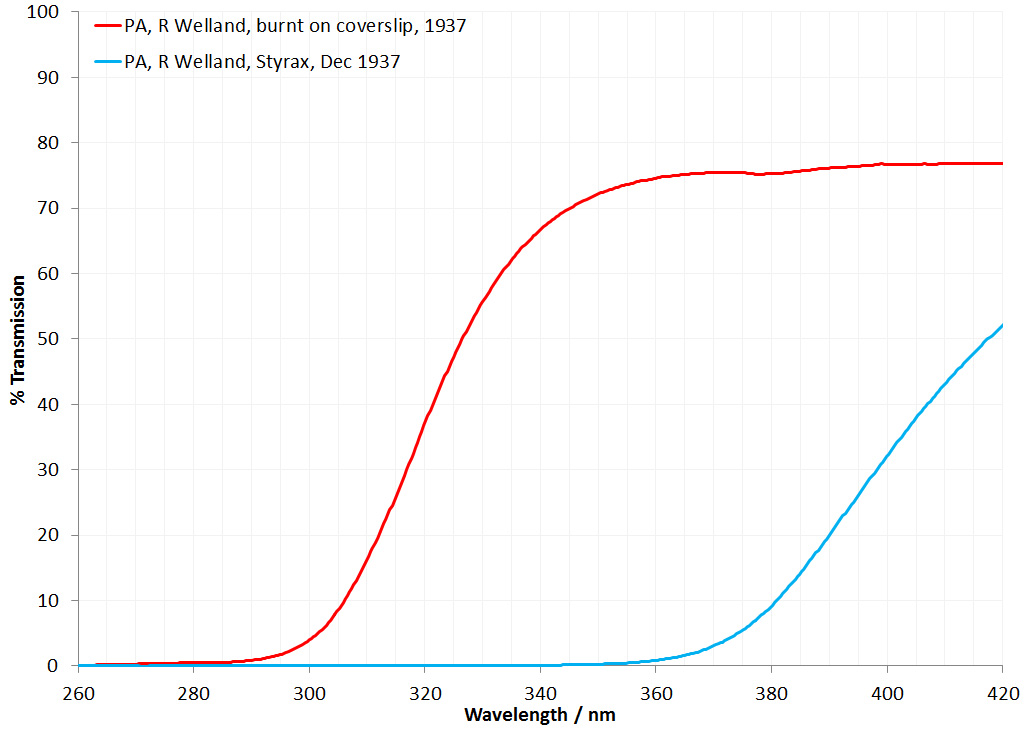
The Styrax slide is very low contrast – Autocontrast is doing a lot of the heavy lifting on this slide. The Dry mount is much higher contrast, although the diatoms look different across the coverslip. The ones away from the edge are more heterogeneous in appearance. I measured the transmission through the two slides and the dry mount has much greater transmission down into the UV, while the Styrax is strongly absorbing the light strongly below 380nm. The dry mount also quite strongly scatters blue light as seen from the photos of the slides on the stage.
Dry mounting is interesting as it involves using high temperature to burn the diatoms directly to the coverslip. The section below is from: Johnson, JC. Microscopic objects: How to mount them. The English Universities Press Ltd, 2nd edition, 1948;
“To Mount Diatoms Dry
It was stated above that when diatoms had been cleaned, they might be preserved in small phials of distilled water. When required for mounting, shake the phial, and with a thin glass rod or tube take up a drop of the fluid and let it fall on a perfectly clean cover glass. This must be allowed to dry by the aid of a spirit-lamp or Bunsen-burner flame, without being shaken or interfered with, otherwise the uniformity of dispersion will suffer. As dry mounts of diatoms have often a tendency to develop moisture owing to insufficient drying of the specimens, they should be burnt upon the cover glass at a dull red heat. Diatoms burnt in this way can be used satisfactorily for dry, balsam, or any other type of mount, and the burning not only acts as an additional cleaning process, but effectually fixes the diatoms and prevents them from falling off. The thinnest covers may be burnt without damage if they are placed on a small piece of perfectly flat platinum foil, about 1/100 inch thick. The flame of a spirit-lamp of Bunsen burner may be used, and it is advisable to shade the cover glass from direct light, so that the action of the flame may be observed. Care must be taken to raise the temperature only to the dull-red heat before-mentioned. The cover will then be ready for mounting as desired. Then take a 3×1 inch glass slide, and by means of a turntable draw thin ring of an adhesive varnish, such as gold size, on the glass slip, and allow it to dry until tacky. The warm both the cover glass and the slide, and gently press the former upon a ring of the varnish until adhesion all round is complete. Put aside, and when quite cold, complete the slide by ringing with black asphalt varnish.”
Note. A ‘dull-red colour’ for glass seems to at around 700°C. By 800°C, the colour should be ‘dull, cherry red’.
Pleurosigma angulatum (J.T.Quekett) W.Smith 1852. Published in: Smith, W. (1852). Notes on the Diatomaceae with descriptions of British species included in the genus Pleurosigma. Annals and Magazine of Natural History, Series 2 9: 1-12, 2 pls. Page 7, Plate 1, Fig. 7, 8 [as var. beta], 9 [as var. gamma].