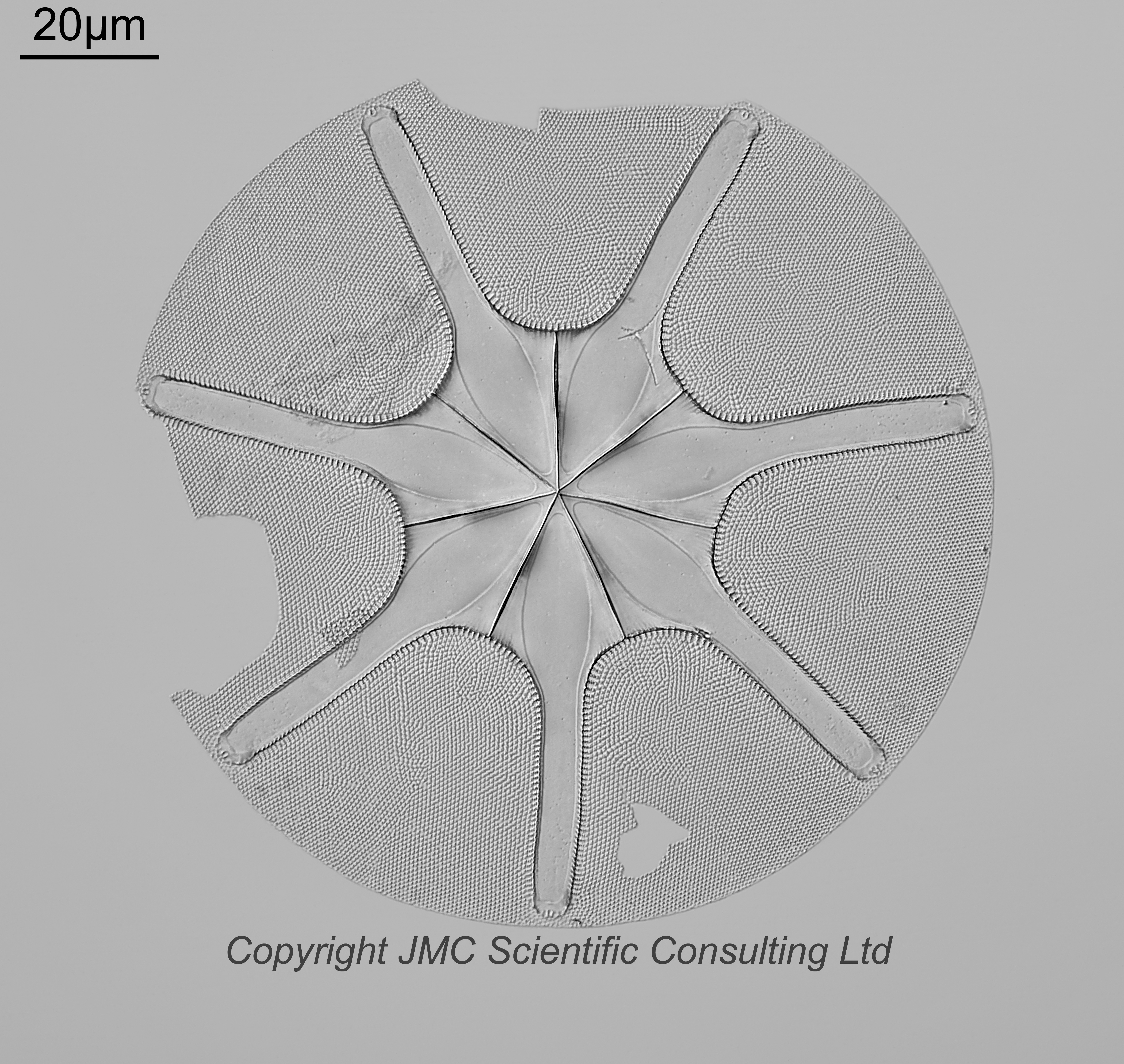
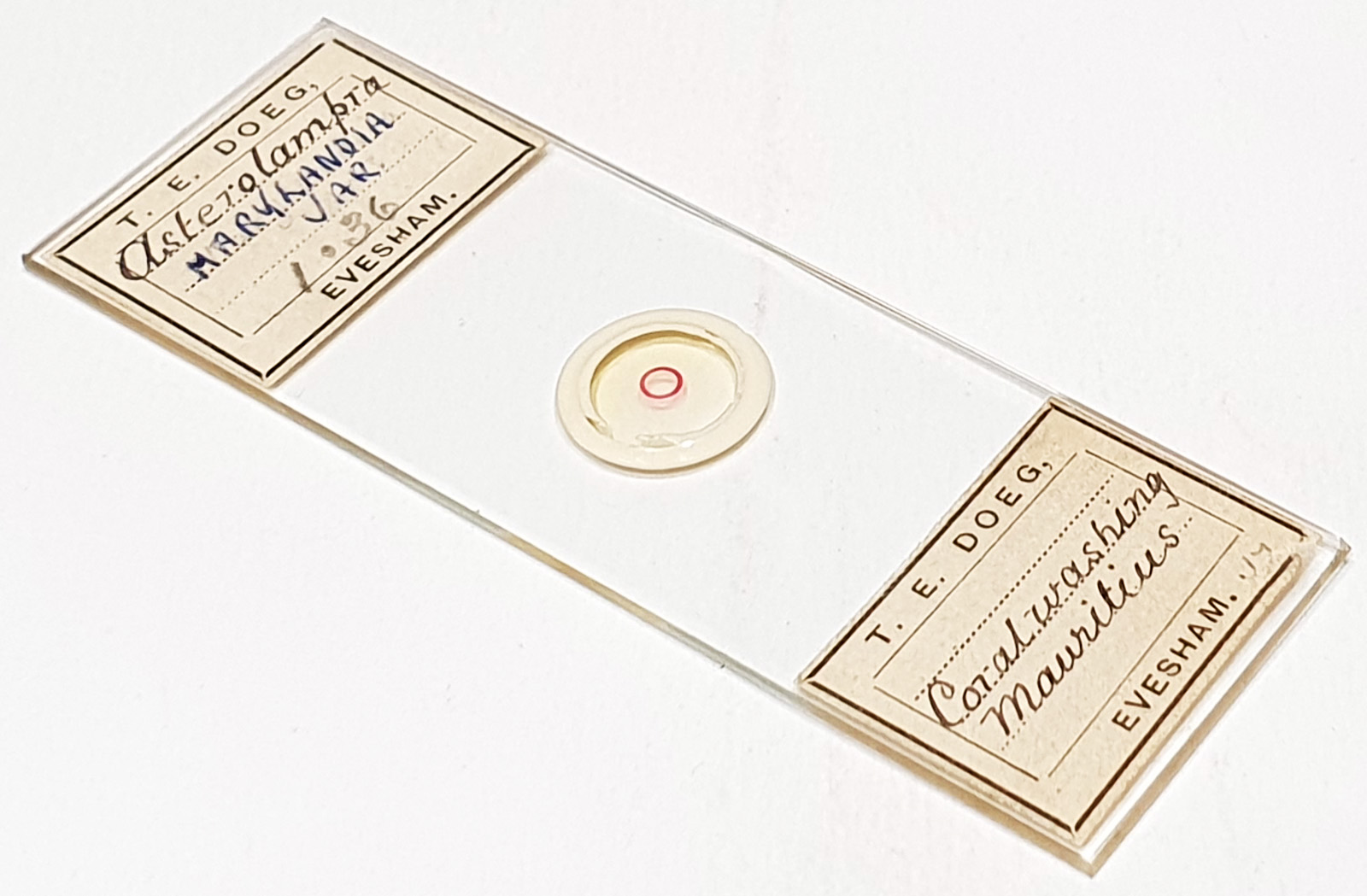
Asterolampra marylandica var. from coral washing, Mauritius. Single example on the slide. Underside view with the rim upwards to the camera. Prepared by Thomas Edward Doeg. Olympus BHB microscope using 450nm LED light. 63x Leitz Pl Apo 1.4 objective, oil immersion. Olympus Aplanat Achromat condenser, oil immersion, oblique lighting. 2.5x Nikon CF PL photoeyepiece. Monochrome converted Nikon d850 camera. 45 images stacked in Zerene. 126µm diameter measured in ImageJ.
To start with here’s the description for A. marylandica. Asterolampra marylandica Ehrenberg, 1844. Published in: Ehrenberg, C.G. (1844). Mittheilung über 2 neue Lager von Gebirgsmassen aus Infusorien als Meeres-Absatz in Nord-Amerika und eine Vergleichung derselben mit den organischen Kreide-Gebilden in Europa und Afrik. Bericht über die zur Bekanntmachung Geeigneten Verhandlungen der Königl. Preuss. Akademie Der Wissenschaften zu Berlin 1844: 57-97.
As for what this one is specifically, it certain looks superficially like other examples of Asterolampra marylandica that I have, however there are differences. For instance, this one is larger. The ‘arms’ are longer with respect to the central region. The patterning in the sectors is finer. The nearest looking one I have would be one I described as A. marylandica from a Barbados arrangement (see here).
While looking for possibilities (maybe a variant) I came across Asterolampra marylandica var. major H.Peragallo, 1888. Published in: Peragallo, H. (1888). Diatomées de la Baie de Villefranche (Alpes Maritimes). Bulletin de la Société Histoire Naturelle de Toulouse 22: 13-100, 6 plates [I=VI], 2 tables. Page 82.
Translation from Peragallo 1888:
“Asterolampra marylandica var. major, Wallich, in: T.M.S. vol. 8, 2, f. U. I have found this very curious form at Cette and Villefranche; it is always much larger than the type—whereas the latter has a diameter varying from 50 to 100µm in the specimens I have observed, the variety rarely measures less than 200µm and reaches 250µm. On the other hand, the central smooth area is no larger in the large form than in the other, whose radii are consequently disproportionately long (1). The silica of this form is much thinner than in the type; the sectors appear bluish rather than yellow when viewed dry, and the whole structure almost completely disappears in balsam—or even in Styrax. It is possible that this is the sporangial form of the type species.
(1) I deem it unnecessary to provide a figure of this form, which can easily be visualized by doubling the diameter of A. marylandica and extending the rays to the new outline, without altering the central part.”
Mine is larger than expected, but not as big as the one mentioned in Peragallo. He does mention that the the arms are longer in relation to middle section, which mine is. Also the thinner silica (mine looks more delicate that typical). He did not however provide a picture.
This name is currently regarded as a synonym of Asterolampra vanheurckii Brun, 1891. Published in: Brun, J.-J. (1891). Diatomées espèces nouvelles marines, fossiles ou pélagiques. Mémoires de la Société de Physique et d’Histoire Naturelle de Genève 31 (part 2, no. 1): 1-47, pls 11-22. Page 10, Plate 14, Figure 1.
The translation from this says;
“Valve flat and composed of very thin, fragile silica. Diameter 0.18 to 0.24 mm. Usually with 7 compartments. Sides straight, rod-like, bordered by a fairly distinct punctate margin. The rest of the surface exhibits very delicate Pleurosigma-like striation (clearly visible in photograph b, at 1000x magnification). Silica diaphanous, appearing colorless even when dry.
Naples (1876; Penard collection). Messina (pelagic). Rare.”
The picture does look similar to mine, but the central region is too small for mine. The description “delicate Pleurosigma like striation”. Struck me as being very like mine. Mine does have 7 sectors. However mine is a bit smaller than mentioned by Brun.
So, Asterolampra marylandica? Probably. A variant of? Possibly. A. marylandica seem to have quite a wide morphological variability, so this could well be a variant.