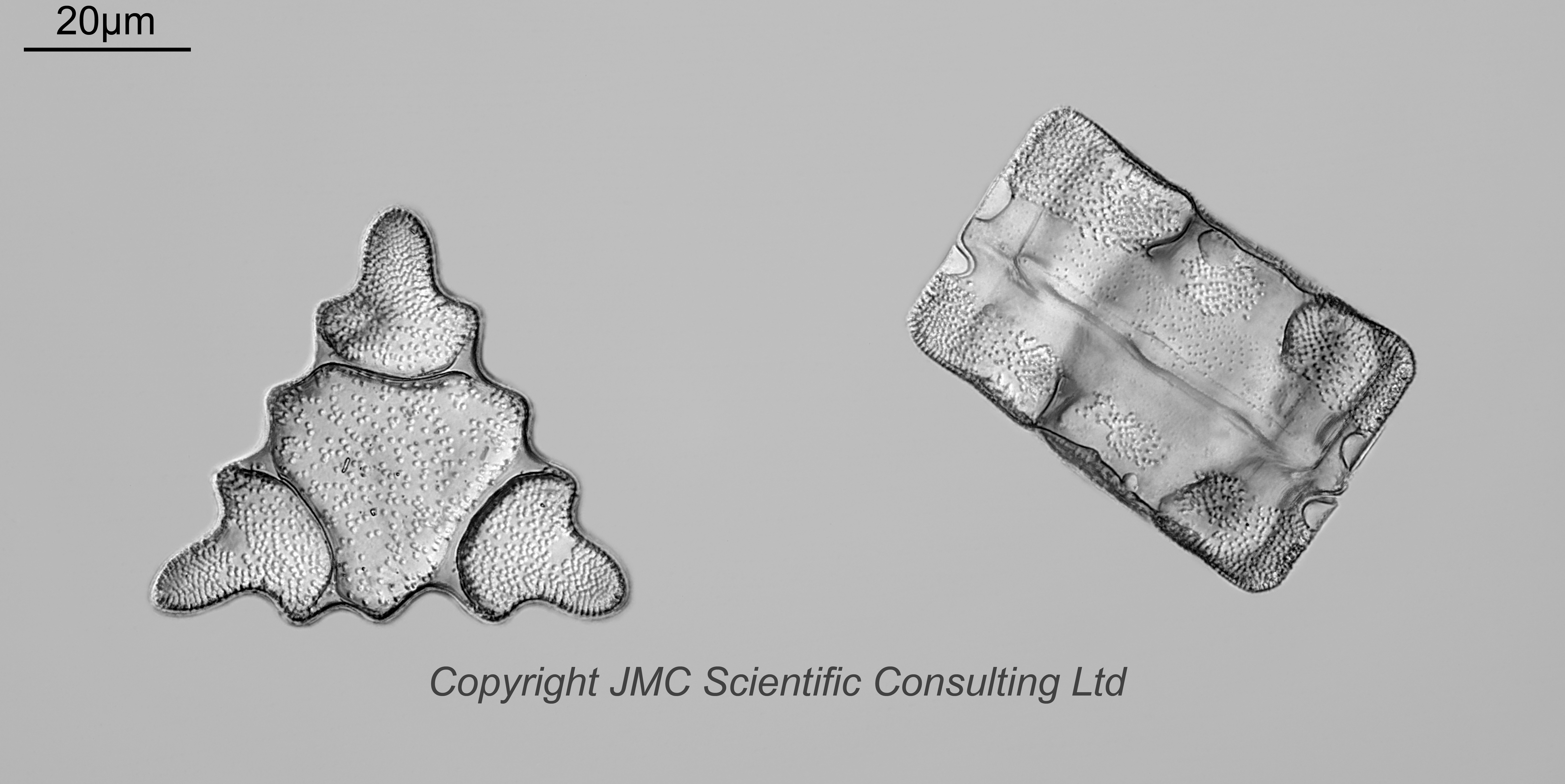
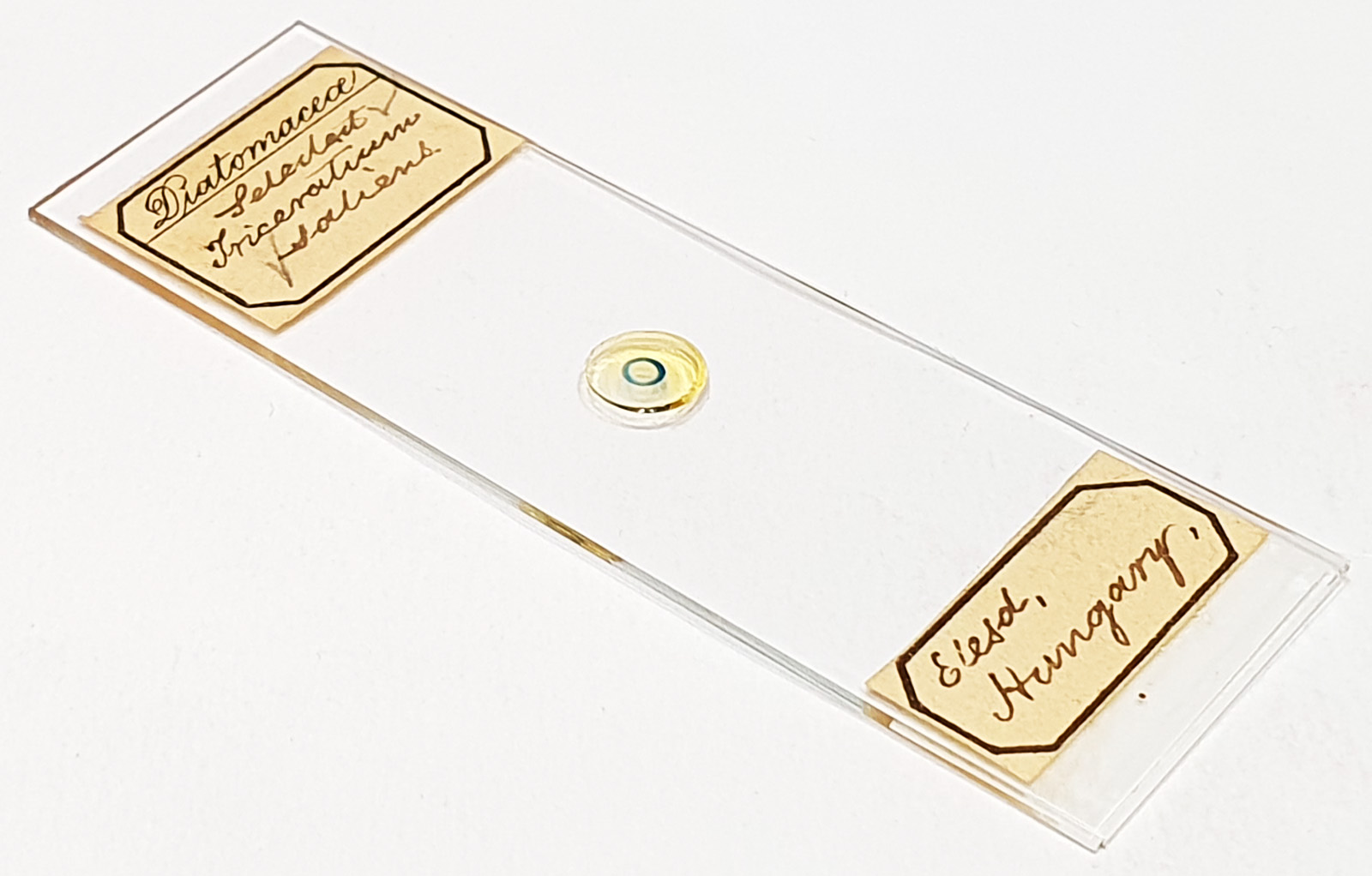
Interesting one this. Labelled as Triceratium saliens from Elesd, Hungary (Élesd, Slovak: Alešď, is a town in Bihor County, western Romania). More on the name in a minute, as I don’t think this is a Triceratium. Top and girdle view. Prepared by Laurence Hardman. Slide from the collection of Howard Lynk. Olympus BHB microscope using 450nm LED light. 63x Leitz Pl Apo 1.4 objective, oil immersion. Olympus Aplanat Achromat condenser, oil immersion, oblique lighting. 2.5x Nikon CF PL photoeyepiece. Monochrome converted Nikon d850 camera. 34 images stacked in Zerene (Pmax).
Back to the name. I cannot find anything on Triceratium saliens other than a mention of the name. Looking at it, it doesn’t look like a Triceratium to me. First thought would be a Terpsinoë or Hydrosera. Digging further I came across Terpsinoë triquetra Pantocsek 1892. Published in: Pantocsek, J. (1892). Beiträge zur Kenntnis der Fossilen Bacillarien Ungarns. Teil III: Süsswasser Bacillarien. Anhang-analysen 15 neuer Depots von Bulgarien, Japan, Mahern, Russland und Ungarn. pp. pls 1-42. Nagytapolcsány Topo: Buchdrucherei von Julius Platzko. Page 105, Plate 26, Figure 390 (rather roughly drawn figure).
Translation of the source:
478. Terpsinoé triquetra Pant. nov. spec.
“Trigonous, with wavy sides, rounded sides. Valve separated by three transverse septa at the poles. Center of valve triangular. Punctuated structure. Points scattered at the poles and at the center. Height 48.5 µm, length of side 57 µm.
In tertiary marine strata at Izsopallaga in Hungary.
Icon: Beitrg. IIL, tab. 26., fig. 390.”
Overall the description seems to be a close match. The figure is a fairly rough drawing, so it is difficult to be certain. However I would probably go with this being Terpsinoé (Terpsinoë) triquetra for now at least.
I did come across another genus name – Stoermeria – in Kociolek, J. P., Escobar, L., & Richardson, S. (1996). Taxonomy and ultrastructure of Stoermeria, a new genus of diatoms (Bacillariophyta). Phycologia, 35(1), 70–78. https://doi.org/10.2216/i0031-8884-35-1-70.1
Quote from the abstract: “The new genus shares the feature of costae with Hydrosera Wallich and Terpsinoë Ehrenberg, but differs from these two genera and other members of the Biddulphiaceae by lacking processes and pseudocelli and by having simple puncta. Based on occurrences in the fossil record, Stoermeria appears to have been distributed in the Northern and Southern Hemispheres, but extant material has been found only in non-marine localities in New Zealand.”
However I don’t have access to this paper, so cannot read further.