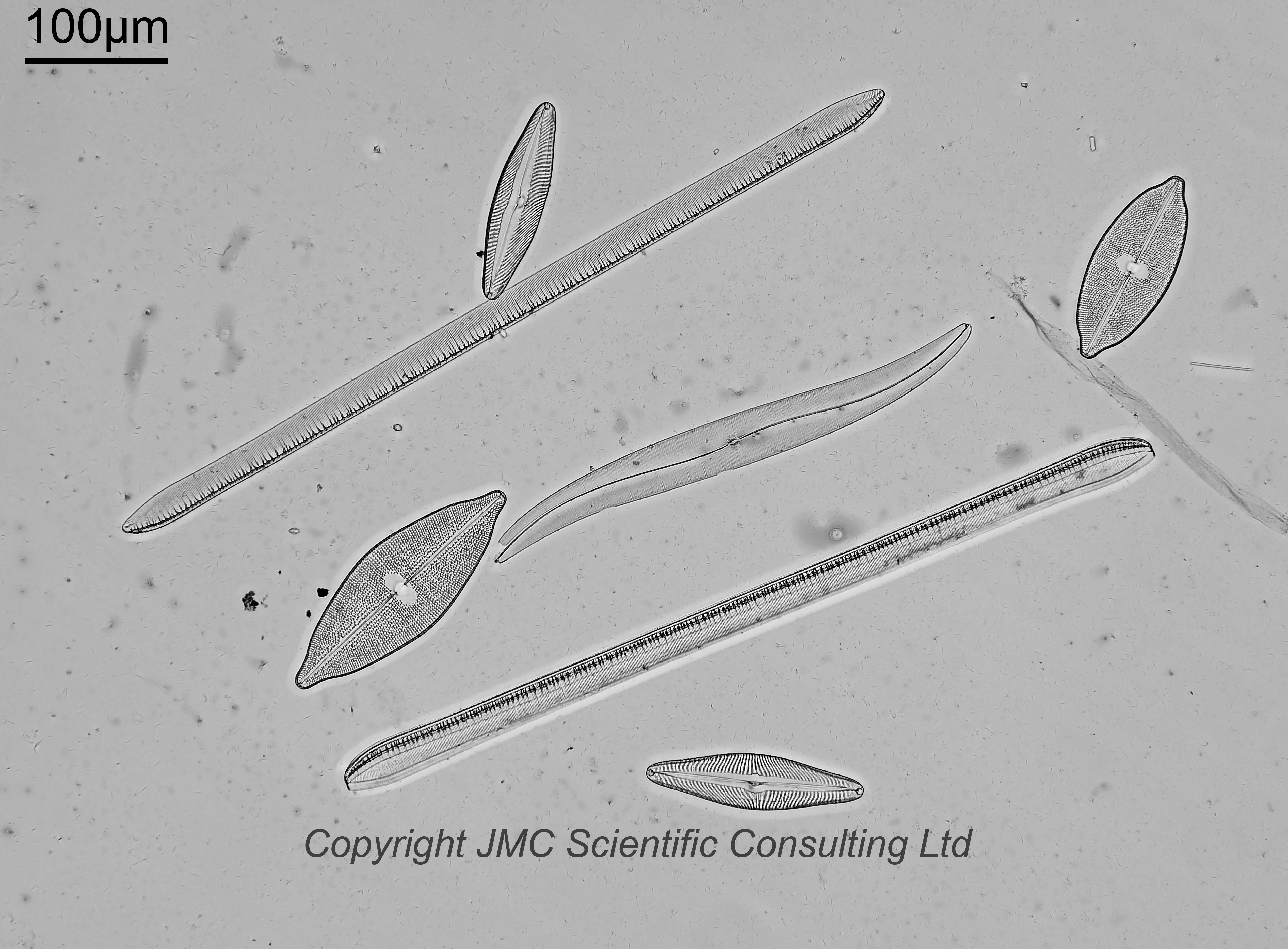
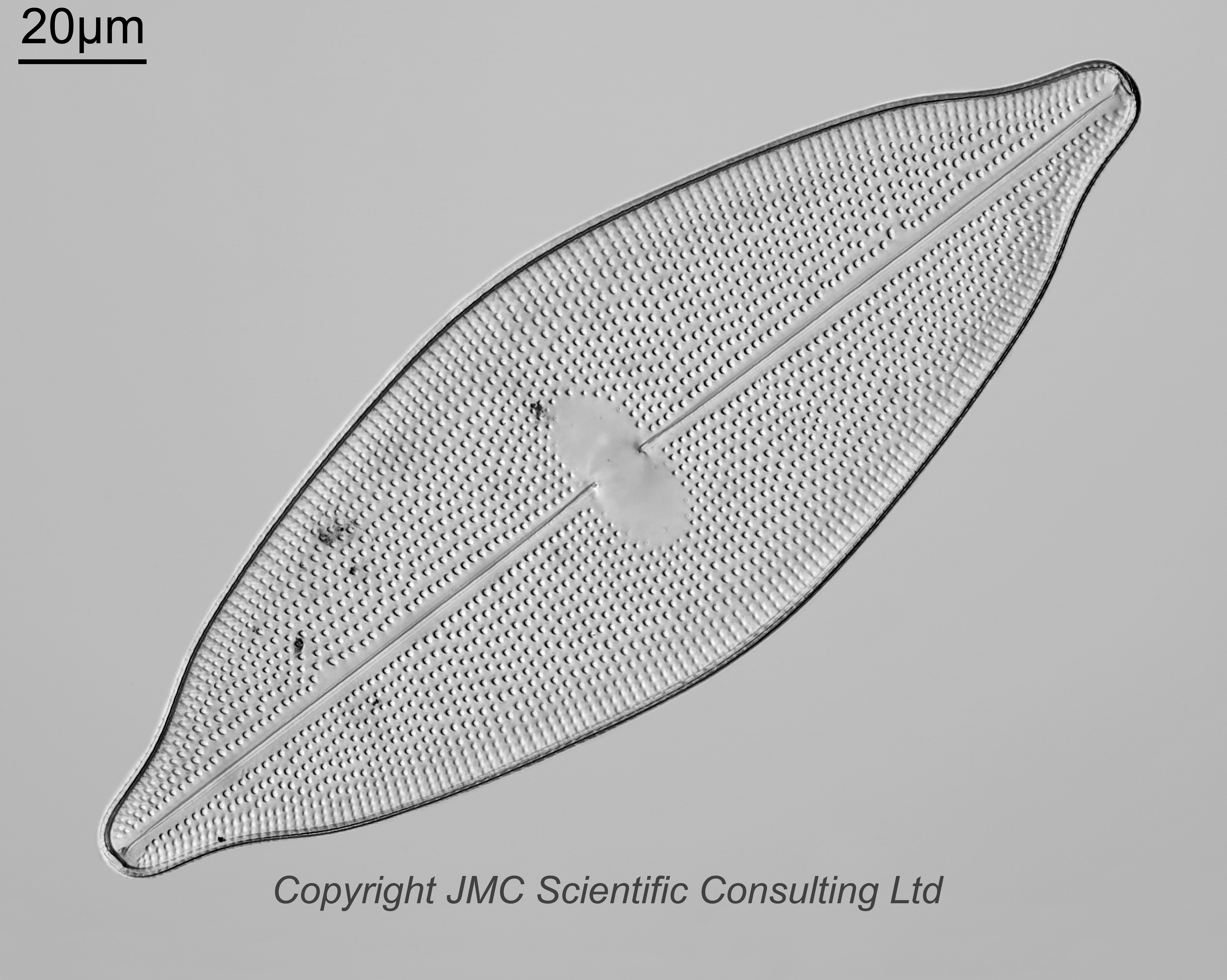
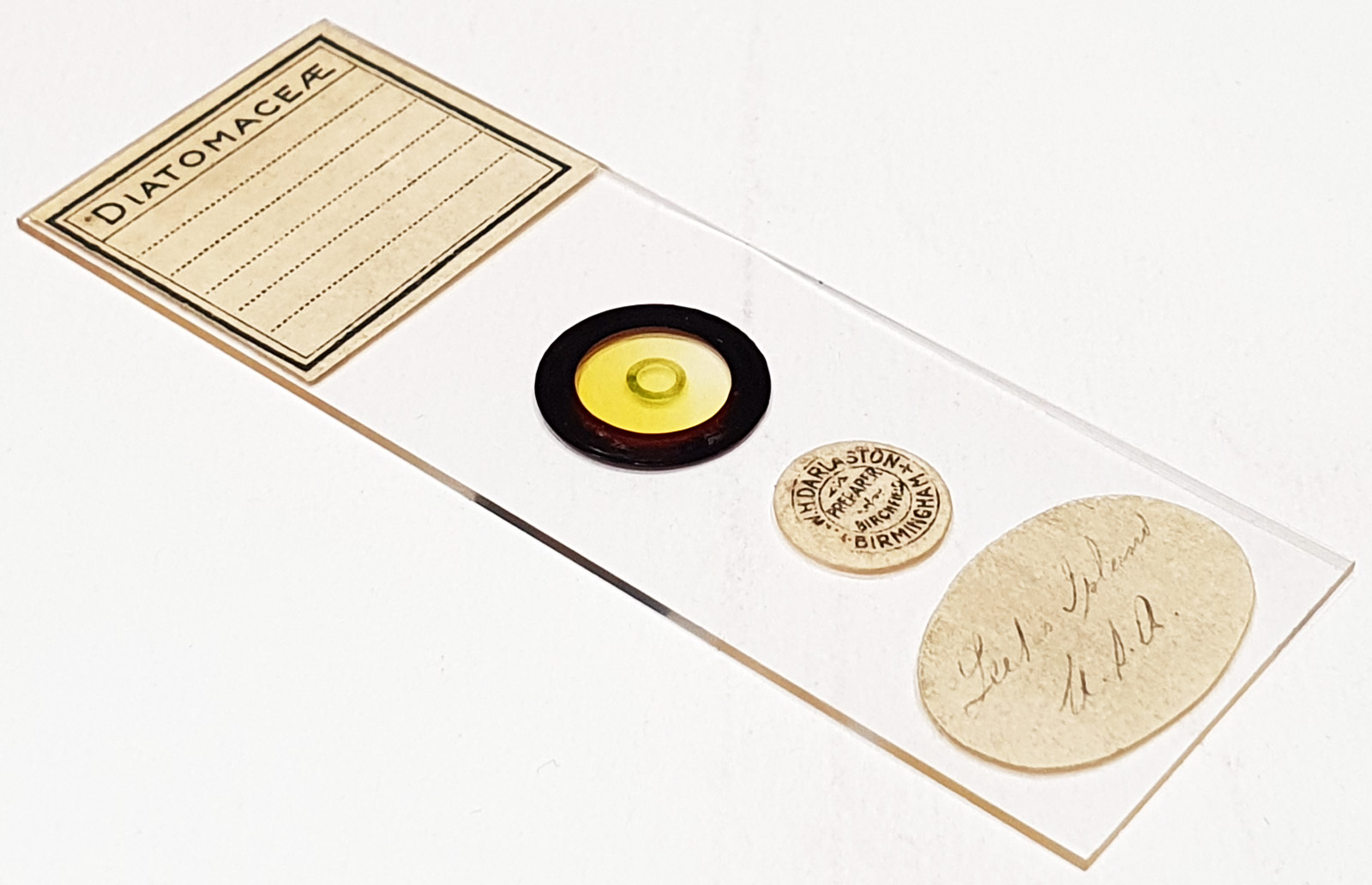
An arrangement of diatoms from Leete’s Island, Connecticut, USA. Prepared by HWH Darlaston. Looks to be Navicula sp. (likely N. maculata), Nitzschia sp., Caloneis sp., and a Gyrosigma sp.. Some yellowing of the mountant. Olympus BHB microscope using 450nm LED light. As well as the arrangement I imaged one (Navicula maculata, underside view, rim towards the coverslip) using the 63x Leitz Pl Apo 1.4 objective, oil immersion. Olympus Aplanat Achromat condenser, oil immersion, oblique lighting. 2.5x Nikon CF PL photoeyepiece. Monochrome converted Nikon d850 camera. 33 images stacked in Zerene (Pmax).
Navicula maculata (Bailey) A.M.Edwards, 1859. Published in: Edwards, A.M. (1859). On Diatomaceae collected in the United States. Transactions of the Microscopical Society, New Series 7: 84-91. Page 90. This name is currently regarded as a synonym of Cavinula maculata (Bailey) J.Y.Li & Y.Z.Qi, nom. inval., 2018. Published in: Li Jiaying & Qi Yuzao [Li, J.Y. & Qi, Y.Z.] (2018). Flora algarum sinicarum aquae dulcis Tomus XXIII Bacillariophyta Naviculaceae (III). pp. [1-8], i-xxiii, 1-214, pls I-XLVIII. Beijing: Science Press. Pages 90,91. Homotypic synonyms: Stauroneis maculata Bailey 1851, Navicula maculata (Bailey) A.M.Edwards 1859, Schizonema maculatum (Bailey) Kuntze 1898.
I’d not heard of Leete’s Island before seeing this slide. Interesting place. There’s a good reference which talks about it: Terry, W. A. (1907). A partial list of Connecticut diatoms with some account of their distribution in certain parts of the state. Rhodora, 9(104), 125–140. http://www.jstor.org/stable/23293973
Quotes from Terry (1907);
“The ancient channel of Leete’s Island from Great Harbor on the south around to Shell Beach on the north, is one immense mass of marine deposit, in some places fifty feet thick. When the railroad crossing it was changed from a trestle to an embankment, the pressure of the great bank of earth forced out the marine mud below it which rose up in-great banks on each side of the railroad. All this material contained diatoms, and some of it was very rich, especially in number and rarity of species. I dug up material from about twelve feet below the surface, and found a stratum rich in the beautiful Surirella Febigerii Lewis and other rare kinds. One pound of this earth furnished diatoms enough to make several thousand slides, each slide containing thousands of diatoms.”.
“The species of Pleurosigma are found with it at Leete’s Island, and also a remarkable colony of Navicula maculata Bail., which occurs here in great abundance, and in three distinct types ; the largest is extremely rare elsewhere, the second found occasionally along the Connecticut shore, and the third and smallest is the most common. I have it from the New Jersey shore and from Cuxhaven, North Sea. A much smaller variety but with coarser puncta is found in Alabama.”.