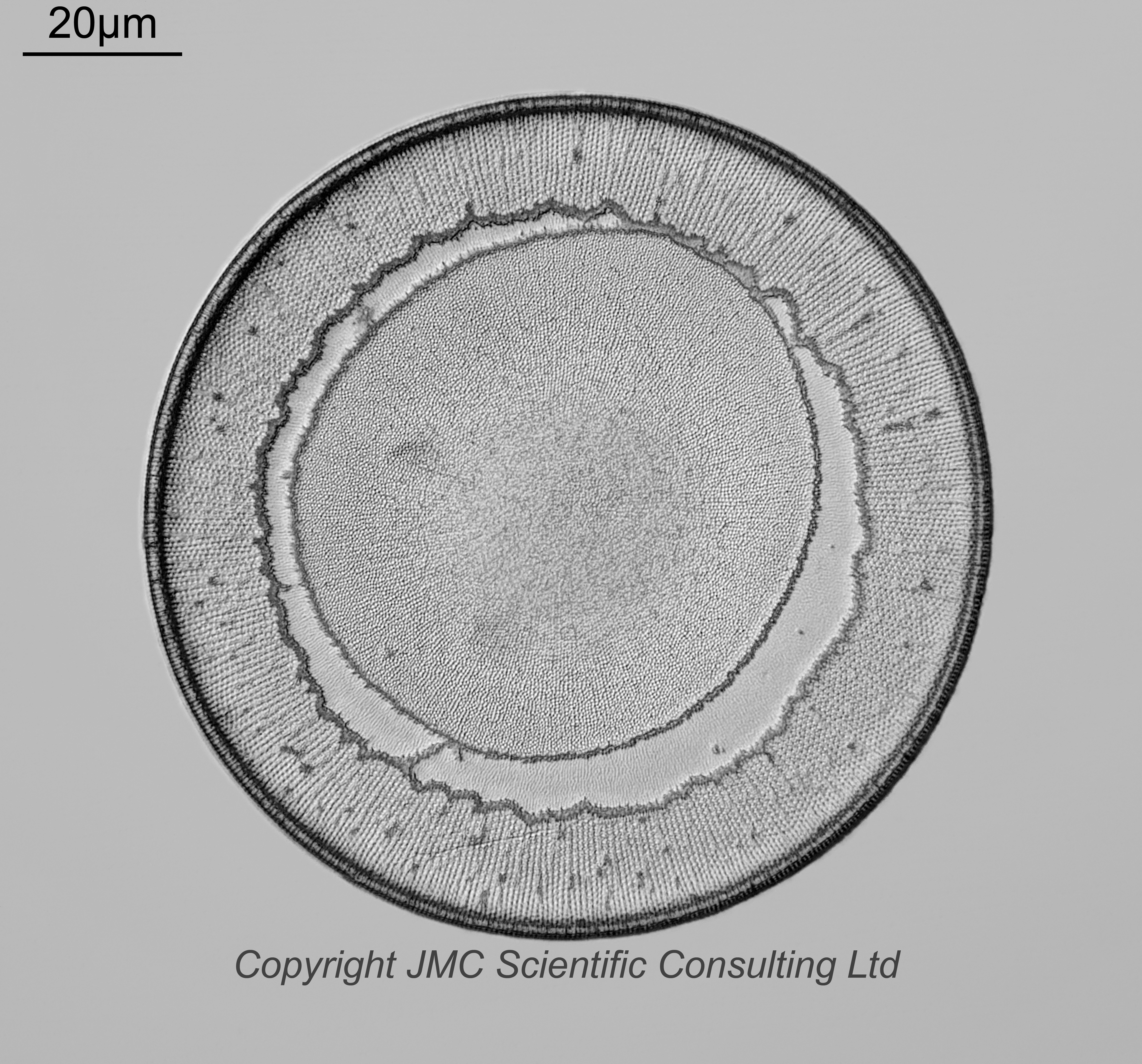
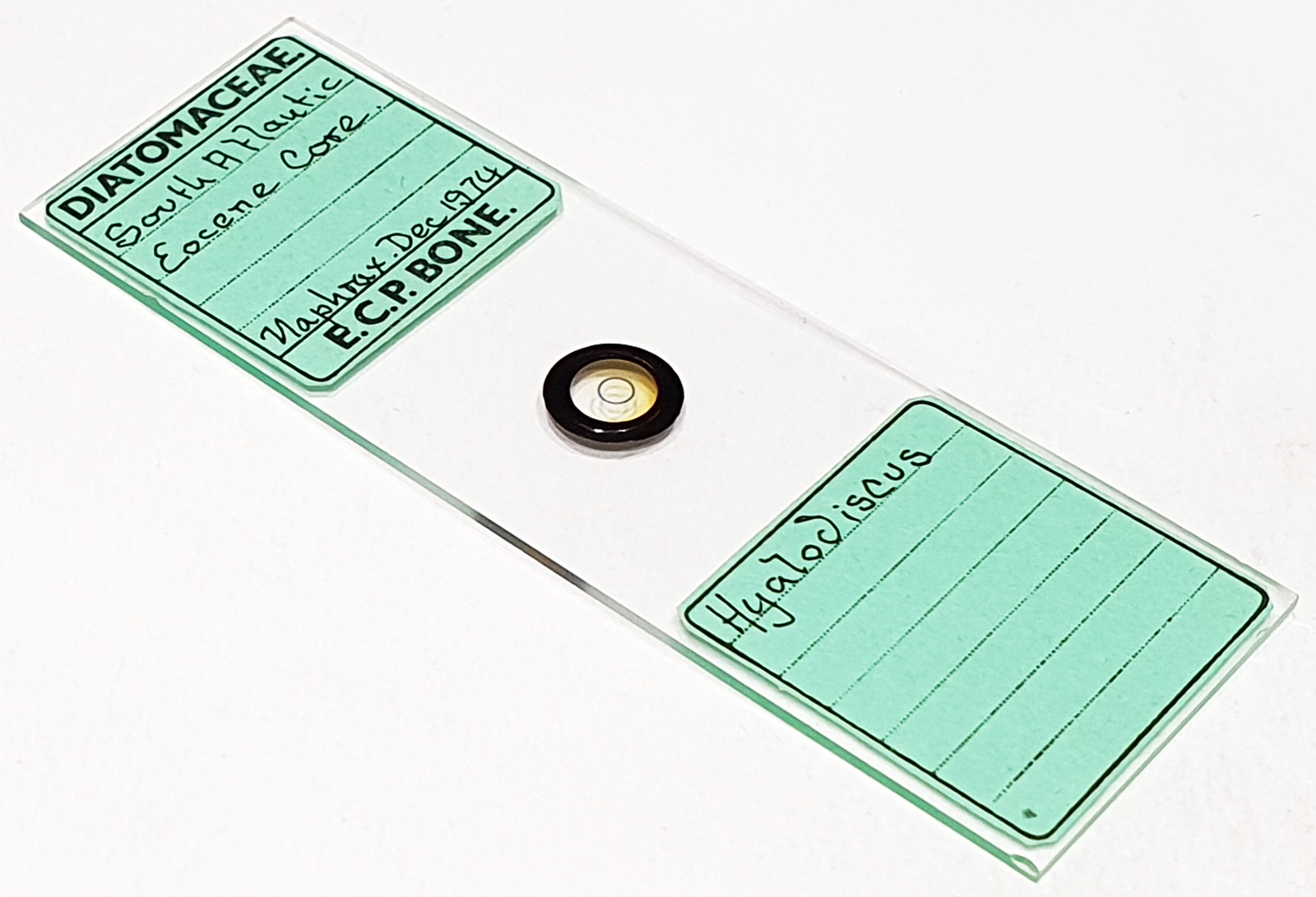
Hyalodiscus sp. from South Atlantic Eocene Core (would love to know more about this and which specific core it came from). Single example on the slide. Mounted in Naphrax and dated December 1974. Prepared by ECP Bone. Olympus BHB microscope using 450nm LED light. 63x Leitz Pl Apo 1.4 objective, oil immersion. Olympus Aplanat Achromat condenser, oil immersion, oblique lighting. 2.5x Nikon CF PL photoeyepiece. Monochrome converted Nikon d850 camera. 46 images stacked in Zerene (Pmax).
As for a specific ID, Hyalodiscus franklinii from the Oamaru Diatoms website is a good visual match and therefore is an option (see here). Hyalodiscus franklinii (Ehrenberg) Ross 1986. Published in: Hartley, B. [in collaboration with Ross, R. & Williams, D.M.] (1986). A check-list of the freshwater, brackish and marine diatoms of the British Isles and adjoining coastal waters. Journal of the Marine Biological Association of the United Kingdom 66(3): 531-610. Page 609. This name is currently regarded as a synonym of Hyalodiscus scoticus (Kützing) Grunow 1879. Published in: Grunow, A. (1879). Algen und Diatomeen aus dem Kaspischen Meere. New species and varieties of Diatomaceae from the Caspian Sea, translated with additional notes by F. Kitton. Journal of the Royal Microscopical Society 2: 677-691, pl. 21. Page 690, Plate 21, Figure 5.
I was wondering if the feature in the middle was ‘real’ or an issue with the mountant. After thinking about it a bit I am tending towards it being a real feature rather than just a mountant problem. Something else to note, this one is relatively flat for a Hyalodiscus (think dinner plate rather than soup bowl). Not sure if this is a species feature or just happens to be this one.