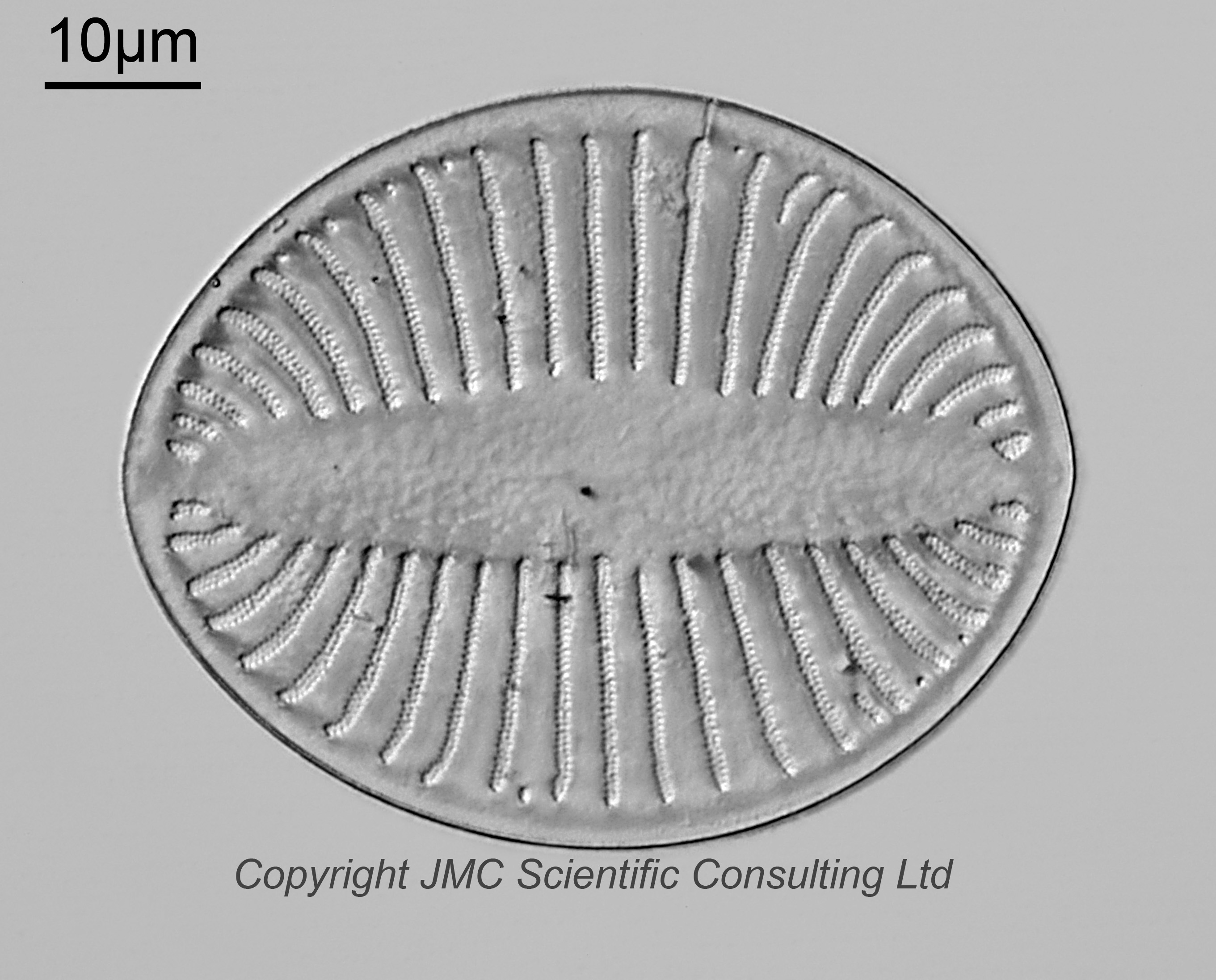
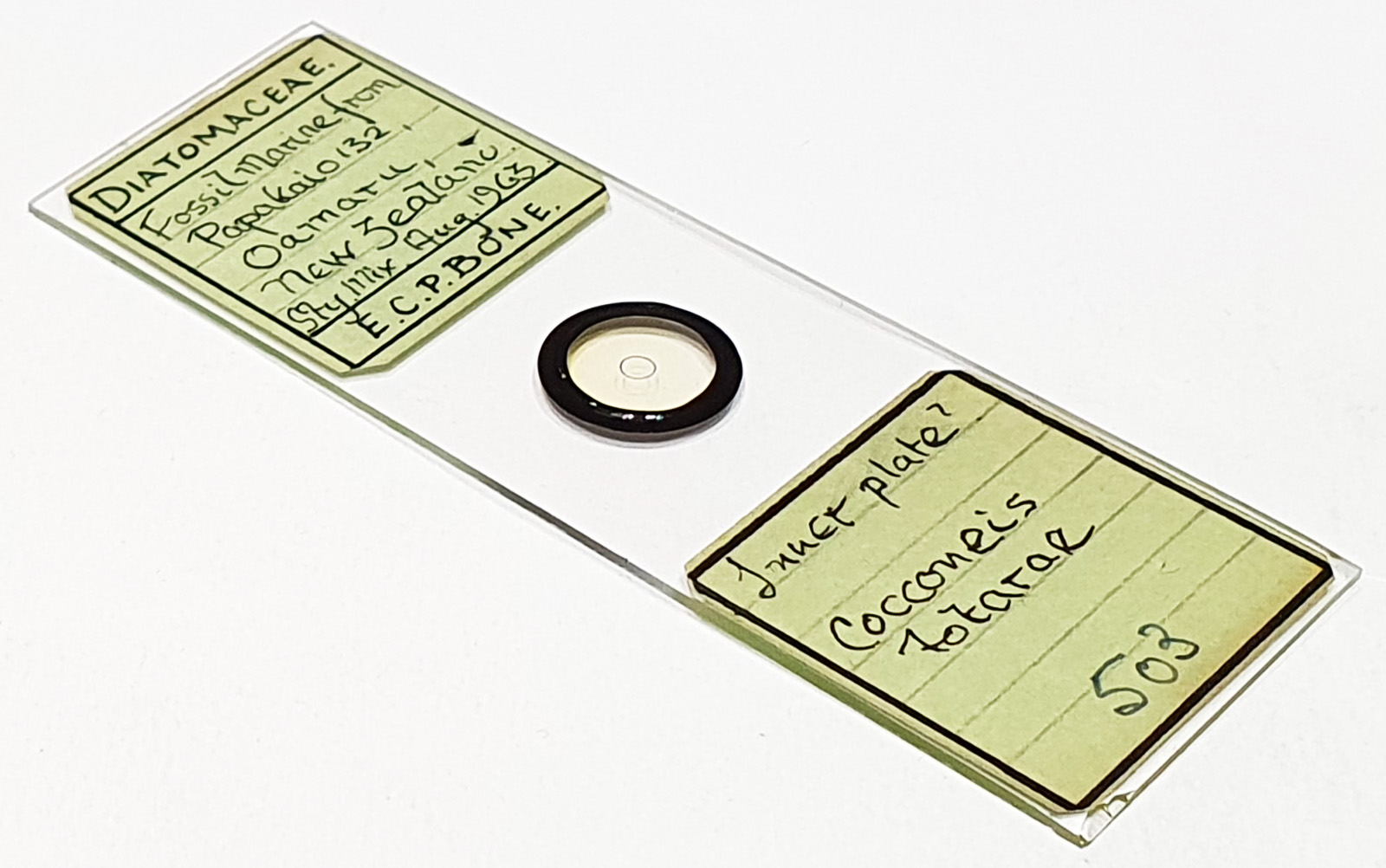
Bit of a mystery this one. Slide labelled as Cocconeis totarae (inner plate?) from Papakaio 132, Oamaru, New Zealand. Single example on the slide. Sty.mix (Styrax mix) mountant, and dated August 1963. Prepared by ECP Bone. Olympus BHB microscope using 450nm LED light. 63x Leitz Pl Apo 1.4 objective, oil immersion. Olympus Aplanat Achromat condenser, oil immersion, oblique lighting. 2.5x Nikon CF PL photoeyepiece. Monochrome converted Nikon d850 camera. 28 images stacked in Zerene (Pmax).
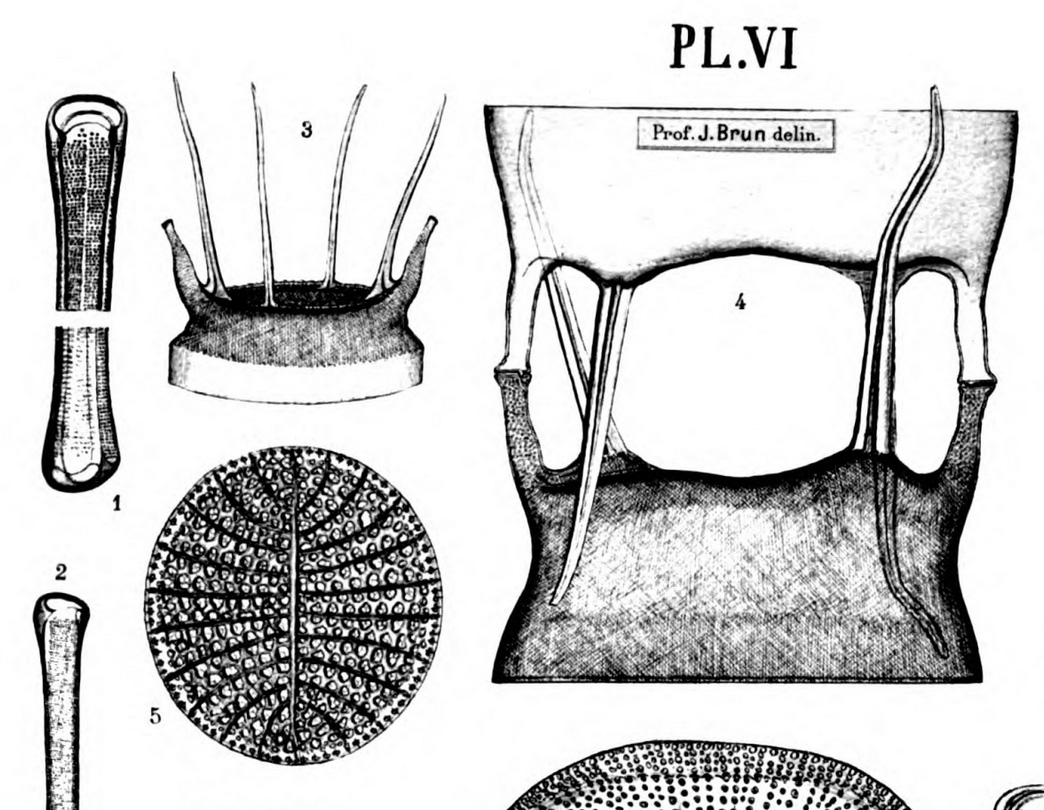
Cocconeis totarae Brun 1894 (as ‘Totaræ‘). Published in: Brun, J. (1894). Espèces nouvelles. Le Diatomiste 2(16): 72-78, plates 5-6. Page 75, Plate 6, Figure 5. Translation of the description:
“Length 58 to 67 µm. Width 50 to 63 µm. Upper valve regularly domed.
Very large, wide, flat, tetra- or pentagonal beads; joined towards the center in double rows that split near the edge, thus forming curved sections separated by pseudo-ribs. — Marginal lines finely segmented. The silica of this valve is robust and has a blue luster, seen dry and at low magnification. — Lower valve with smooth ribs, whose curvatures correspond to those of the other valve. Median nodes are barely and rarely visible. —
This valve is thin and very deciduous [?] (found too late to be drawn).
Totara. Bains Lower and Cormack’s Top. (fossil). — Very rare.
Raphoneis Lorenziana Grun. is actually a Cocconeis and exhibits the same phenomenon; because the median nodes are also faintly visible and are sometimes even invisible. Raphoneis suborbicularis O. Meara, “Diat. from Arran 7. 9”, resembles it somewhat and must also belong to the Cocconeis. – In short, the current species is close to C. Norvegica Grun. (A. S. Arct. Diat. 3/18) which is abundant in preparation no. 311 of Cleve and Möller.”
To me this one doesn’t strongly resemble the image in Le Diatomiste. Also, C. totarae isn’t mentioned in Desikachary and Sreelatha’s book on Oamaru Diatoms. However this one does look a little like Campyloneis grevellei [grevillei], Plate 45, Figure 1. Funnily enough the examples of C. grevellei also look like the image of Cocconeis totarae in Le Diatomiste, however on that image the transverse lines go to middle, which they do not in the image on the slide. All in all a bit of a mystery.
EDIT 12/9/25.
I posted about this on the Diatom Imaging facebook page, and one suggestion for this was Cocconeis oamaruensis, a rapheless valve. Looking on the Oamaru Diatoms website, I can see some similarities, however the central region doesn’t look like a good match.
However, it did get me looking in a different place. Cocconeis oamaruensis H.-J.Schrader 1969 is written about in: Schrader, H.-J. (1969). Die Pennaten Diatomeen aus dem Obereozän von Oamaru, Neuseeland. Beihefte zur Nova Hedwigia 28: 1-163, pls 1-39. Page 33, Plate 19, Figure 1. I have a copy of this book, and looking through it also moved me away from C. oamaruensis, but it did show two unnamed Cocconeis sp. which looked to have very similar features to this one. Specifically No 56. Plate 13 figure 7, and No 60. Plate 14 figure 7b. However there were too few samples available for the authors to give positive species identification. I think I have to conclude that this is a Cocconeis sp., but go no further than that at the moment.