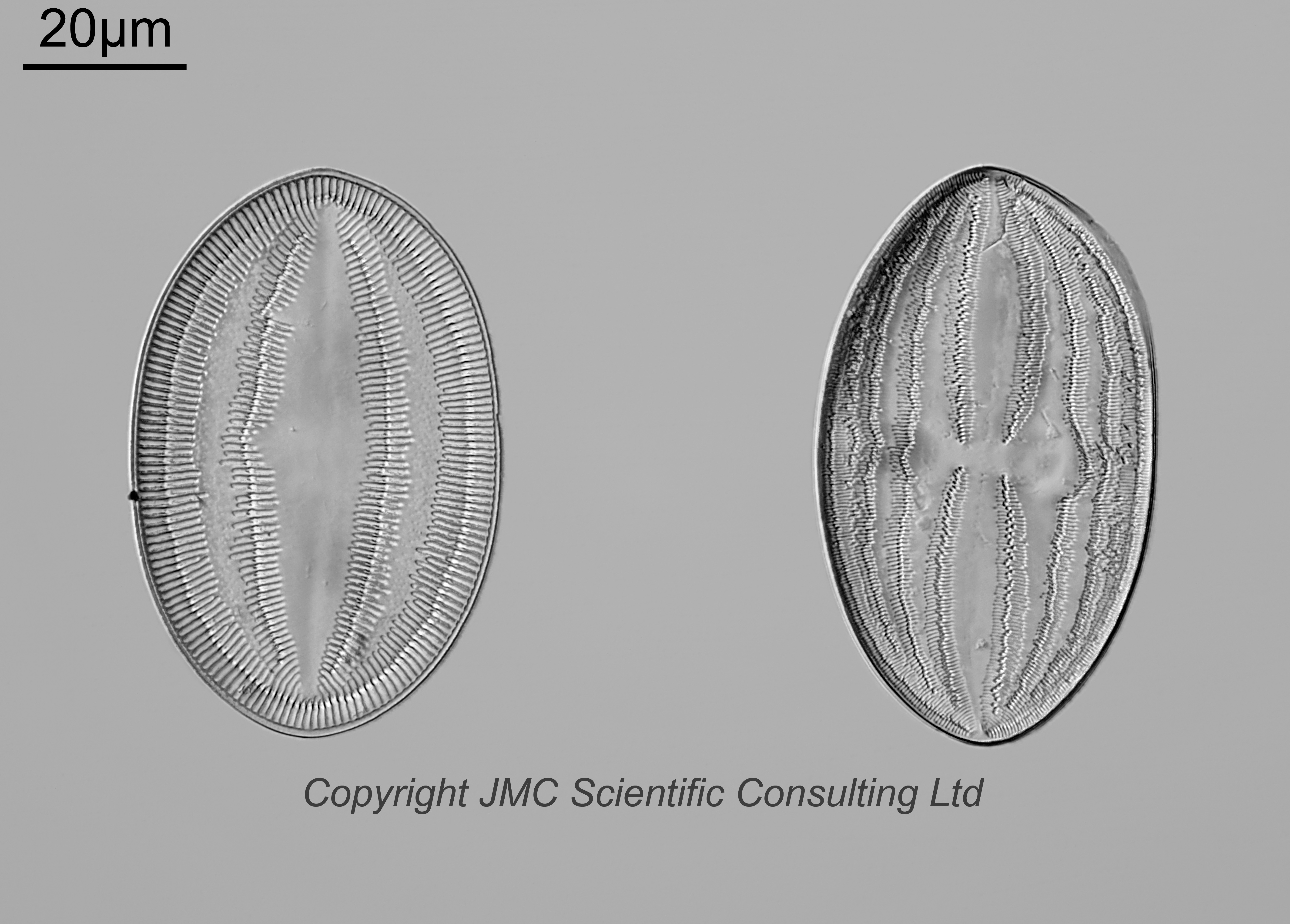
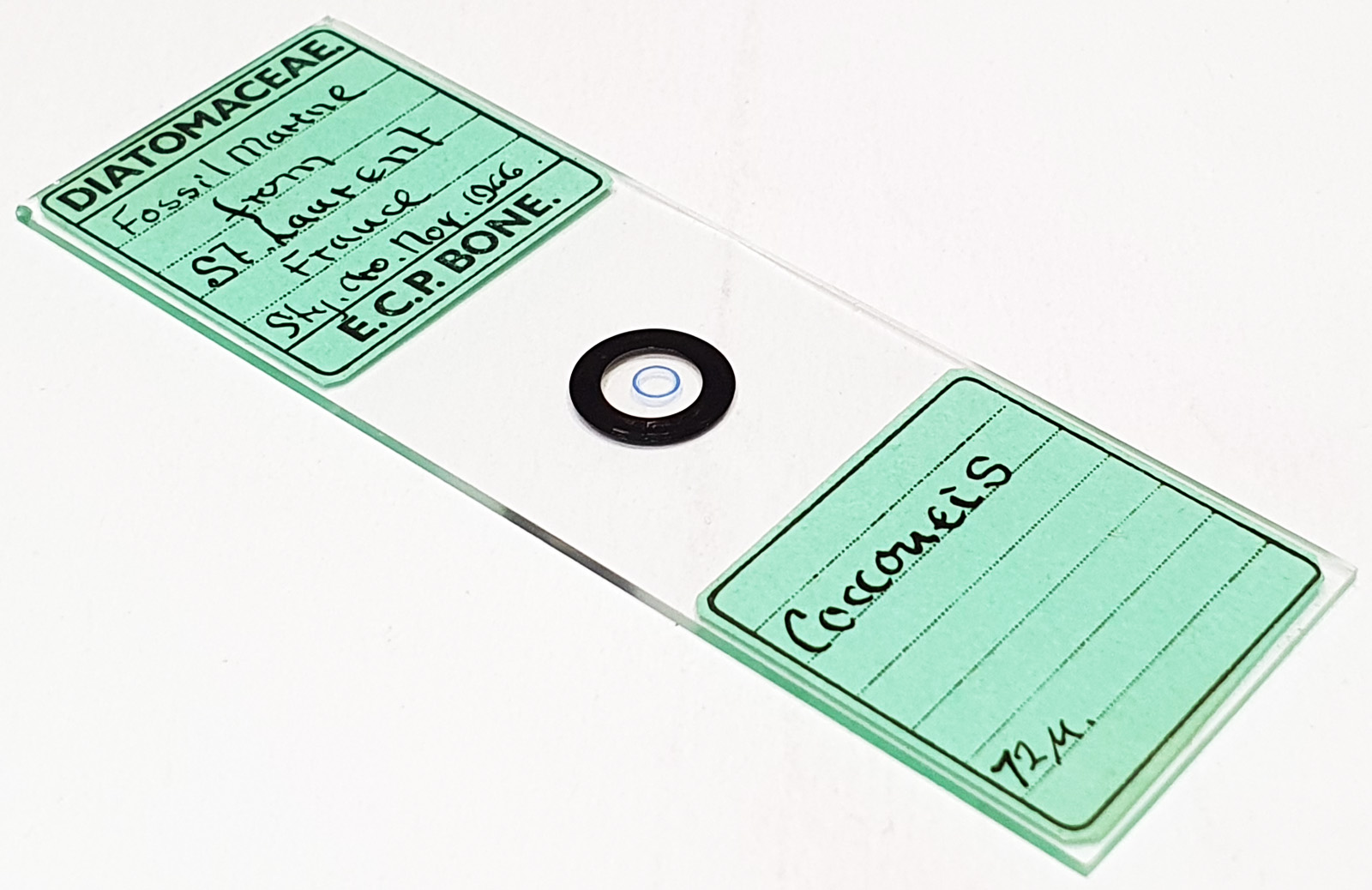
Two Cocconeis sp. from St Laurent-La-Vernède, France (I’ll come back to the names in a minute). Fossil marine material. Mounted in Styrax/Aroclor, and dated November 1966. Prepared by ECP Bone. Olympus BHB microscope using 450nm LED light. 63x Leitz Pl Apo NA 1.4 objective, oil immersion. Olympus Aplanat Achromat condenser, oil immersion, oblique lighting. 2.5x Nikon CF PL photoeyepiece. Monochrome converted Nikon d850 camera. 68 images stacked in Zerene (Pmax).
Ok, the names.
Left hand one looks a bit like Cocconeis moronensis A.W.F.Schmidt, 1894. Published in: Schmidt, A.[W.F.] (1894). Atlas der Diatomaceen-kunde. Series V: Heft [50]. pp. pls 193-196. Leipzig: O.R. Reisland. Plate 194, Figure 9. Moron (Weissfl.). I am not 100% convinced on this one.
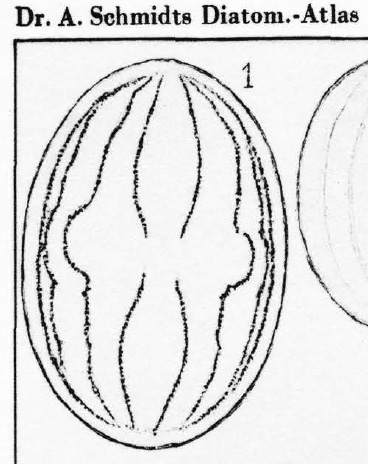
As for the right hand one, I initially thought it was an aberrant form, but I did find a match. Schmidt’s Atlas plate 196, Figure 1, Cocconeis praecellens Pant. Szakal (Brun). Screen grab shown above.
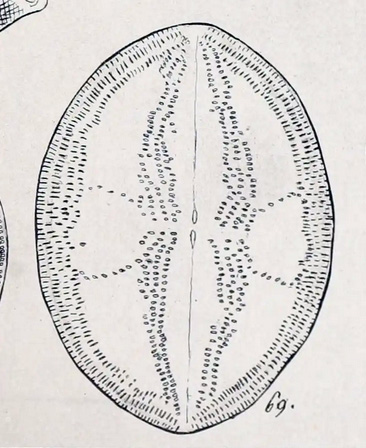
This is described in Beiträge zur Kenntniss der fossilen Bacillarien Ungarns / bearbeitet durch Josef Pantocsek. 1886. Plate VIII, Figure 69. Screen grab of the figure from there also included.
Translation from Pantocsek;
“*Cocconeis praecellens* n. sp. (Plate 8, fig. 69, 1133/1). Oval, 0.045 mm long, 0.034 mm wide. At the margin, there are very short, fine, radiating striae (16 per 0.01 mm), composed of a series of three striaelets. Near the central line, there are three curved punctate lines running toward the central nodule, where they are interrupted. A large, smooth, arcuate area is present. — The lower valve is shorter—oval, 0.0299 mm long, 0.0187 mm wide—and similar to the upper one, but the line bordering the raphe is connected in the middle to two opposing, curved, finely striated lines that join with the marginal striae.”.
Mine looks closer to the image provided by Schmidt than Pantocsek. However it looks like a good match.
How do the ages match up for the fossil deposits mentioned (thank you GoogleAI for this):
The Saint-Laurent-la-Vernède diatomite deposit in France is of early Miocene age, which dates back roughly 16 to 23 million years.
The Morón diatomite deposit located in the Guadalquivir Basin of southern Spain dates back to the Miocene epoch (an approximate age of 12 to 10 million years old).
The Skazal diatomite deposit (historically recorded as Szakal or Nógrádszakál in Hungary) is late middle Miocene in age (12 to 15 million years old).
So, the St Laurent site is a bit earlier than the other two, but they seem like reasonable matches.