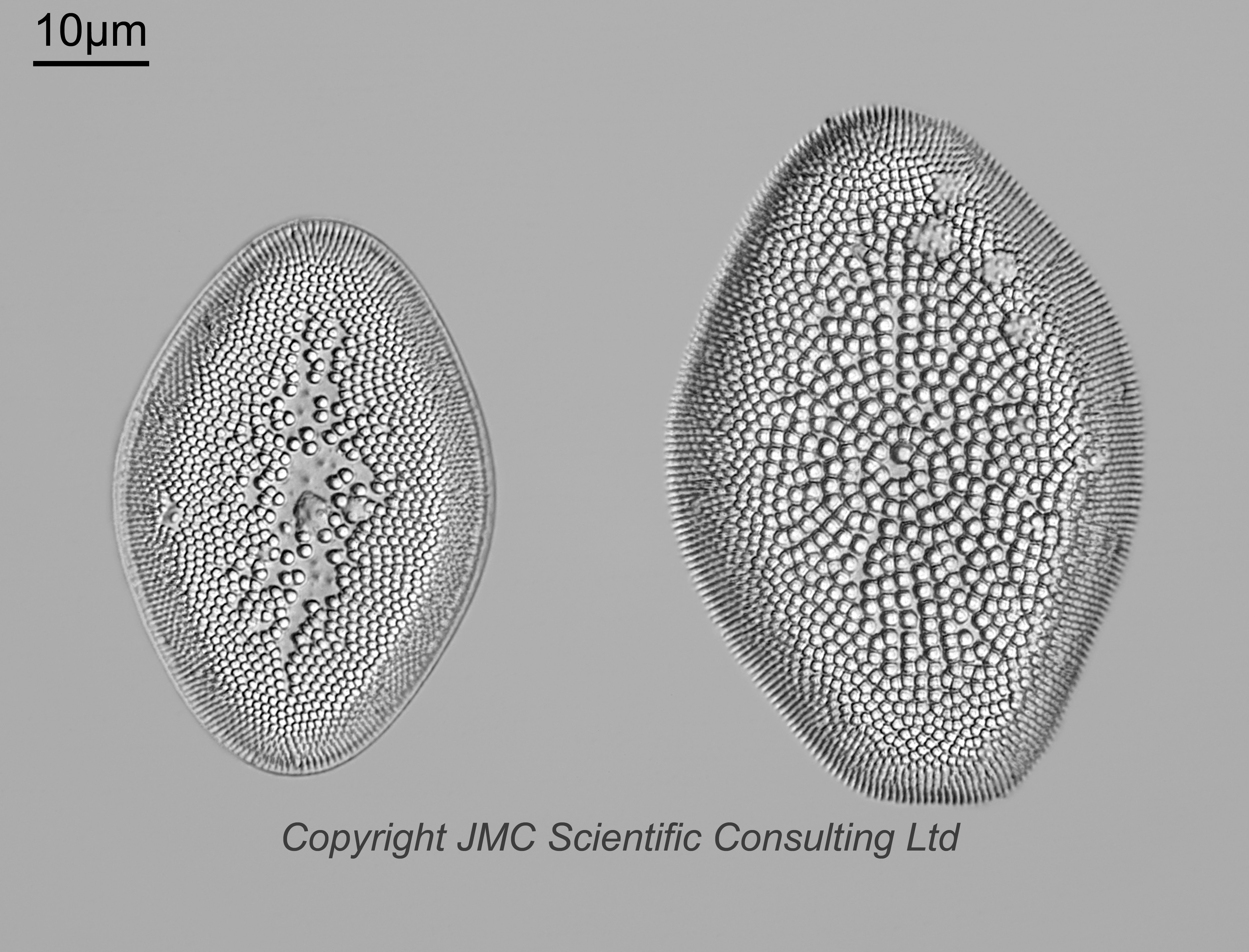
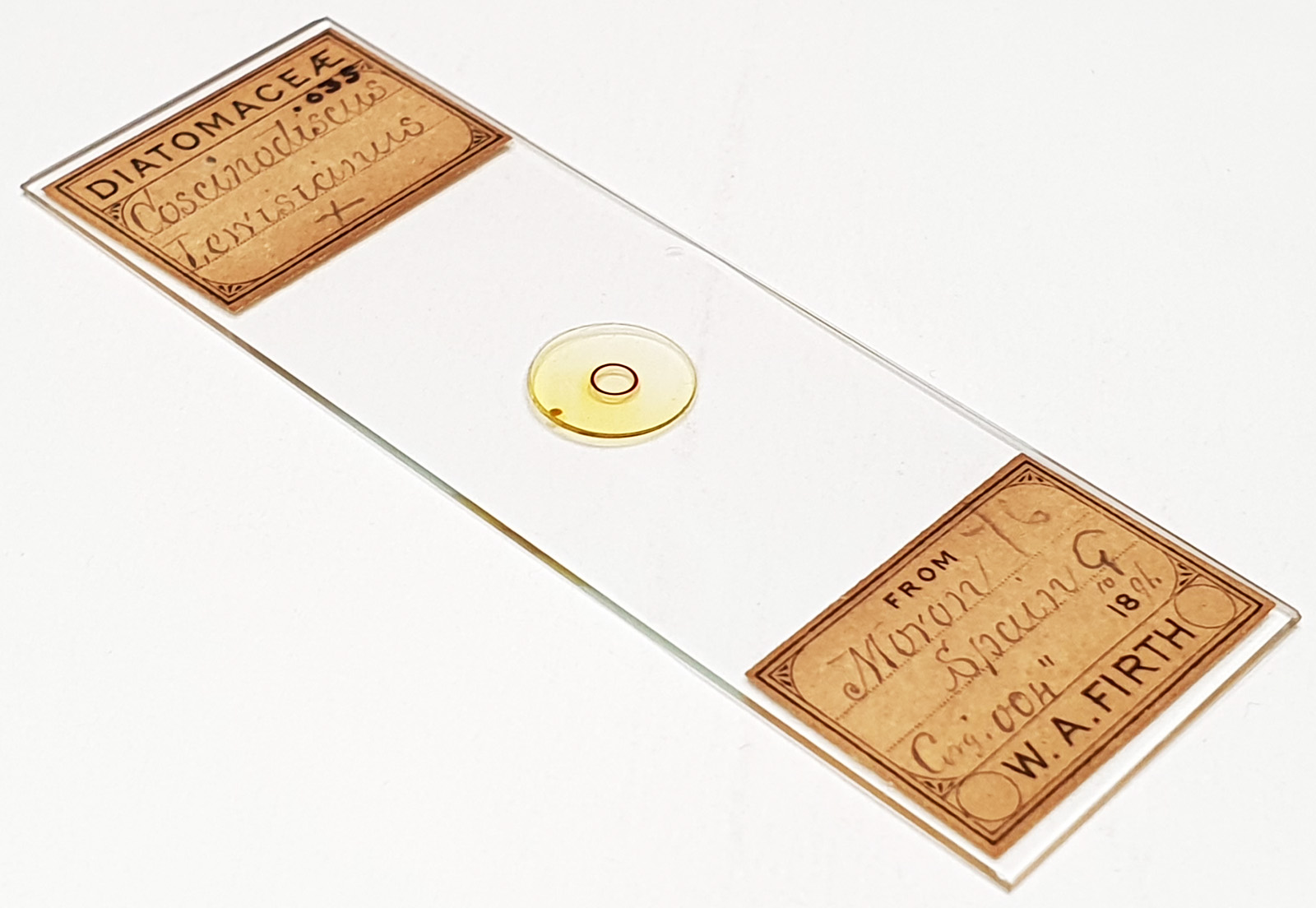
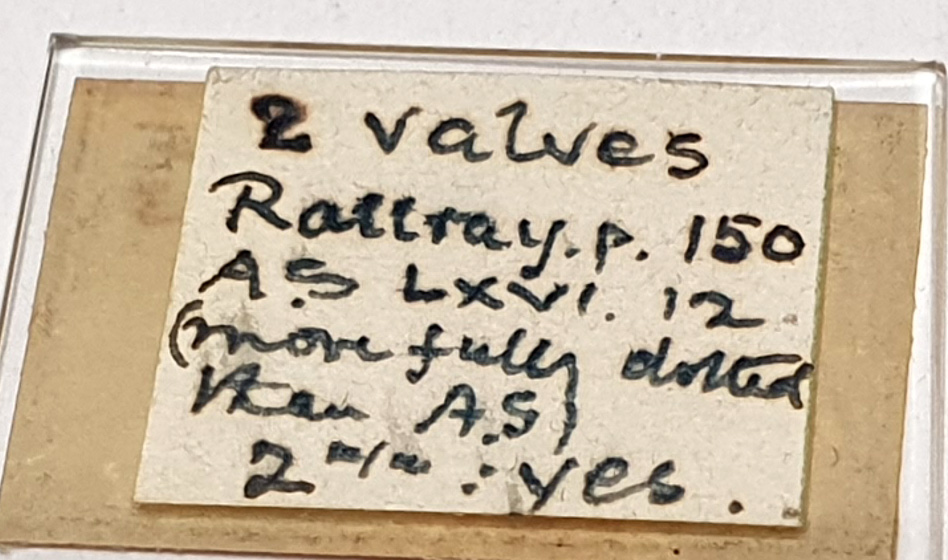
Interesting slide this. A slide of what I think are two Cestodiscus sp. (I’ll come back to the name on the slide label in a minute). Location given as Moron, Spain. Cover gauge 0.004” (0.10mm) – thin coverslip. 10 1896 (presumably October 1896). Prepared by William Allott Firth. Olympus BHB microscope using 450nm LED light. 63x Leitz Pl Apo 1.4 objective, oil immersion. Olympus Aplanat Achromat condenser, oil immersion, oblique lighting. 2.5x Nikon CF PL photoeyepiece. Monochrome converted Nikon d850 camera. 43 images stacked in Zerene (Pmax). Label on the back says ”2 valves. Rattray p. 150. AS LXVI, 12 (more fully dotted than AS). 2mm yes.”.
Coscinodiscus lewisianus Greville 1866. Published in: Greville, R.K. (1866). Descriptions of new and rare diatoms. Series XX [actually XIX]. Transactions of the Microscopical Society, New Series 14: 77-86, pls VIII, IX. Page 78, Plate VIII [8], Figures 8-10. This name is currently regarded as a synonym of Araniscus lewisianus (Greville) Komura. 1998. Published in: Komura, S. (1998). A perplexing morphotype of some centric diatoms inclusive of Coscinodiscus lewisianus Grev. and its allies. Diatom 14: 1-23, 147 figs [photographs], 1 text-fig. Page 6. However these ones lack the parallel rows of areolae make this species (C. lewisianus) easy to recognize. As such I am not convinced this is a C. lewisianus. Could be Cestodiscus sp. (something like C. rhombicus maybe)? Cestodiscus rhombicus. Van Heurck, H. (1880). Synopsis des Diatomées de Belgique. Atlas. Ducaju & Cie., Anvers. plate 129, figure 3.
Both of these do look to have the holes which are typical of Actinocyclus (9 o’clock on the left one, and 3 o’clock on the right one). There there does look to be some similarity and cross over between Cestodiscus and Actinocyclus. As I say, interesting slide.