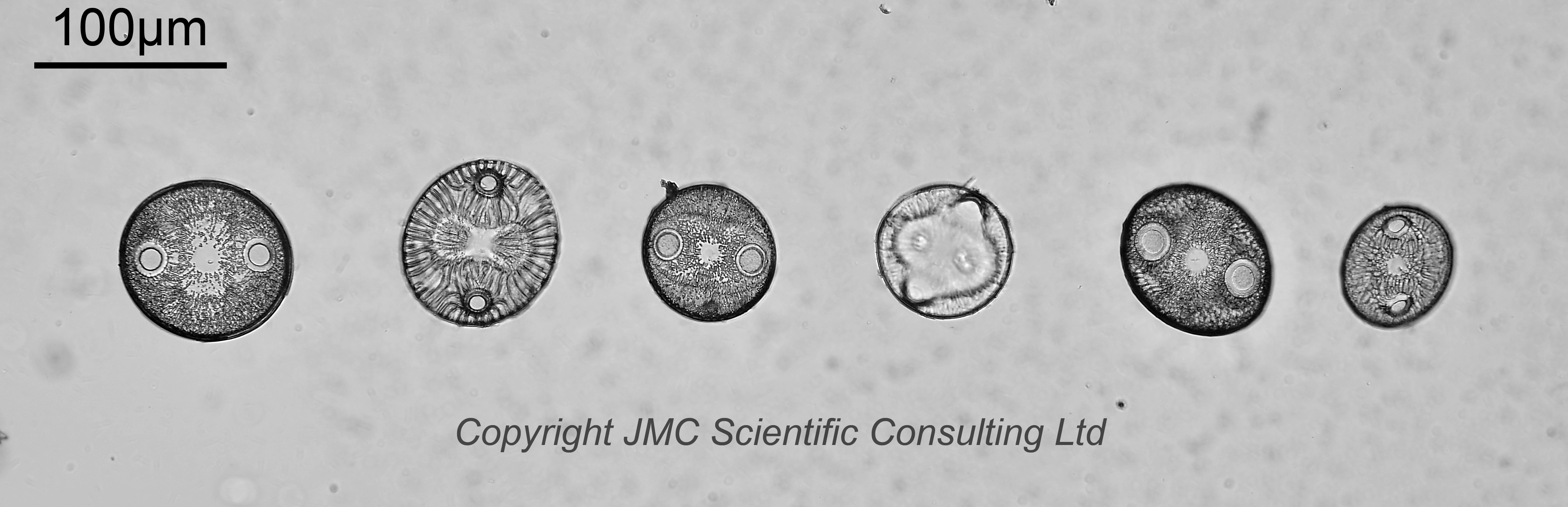
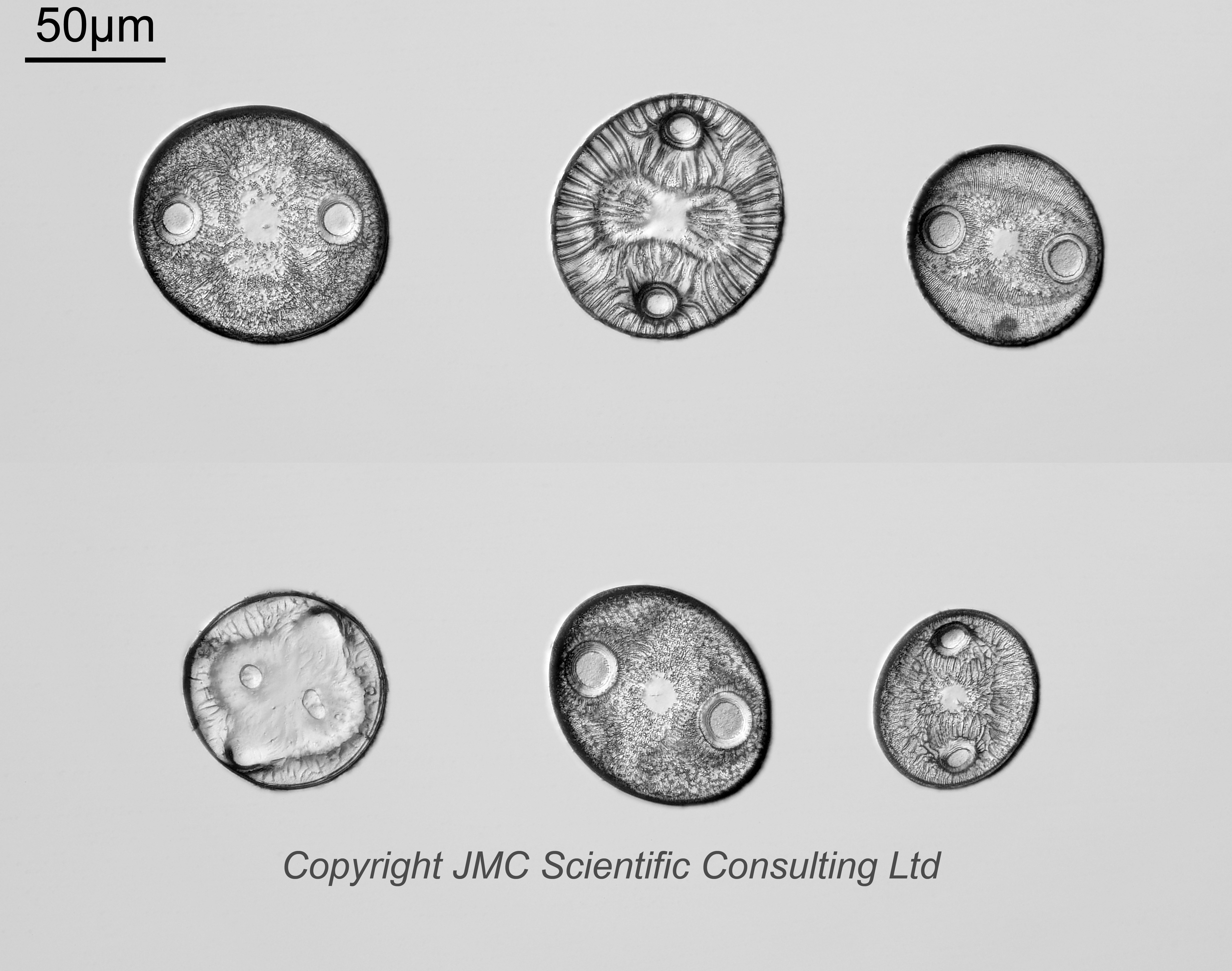
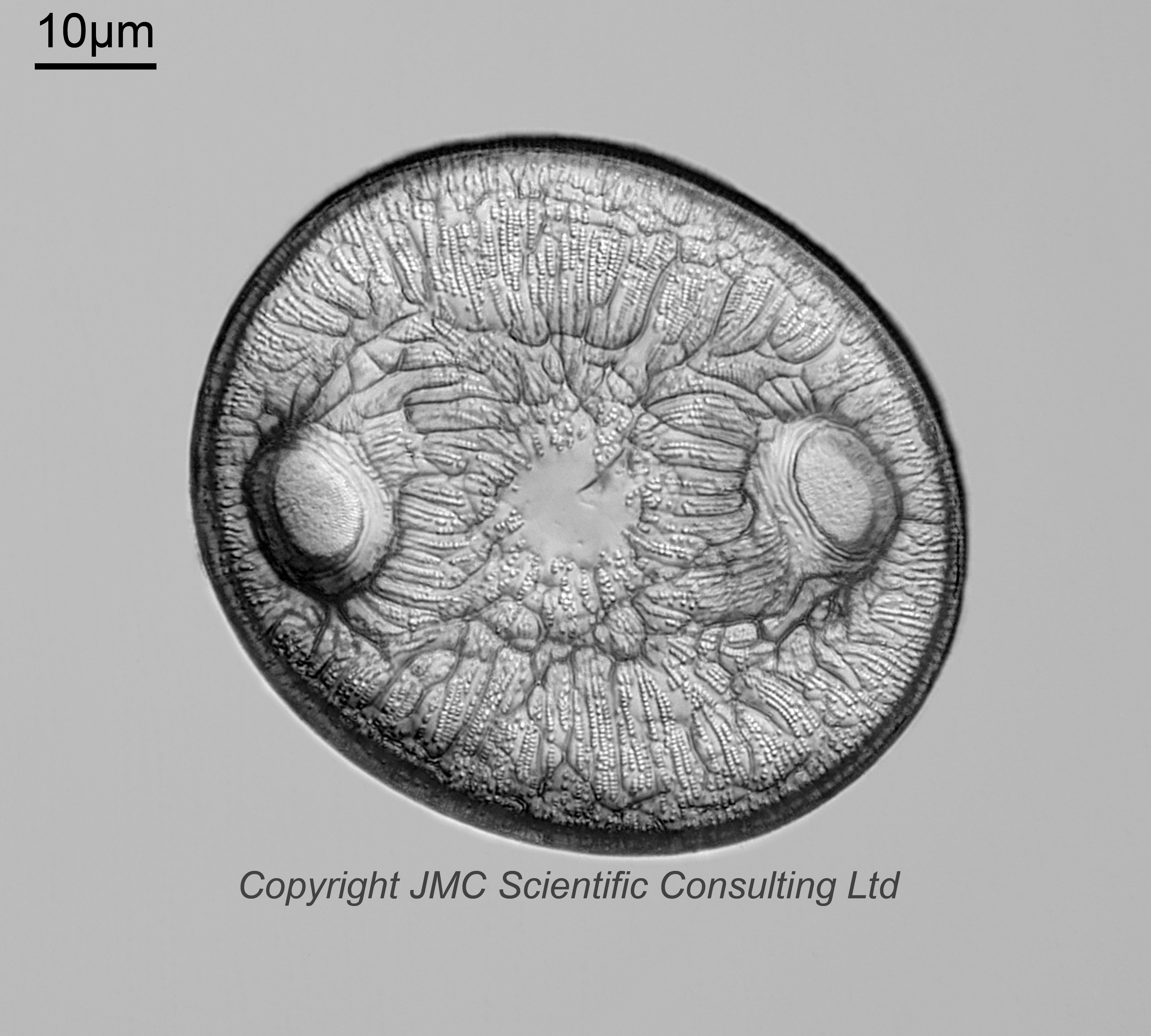
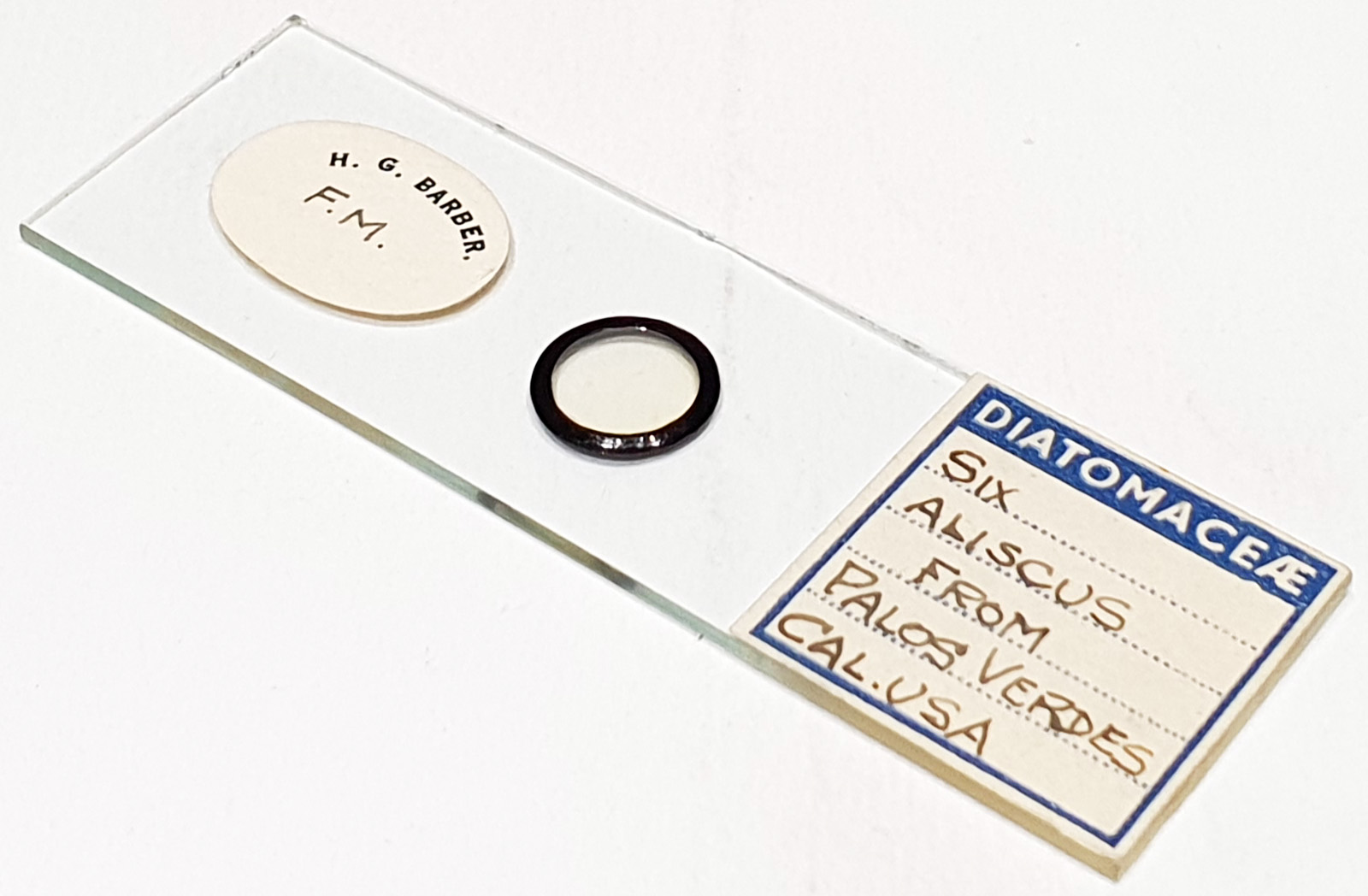
A linear arrangement of six Auliscus diatoms (written as Aliscus on the slide) from Palos Verdes, California, USA. Fossil marine material. Prepared by Horace George Barber. Olympus BHB microscope using 450nm LED light. As well as the arrangement with a 10x objective, I also imaged them all with a 20x Nikon Plan Apo NA 0.65 objective, and oblique lighting. I then selected one (the one at the right hand side of the line) for imaging with the 63x Leitz Pl Apo 1.4 objective, oil immersion. Olympus Aplanat Achromat condenser, oil immersion, oblique lighting. 2.5x Nikon CF PL photoeyepiece. Monochrome converted Nikon d850 camera. 31 images stacked in Zerene (Pmax).
There are some issues withe the mountant. The video shows a scan through it from the top down (showing the issues near the top layers). The slide is quite ‘foggy’ and low contrast, presumably because of these issues. Also, diatom no. 4 has some problems where it is adhered.
As for what they are, my best guesses from left to right are;
1. Auliscus pruinosus.
2. Auliscus caelatus/sculptus.
3. Auliscus stockhardtii.
4. Maybe Aulacodiscus grunowii var. californica, Wornhardt Figure 94. Very tentative.
5. Auliscus pruinosus.
6. Maybe Auliscus albidus. SA Plate 171, Figure 3. Is also mentioned in Wornhardt (Figure 86).
I imaged the right had one, as it looked to be one I hadn’t seen before. I am describing this as Auliscus albidus at the moment, based on the images in Schmidt’s Atlas. Note, the ocelli are not flat to the face of the valve, but more at an angle.
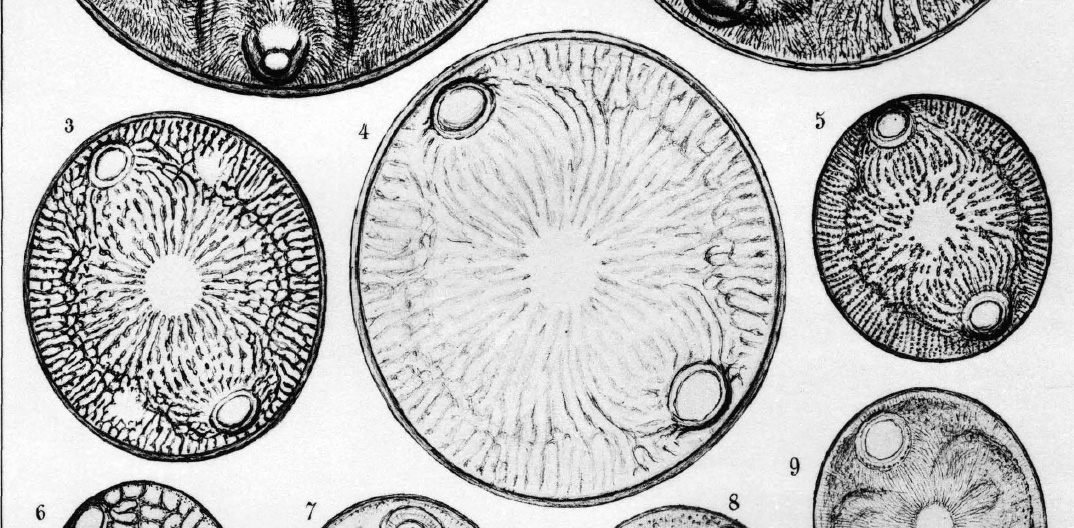
Auliscus albidus Brun, 1892. Published in: Schmidt, A.[W.F.] (1892). Atlas der Diatomaceen-kunde. Series IV: Heft 43/44. pp. pls 169-176. Leipzig: O.R. Reisland. Plate 171, Figures 3,4. Looks like Figure 3.
Auliscus albidus var. baccatus Brun, 1892. Published in: Schmidt, A.[W.F.] (1892). Atlas der Diatomaceen-kunde. Series IV: Heft 43/44. pp. pls 169-176. Leipzig: O.R. Reisland. Plate 171, Figure 5 (as ‘baccata‘).
Translation from Schmidt’s Atlas: “S. Monica, diatomite from the Pacific (Brun), 3. 4. A. albidus Brun, 5. var. baccata Brun. According to information from Groves, = A. subspeciosus Rattray, also from S. Monica, but fossil. Rattray’s drawing bears no resemblance to mine. What strikes me as remarkable in 3 are the two areas lacking any ornamentation, which likely correspond to the underlying processes of the other valve.”.
I think it is more like A. albidus (SA, Plate 171, Figure 3) than the baccactus variant (Plate 171, Figure 5), however I will leave it with a question mark for now.