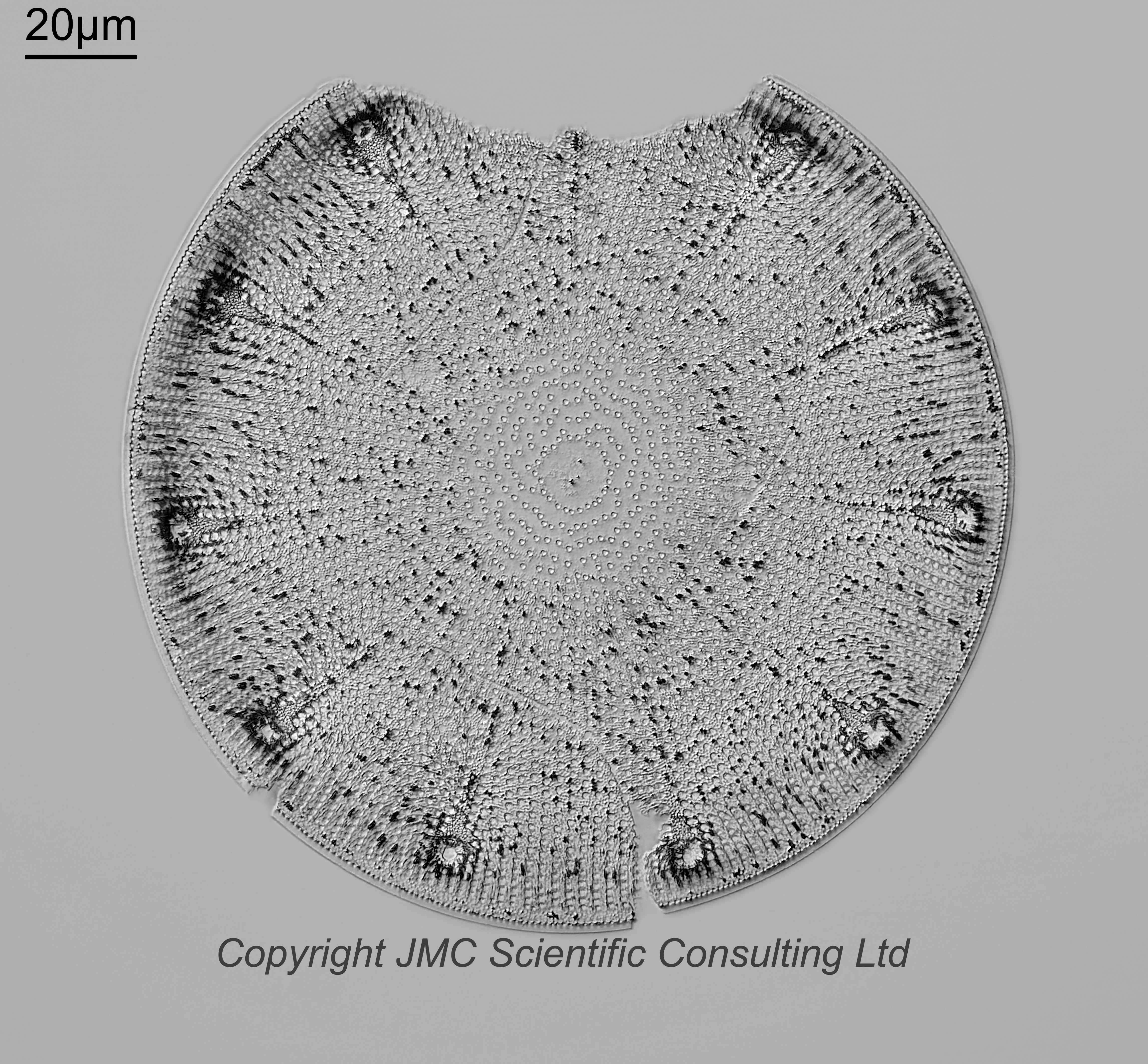
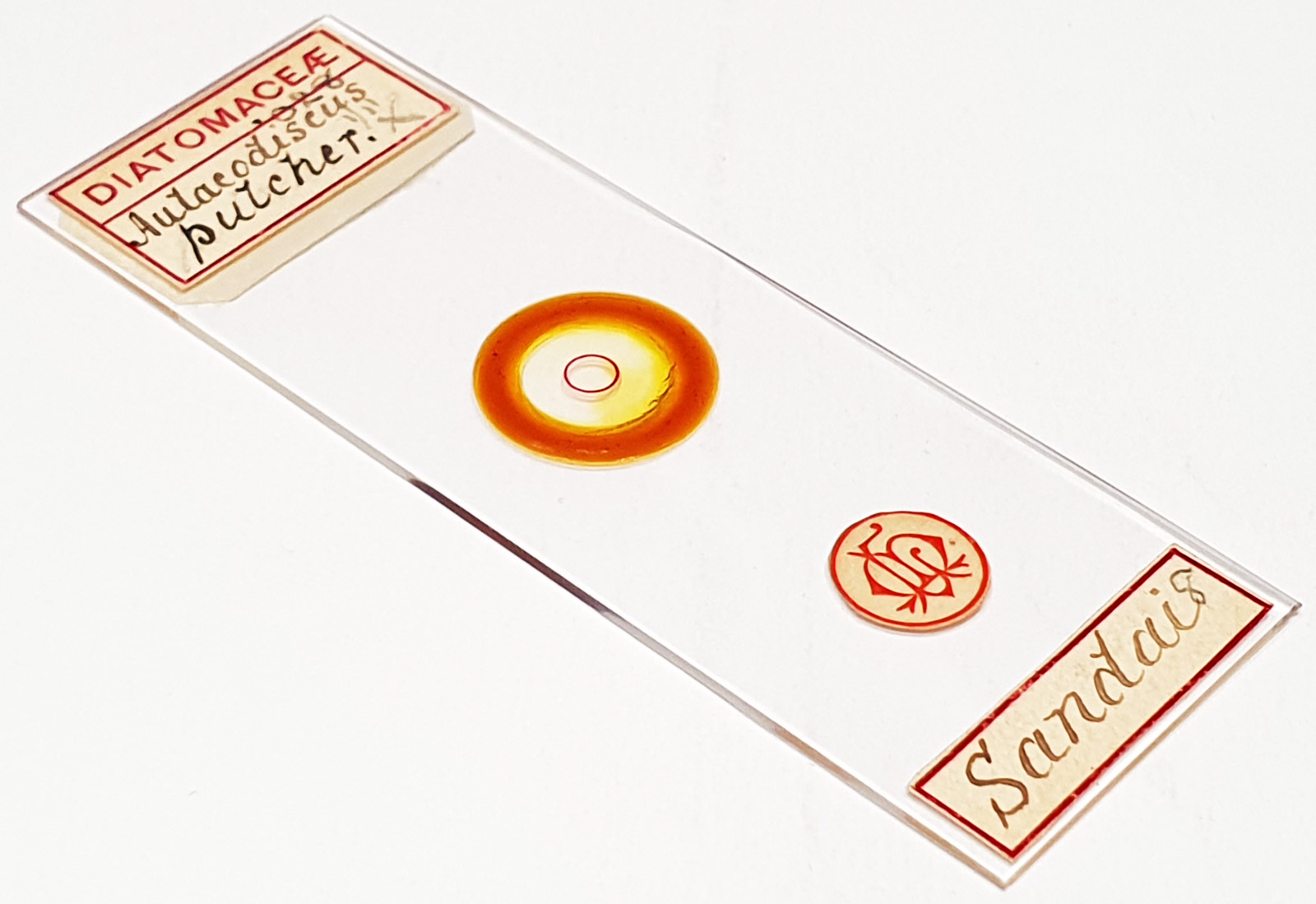
An example of what I think is Aulacodiscus angulatus var. japonica from Sendai (written as Sandai on the label), Japan. Single example on the slide, dipping downwards towards the upper left. 11 processes. 159µm diameter (measured left to right). Prepared by Laurence Miles. Olympus BHB microscope using 450nm LED light. 40x Leitz Pl Apo NA 1.00 objective, oil immersion. Olympus Aplanat Achromat condenser, oil immersion, oblique lighting. 2.5x Nikon CF PL photoeyepiece. Monochrome converted Nikon d850 camera. 67 images stacked in Zerene (Pmax).
The slide is labelled Aulacodiscus pulcher, but I am not convinced by this. I think it could it be Aulacodiscus angulatus var. japonica Tempère & Brun in Brun & Tempère, 1889. Original description: Brun, J. & Tempère, J. (1889). Diatomées Fossiles du Japon. Espèces marines et nouvelles des calcaires argileux de Sendaï et de Yedo. Mémoires de la Société de Physique et d’Histoire Naturelle de Genève, 30(9): 75 pp., 9 pls. Pages 18,19, Plate 4, Figure 14.
A translation from Tempère & Brun;
“Aulacodiscus angulatus Grev. var. Japonica Temp. et Brun.
PI. IV, fig. 14. Rare.
Diameter 80 to 105 µm. Differs from the type (Grev. 1863. 5. 15 and At. Schm. 105. 7 and 103. 2) and from var. hungarica (Pant. 25. 281). 1° by its widely spaced pearls, large especially at the base of the tubules where they leave broad and long conical areas; 2° by its very widely spaced striae (3 in 10 µm); 3° by the well-defined punctate line that runs near the circumference. Tawny-looking silica.
Sendai limestone.
Note: The entire surface of the valve is very finely granulated between the striae [a characteristic that Rattray also gives as belonging to the type (Revision of Aul., page 347, section 3 radiati)].”
The overall description is a good match for the one on this slide, although the size is off (the one of the slide being larger than the one in the book). Hence I will leave my name for it with a question mark for now.