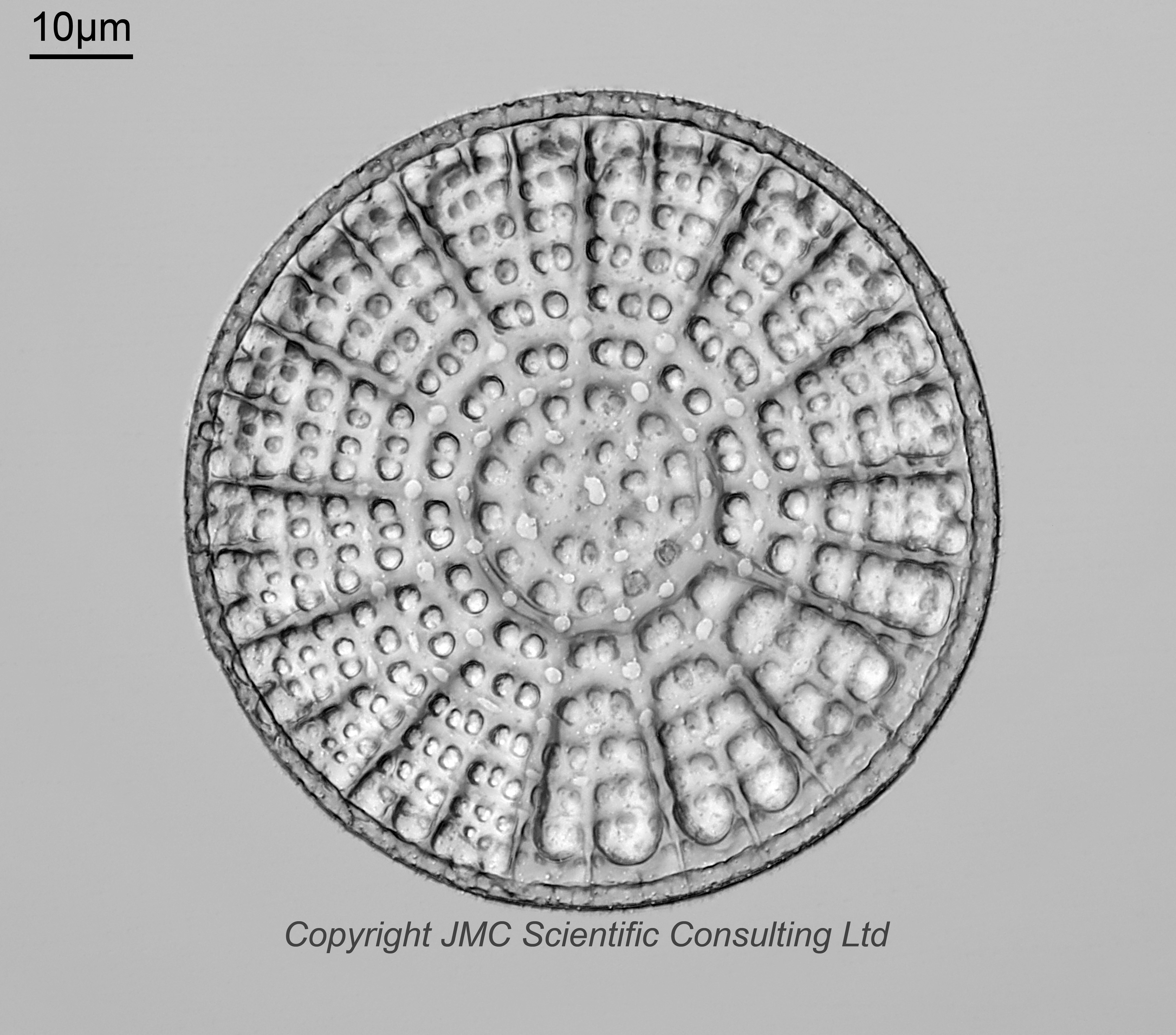
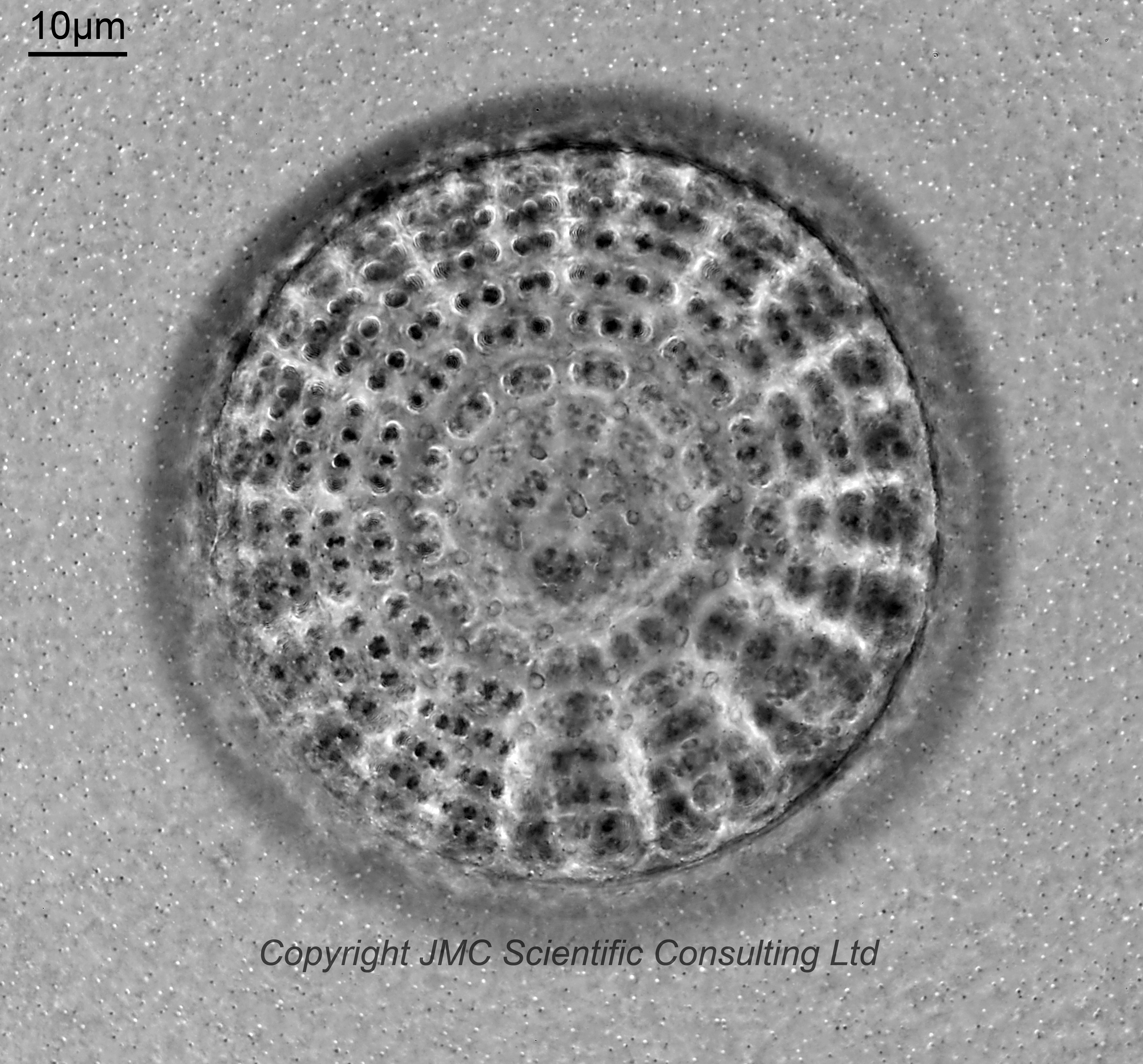
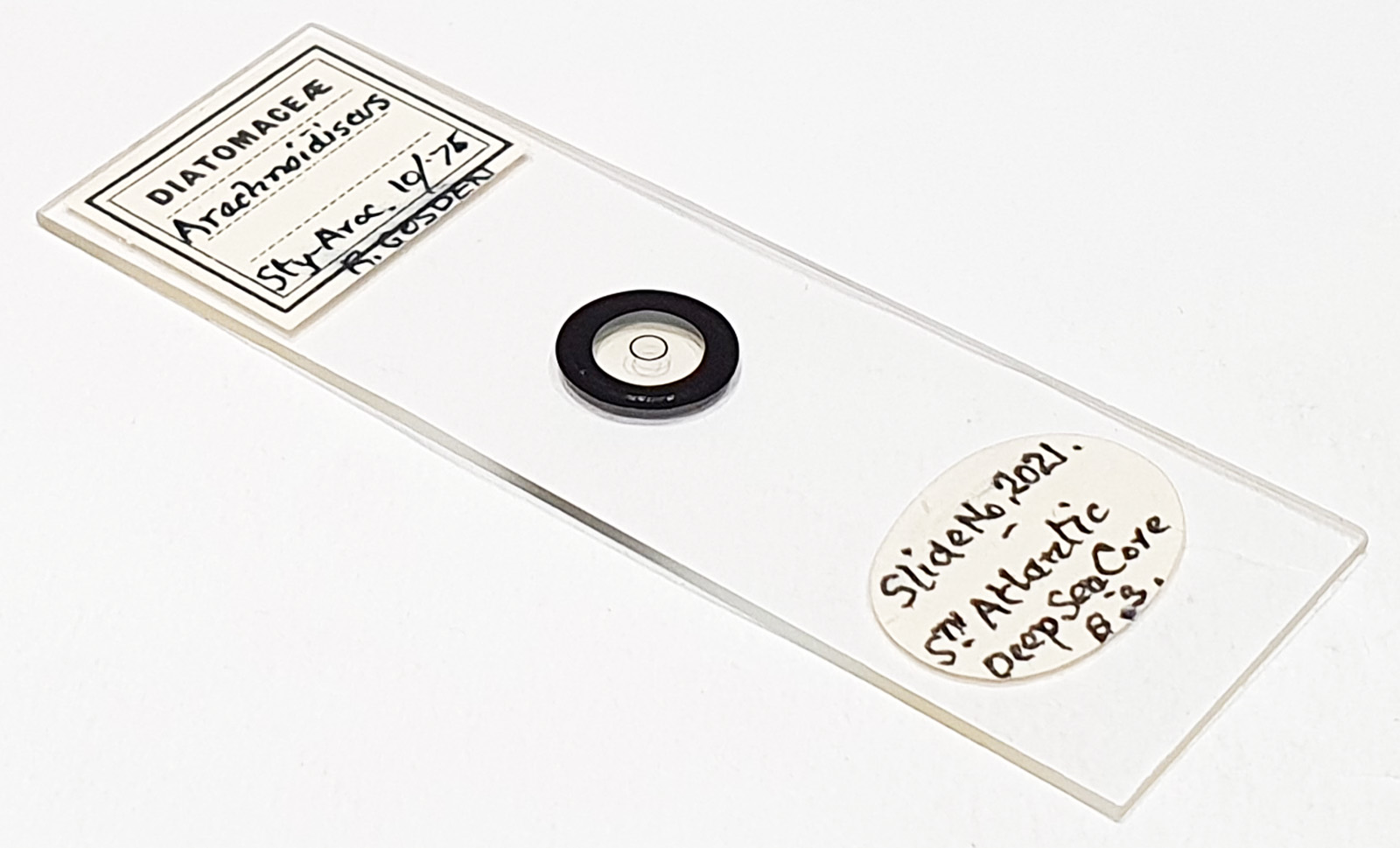
A slide labelled Arachniodiscus. Single example on the slide. Mounted in Sty-Aroc, and dated October (19)75. Labelled ‘Slide No 2021’ and ‘Sth Atlantic Deep Sea Core’. Slide mountant very milky in appearance when lit. Prepared by Richard Gosden. Olympus BHB microscope using 450nm LED light. 63x Leitz Pl Apo NA 1.4 objective. Olympus Aplanat Achromat condenser, oil immersion, oblique lighting. 2.5x Nikon CF PL photoeyepiece. Monochrome converted Nikon d850 camera. 12 images stacked in Zerene (Pmax).
I initially thought this could be an example of Arachnoidiscus longii. Published in: Brown, N.E. (1933). Arachnoidiscus. An account of the genus, comprising its history, distribution, development and growth of the frustule, structure and its examination and purpose in life, and a key to and descriptions of all known species, illustrated. W. Watson & Sons, Ltd., London., 88 pp., 7 pls. Pages 41, 53, Plate 2 Figure 4, Plate 3 Figure 1. Reported as being a fossil, found at Jérémie, Haiti. The overall appearance seems to be a good match.
The Brown book states that A. longii looks ‘interesting especially under dark-ground illumination’. I did try with a Reichert Neo 1.42/1.18 dark ground condenser, but couldn’t get good dark ground even with low NA obejctives. I suspect that the very ‘milky’ appearance of the mountant was scattering too much light, preventing nicely dark ground lighting. I did capture one image with the 63x Leitz objective (which should be COL rather than DG given its high NA) and it does show some structures within some of the cells.
EDIT. On reflection, this could very well be A. lepidus from Päule Heck, Die fossilen Diatomeen Oamarus (Neuseeland) aus den Sammlungen von Bernard Hartley und Nigel Charles, Figure 74. Also in: Williams, D. M. (2023). Notes on the diatom collection of the Natural History Museum, London (BM) VIII: the types of Arachnoidiscus in Brown’s monograph (Brown 1933). Diatom Research, 38(4), 181–208. https://doi.org/10.1080/0269249X.2023.2274330. Looks very similar to this. I will leave both as options for now.
EDIT 13th February 2026. Hmm, the plot thickens. I was just looking through Barron’s paper “Late Miocene-Early Pliocene marine diatoms from southern California”, Palaeontographica Abteilung B 151(B):97-170 April 1975, and came across Arachnoidiscus evanescens, Plate 2, Figure 14. This looks very similar to the image I shared here, so should be considered a possibility for the ID.
NOTE – I have other slides by Gosden from this location – search for “Atlantic Deep Sea Core” – but have no idea where this is actually from. If you know, please drop me a message.