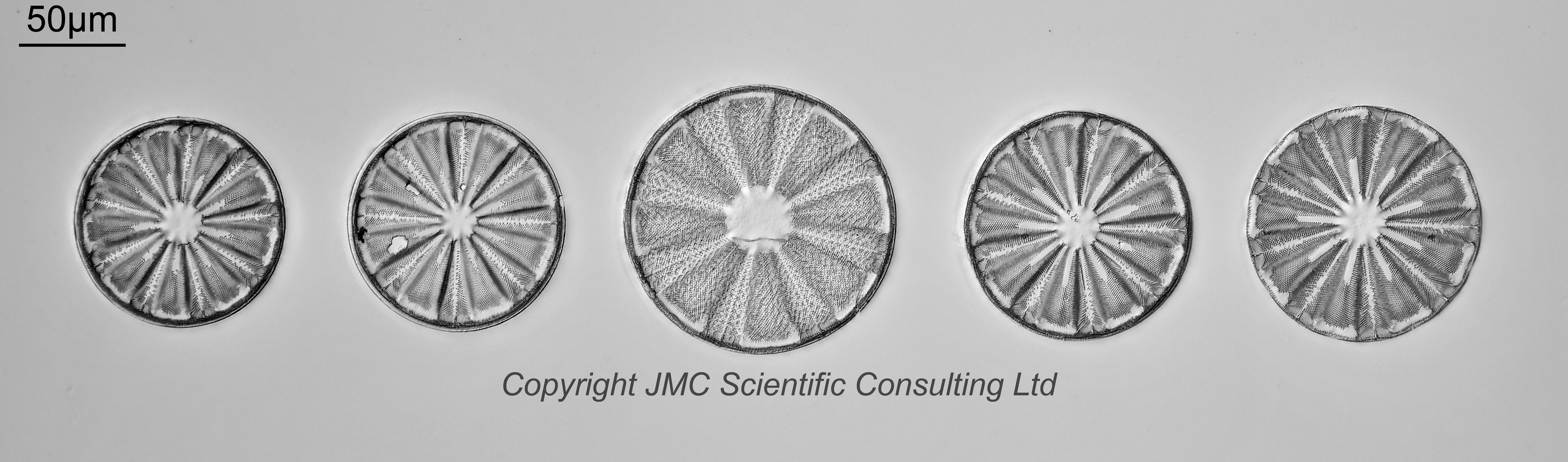
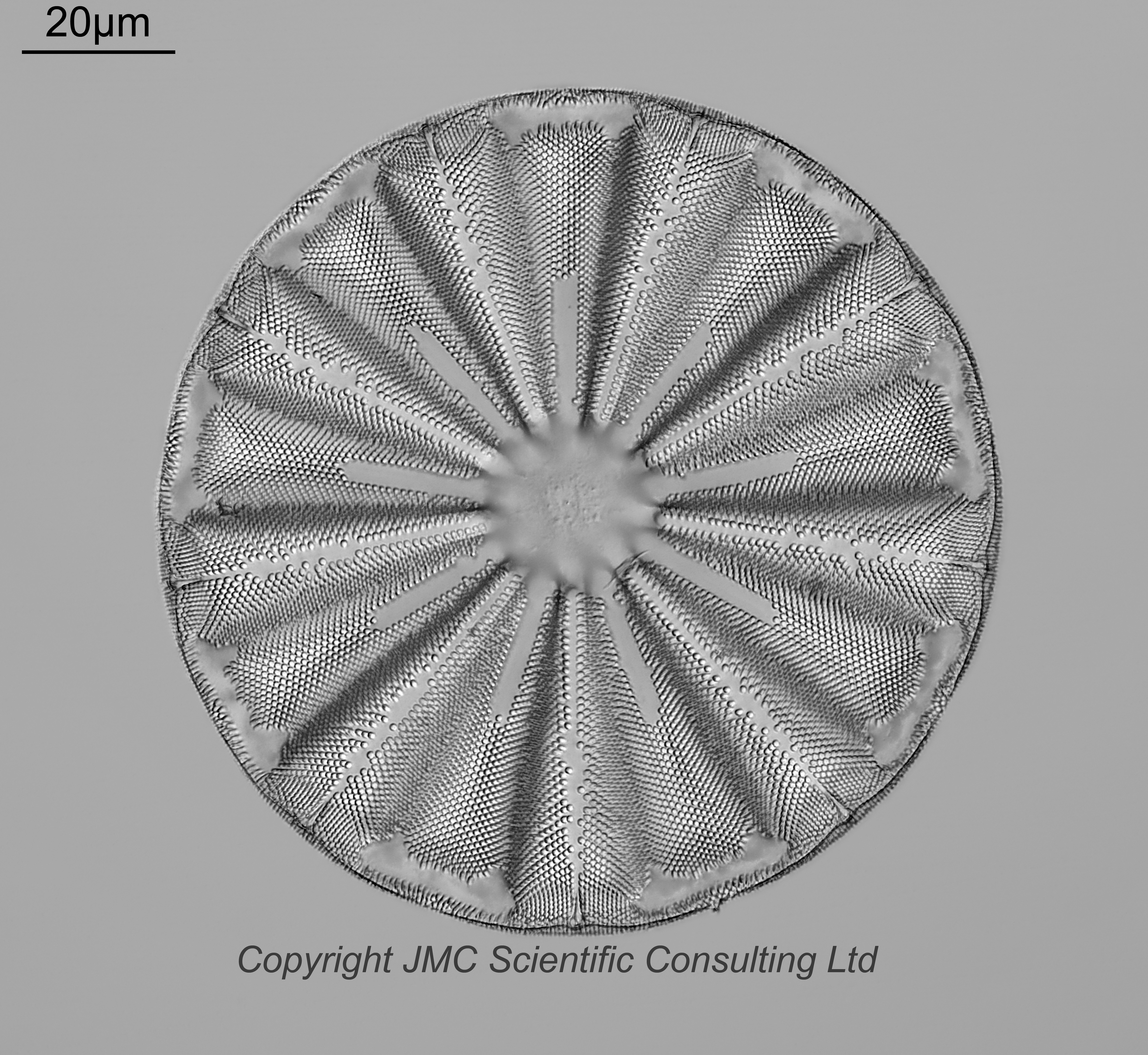
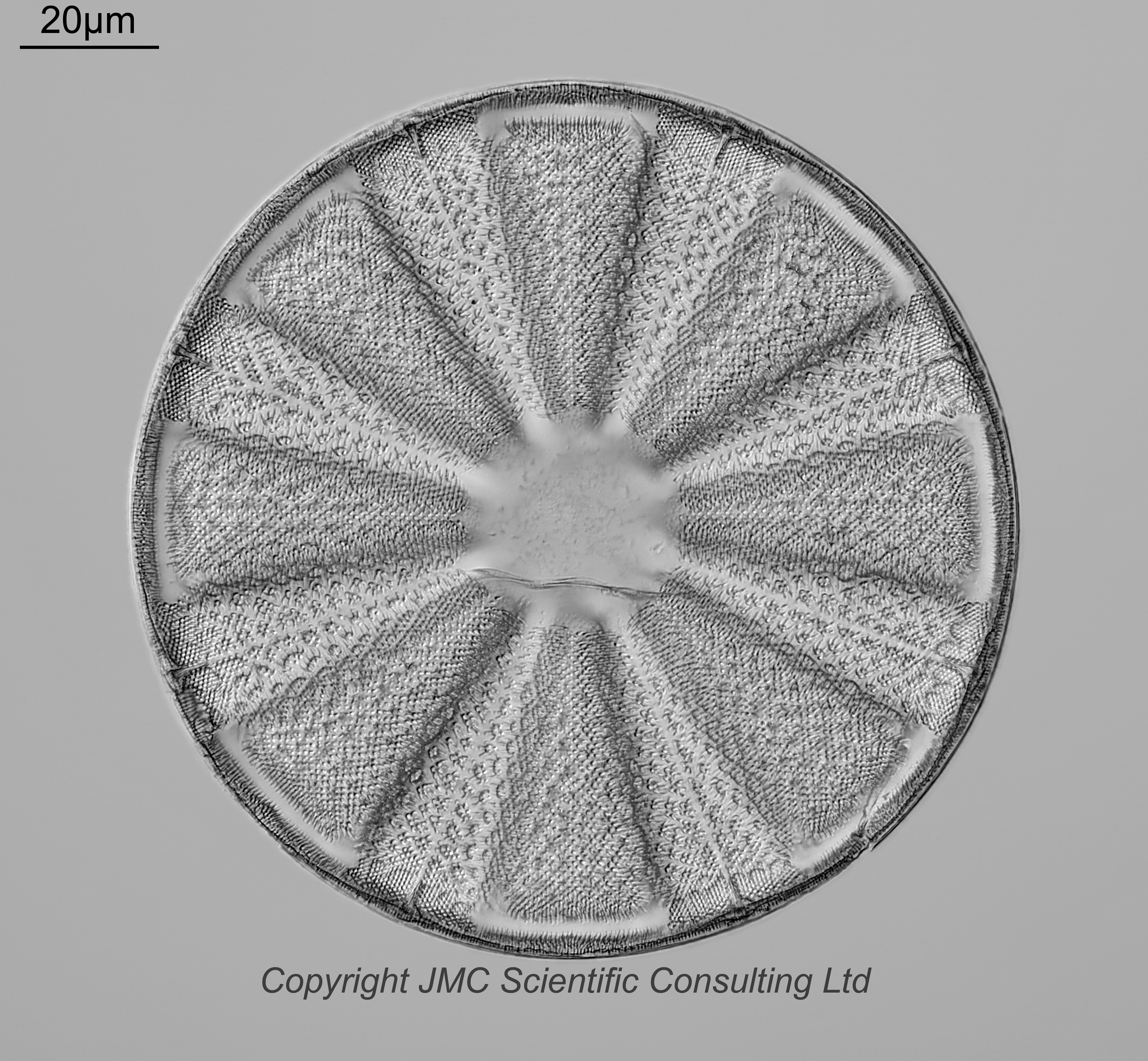
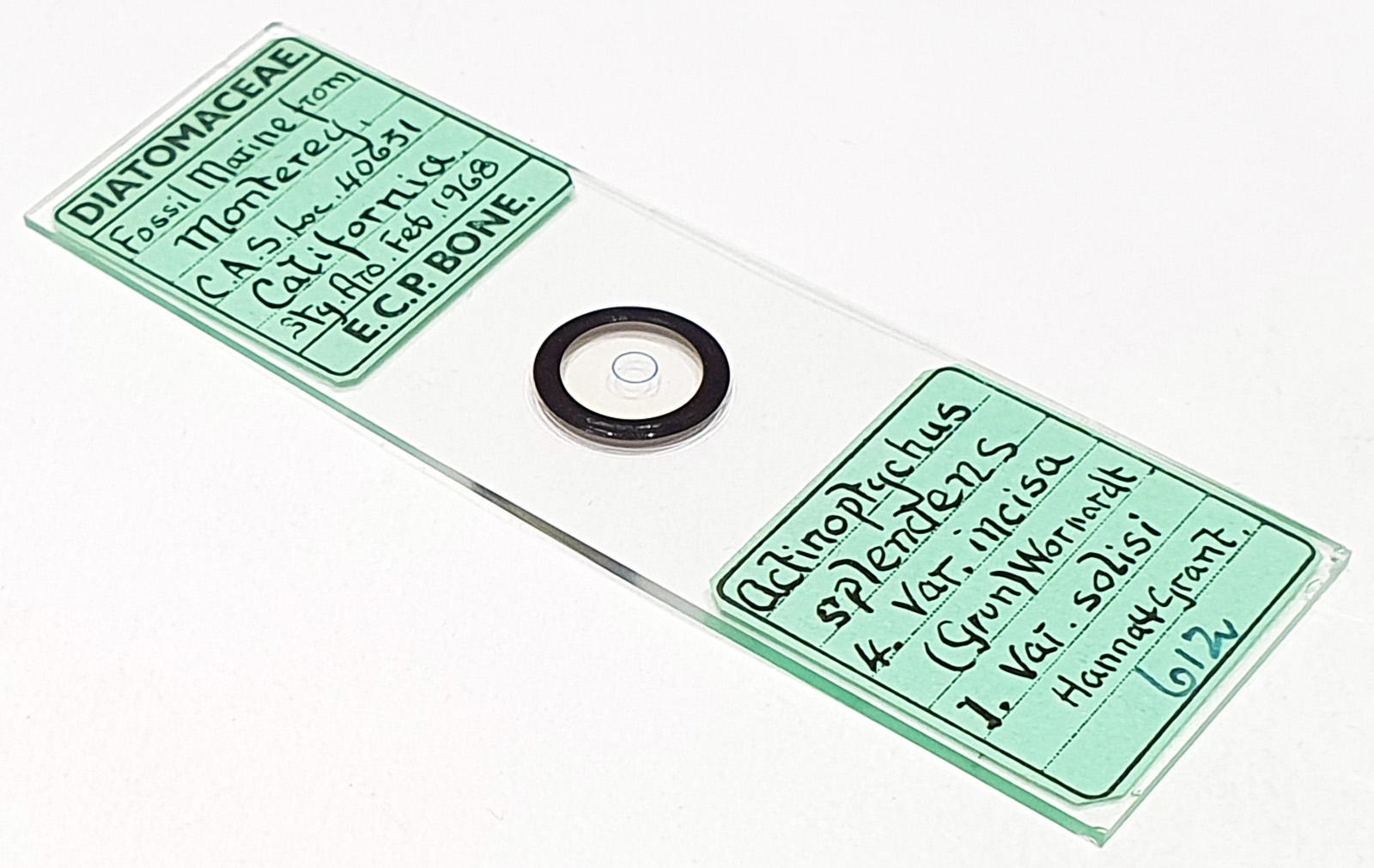
An arrangement of 5 Actinoptychus splendens diatoms from Monterey, California, USA. Four (presumably the smaller ones on either side of the central one) are var. incisa, and one (the middle one) var. solisi. Fossil marine material. Sty.Aro. (Styrax Aroclor) mountant, and dated February 1968. Prepared by ECP Bone. Olympus BHB microscope using 450nm LED light. I imaged the middle one, and the right hand side one with a 63x Leitz Pl Apo 1.4 objective, oil immersion. Olympus Aplanat Achromat condenser, oil immersion, oblique lighting. 2.5x Nikon CF PL photoeyepiece. Monochrome converted d850 camera. Images stacked in Zerene (Pmax).
Actinoptychus splendens var. incisa (Grunow) W.W.Wornardt. 40 images stacked. Wornardt, W.W., Jr. (1967). Miocene and Pliocene marine diatoms from California. Occasional Papers of the California Academy of Sciences, 63: 108 pp. Accepted name: Actinoptychus glabratus var. incisa Grunow in Van Heurck, 1883. Original description (of Actinoptychus glabratus var. incisa Grunow in Van Heurck, 1883): Van Heurck, H. (1880). Synopsis des Diatomées de Belgique. Atlas. Ducaju & Cie., Anvers. Plate 120, Figure 8.
Actinoptychus splendens var. solisi (Hanna & Grant) Wornardt, 1967. 38 images stacked. Miocene and Pliocene marine diatoms from California. Occasional Papers of the California Academy of Sciences, 63: 108 pp. Accepted name: Actinoptychus solisi Hanna & Grant, 1926. Original description (of Actinoptychus solisi Hanna & Grant, 1926): Hanna, G D. & Grant, W. G. (1926). Expedition to the Revillagigedo Islands, Mexico, in 1925, II. Miocene marine diatoms from Maria Madre Island, Mexico. Proceedings of the California Academy of Sciences, series 4, 15(2): 115-193. Page 123, Plate 12, Figures 1-3.