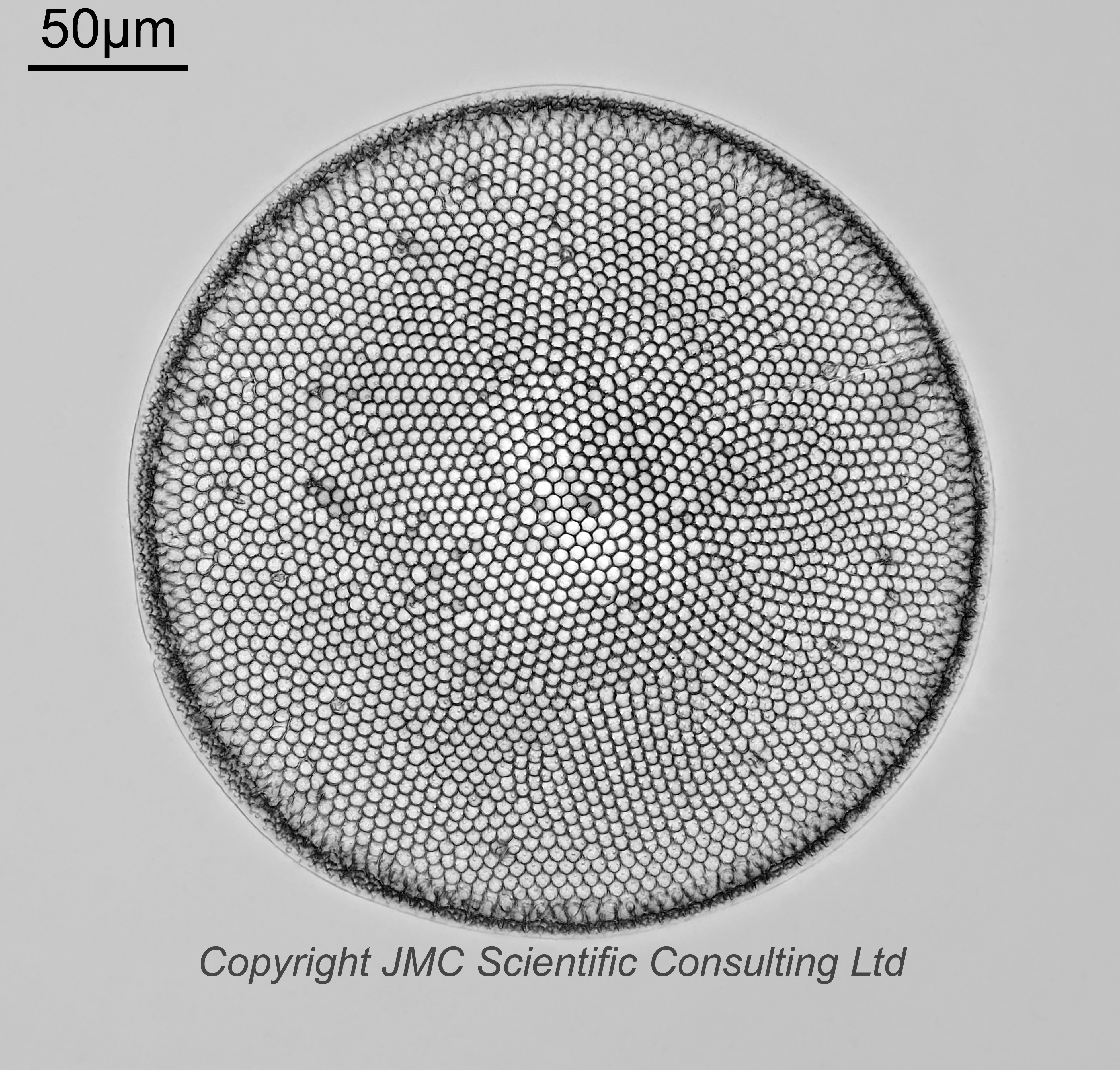
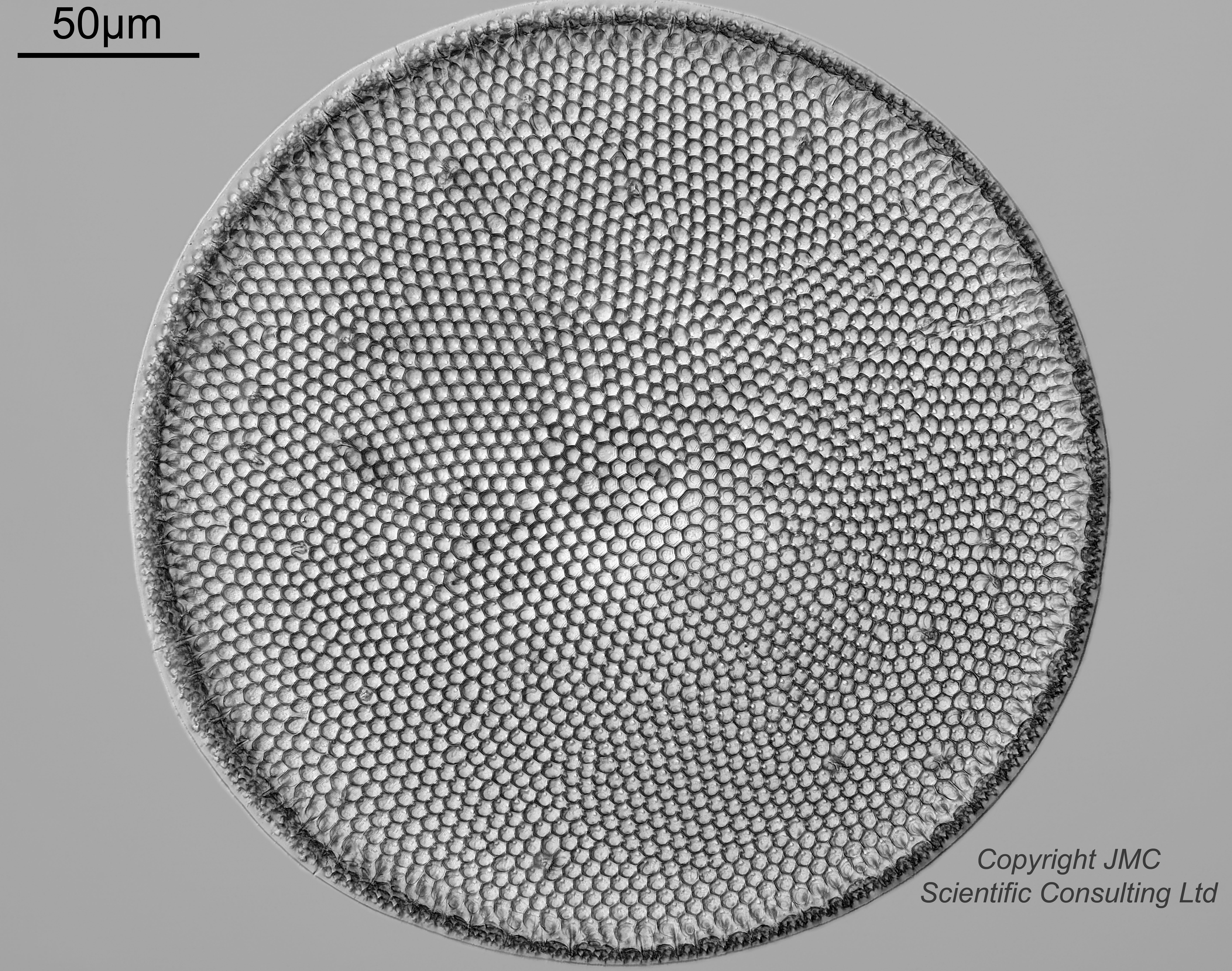
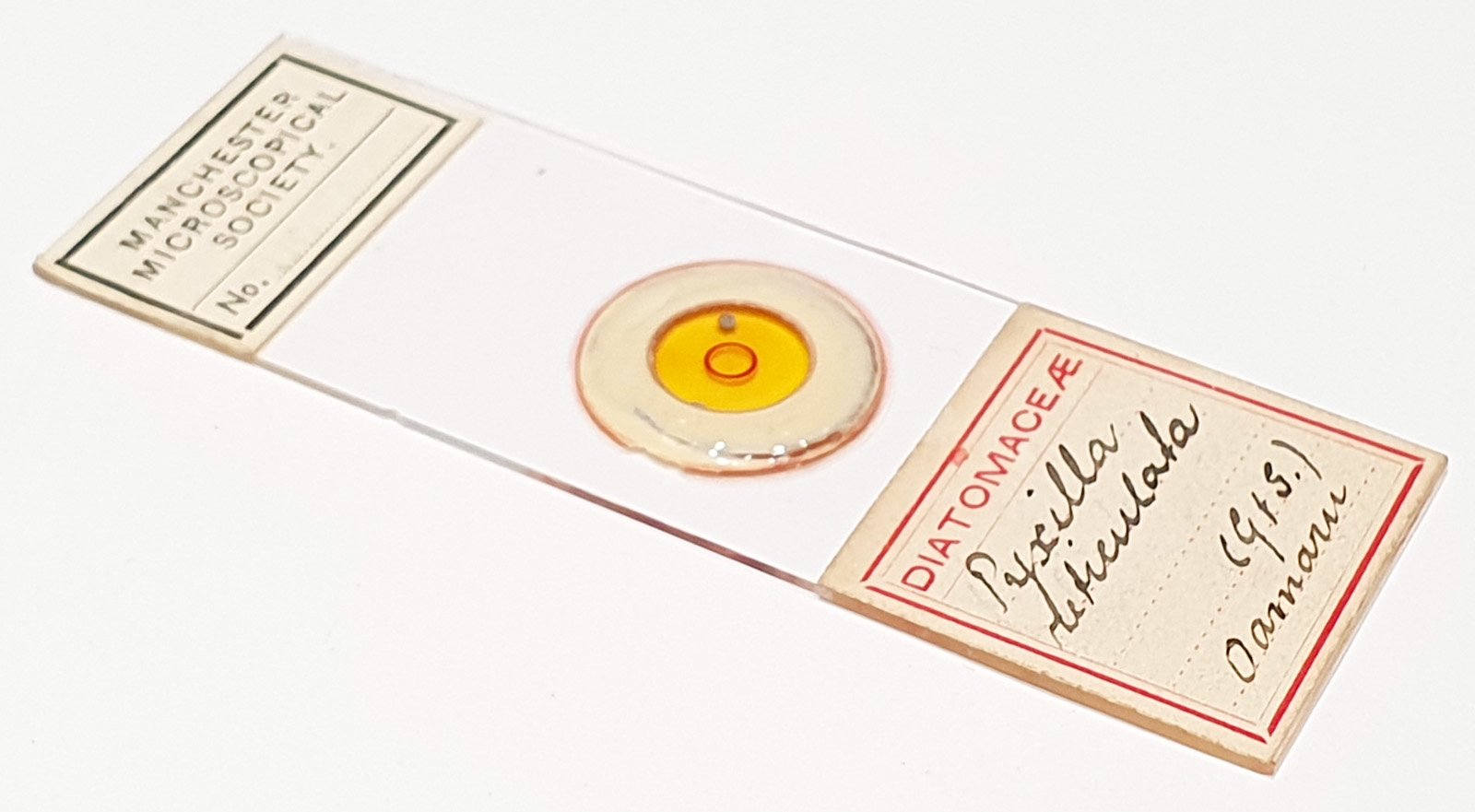
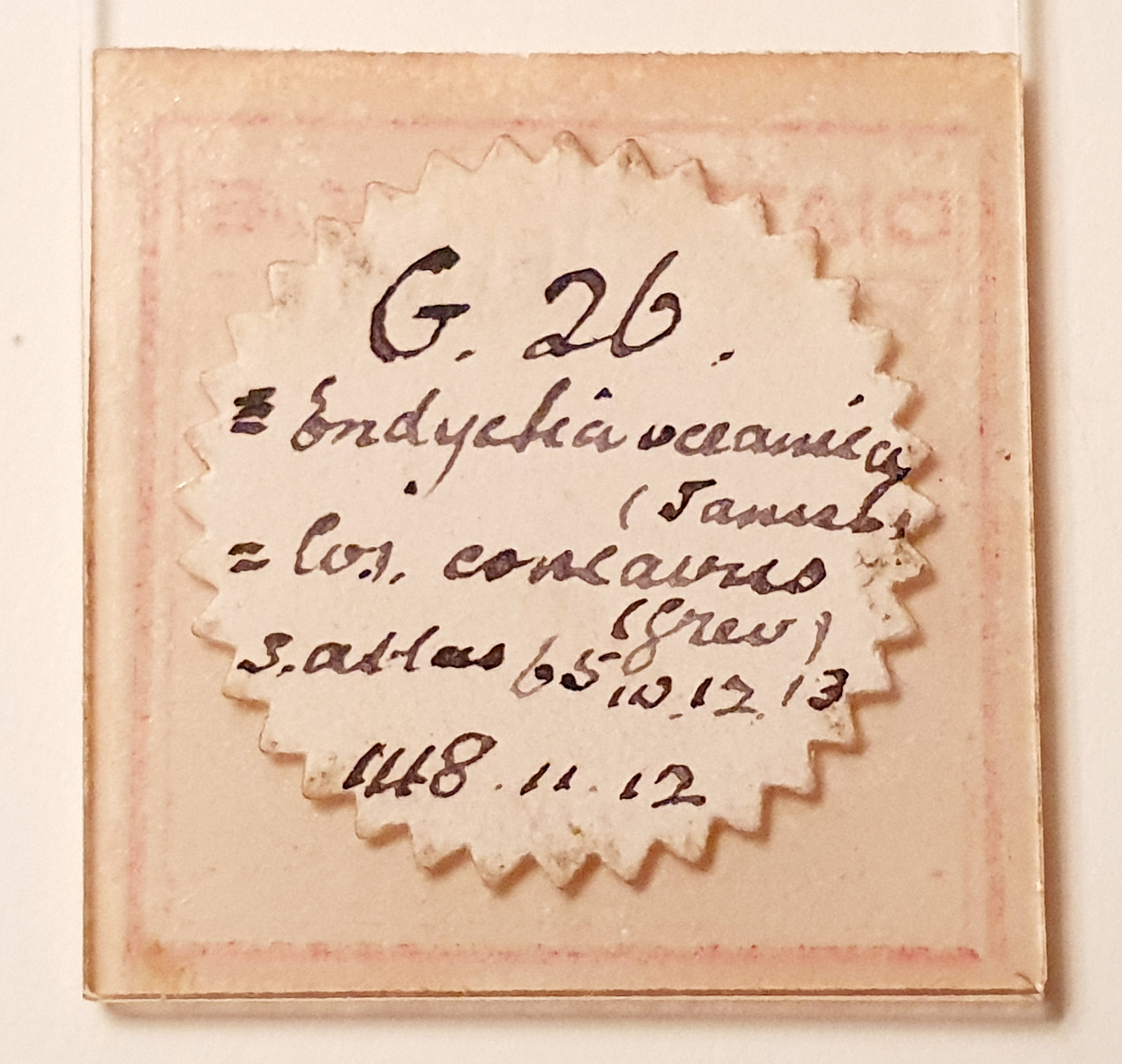
Bit of a mystery this one. It is labelled as Pyxilla reticulata from Oamaru, New Zealand. On the back is a label which says ‘Endictya oceanica‘ and ‘Coscinodiscus concavus‘ and gives a couple of references to Schmidt’s Atlas (Plate 65 Figures 10,12,13, and Plate 148 Figures 11,12). More on the name in a minute. Single example on the slide. Dome shaped. Very orange mountant. Prepared by the Manchester Microscopical Society. Olympus BHB microscope using 450nm LED light. As well as the image with a 20x objective, I did one using the 40x Leitz Pl Apo NA 1.00 objective, oil immersion. Olympus Aplanat Achromat condenser, oil immersion, oblique lighting. 2.5x Nikon CF PL photoeyepiece. 11mm removed from the tube to the camera to increase the field of view. Monochrome converted Nikon d850 camera. 107 images stacked in Zerene (Pmax). Couldn’t get close enough to use the 63x Leitz Pl Apo objective. Approximately 270µm diameter.
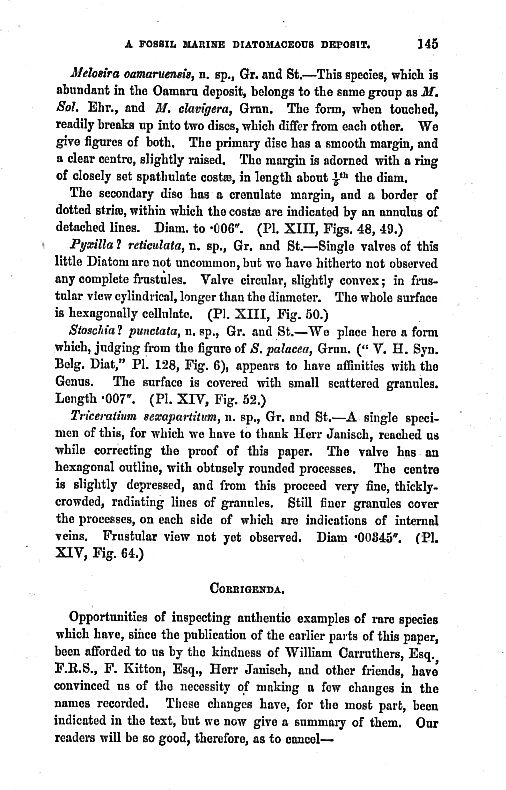
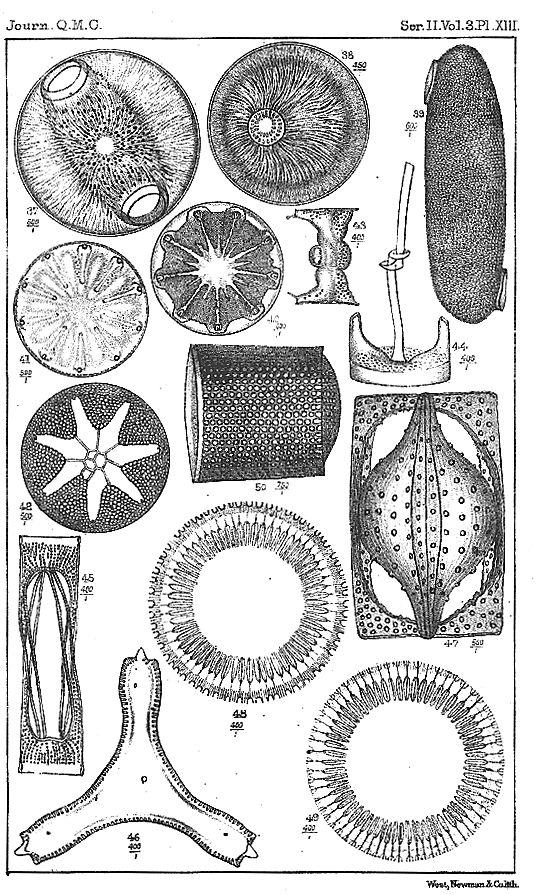
Back to the name. The label on the front says Pyxilla reticulata Grove & Sturt 1887. Published in: Grove, E. & Sturt, G. (1887). On a fossil marine diatomaceous deposit from Oamaru, Otago, New Zealand. Appendix. Journal of the Quekett Microscopical Club, Series 2 3(19): 131-148, pls 10-14. Page 145, Plate XIII [13], Figure 50. I’ve included screen shots from the Quekett Journal, which show the diatom in a side view. It does have a dome shaped end, but the one on the slide shows no evidence of the long tubular shape. I’m not convinced by this (even Grove and Sturt had questions, as there is a question mark after ‘Pyxilla‘ in their paper), nor am I by the ones on the label on the back. I think this could be a Stephanopyxis of some type. It is similar in appearance to Stephanopyxis valida (Grunow) M.Peragallo 1903. Published in: Peragallo, M. (1903). Le catalogue général des Diatomées. Vol. 2 pp. 472-973. Clermont-Ferrand. Page 854. However this would be 37.5-150µm diameter according to D&S Oamaru Diatoms book, and this one is much bigger. Overall I think it is similar in appearance but not the same, so for now am leaving it as Stephanopyxis sp. but with a question mark, and cannot completely rule out the ‘Pyxilla reticulata‘ name.