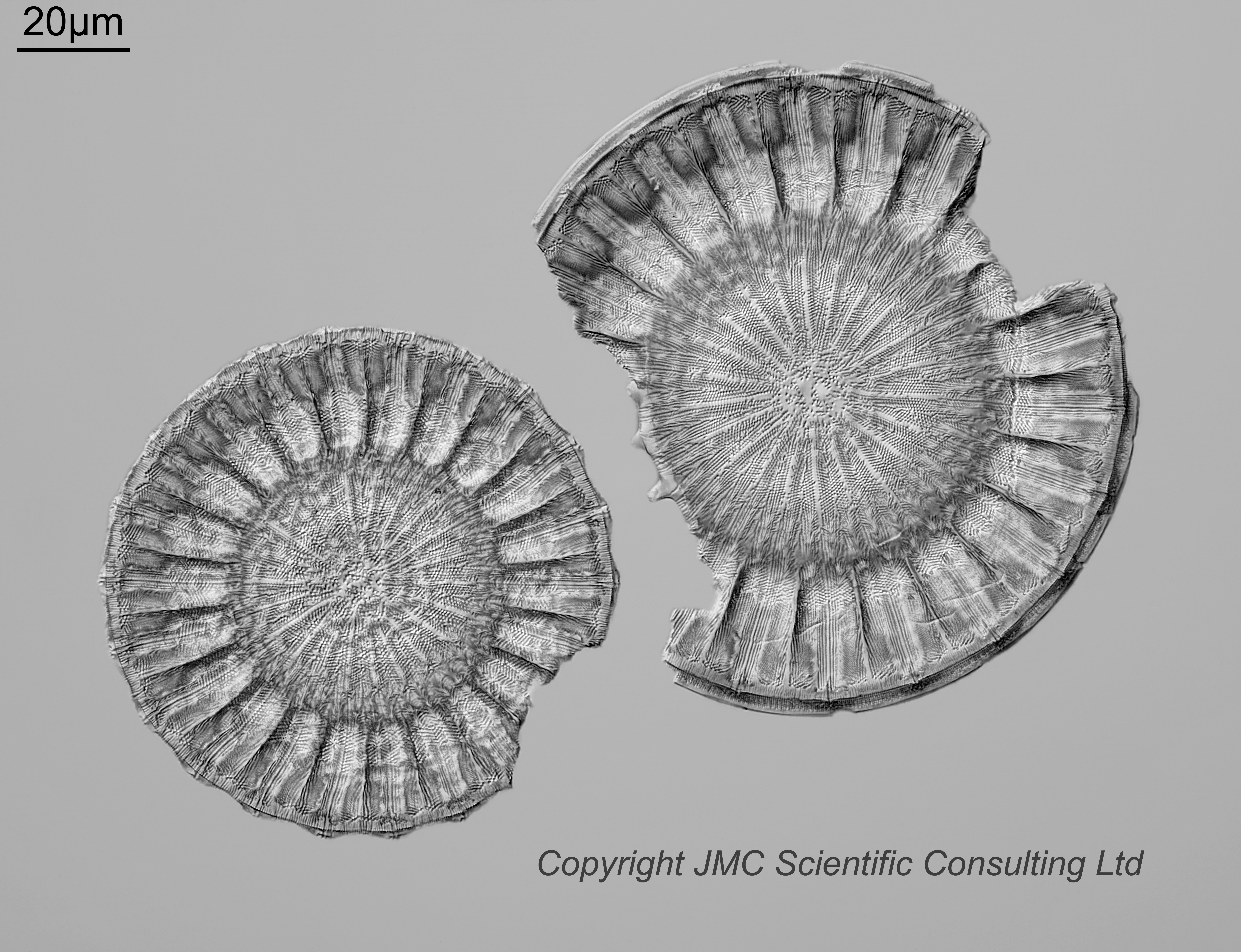
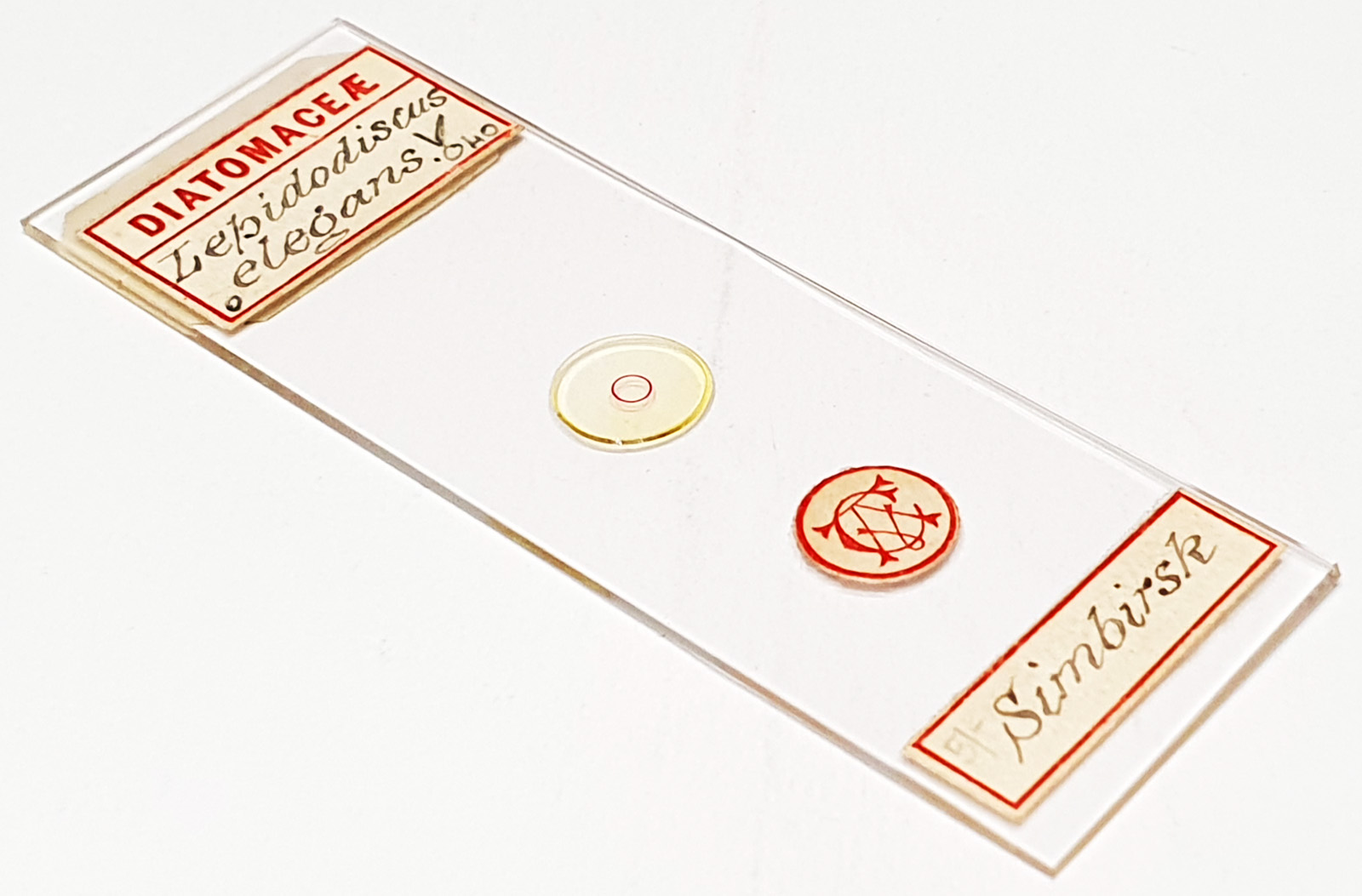
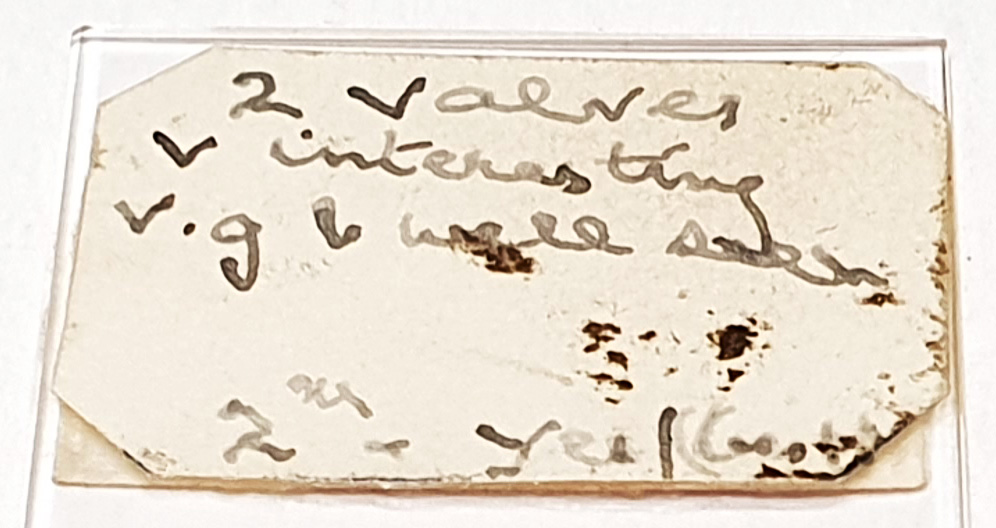
Two examples of Lepidodiscus elegans from Simbirsk, Russia. Both partial. Prepared by Arthur Cottam. Label on the rear of the slide says “2 valves. Very interesting, very good and well seen.”. Olympus BHB microscope using 450nm LED light. 63x Leitz Pl Apo 1.4 objective, oil immersion. Olympus Aplanat Achromat condenser, oil immersion, oblique lighting. 2.5x Nikon CF PL photoeyepiece. 11mm removed from the tube the camera to increase the field of view. Monochrome converted Nikon d850 camera. 66 images stacked in Zerene (Pmax).
Lepidodiscus elegans Witt 1886. Published in: Witt, O.N. (1886 ‘1885’). Ueber den Polierschiefer von Archangelsk-Kurojedowo im Gouv. Simbirsk. Verhandlungen der Russisch-kaiserlichen Mineralogischen Gesellschaft zu St. Petersburg, Series II 22: 137-177, pls. VI-XII. Page 163, Plate 7, Figure 6.
Description on Algaebase: Cells probably discoid, but only valves seen. A small genus of fossils (7 spp. according to VanLandingham, 1971), most occurring in Eocene sediments of marine origin. Valves circular, with concentric undulations of the valve face and in addition a ring of prominent alternating elevations and hollows around the circumference. The system of elevations and hollows is relatively slight in our material; other species have very pronounced external ridges and furrows (P.A. Sims, personal communication) and this results in very dissimilar sibling valves. Areolae in fascicles (striae) radiating from a central annulus, within which the areolae are randomly scattered; the fascicles increase in width towards the margins and then split up again in the undulate marginal region. The areolae are circular and appear to be simple passages through the massive framework of the valve. Valve mantle short and areolate; on a ridge between it and the valve face there appears to be a series of openings, each surrounded by paired flaps of silica; these are presumably the openings of the rimoportulae; a similar arrangement has been seen in several Actinoptychus species. Internally the valve surface is plain; the plain strips between the fascicles become ‘buttresses’ around the margin, connecting the valve face to the edge of the mantle. Within the depressions between the buttresses the rimoportulae can be seen, one per depression, their apertures orientated radially. Copulae unknown.