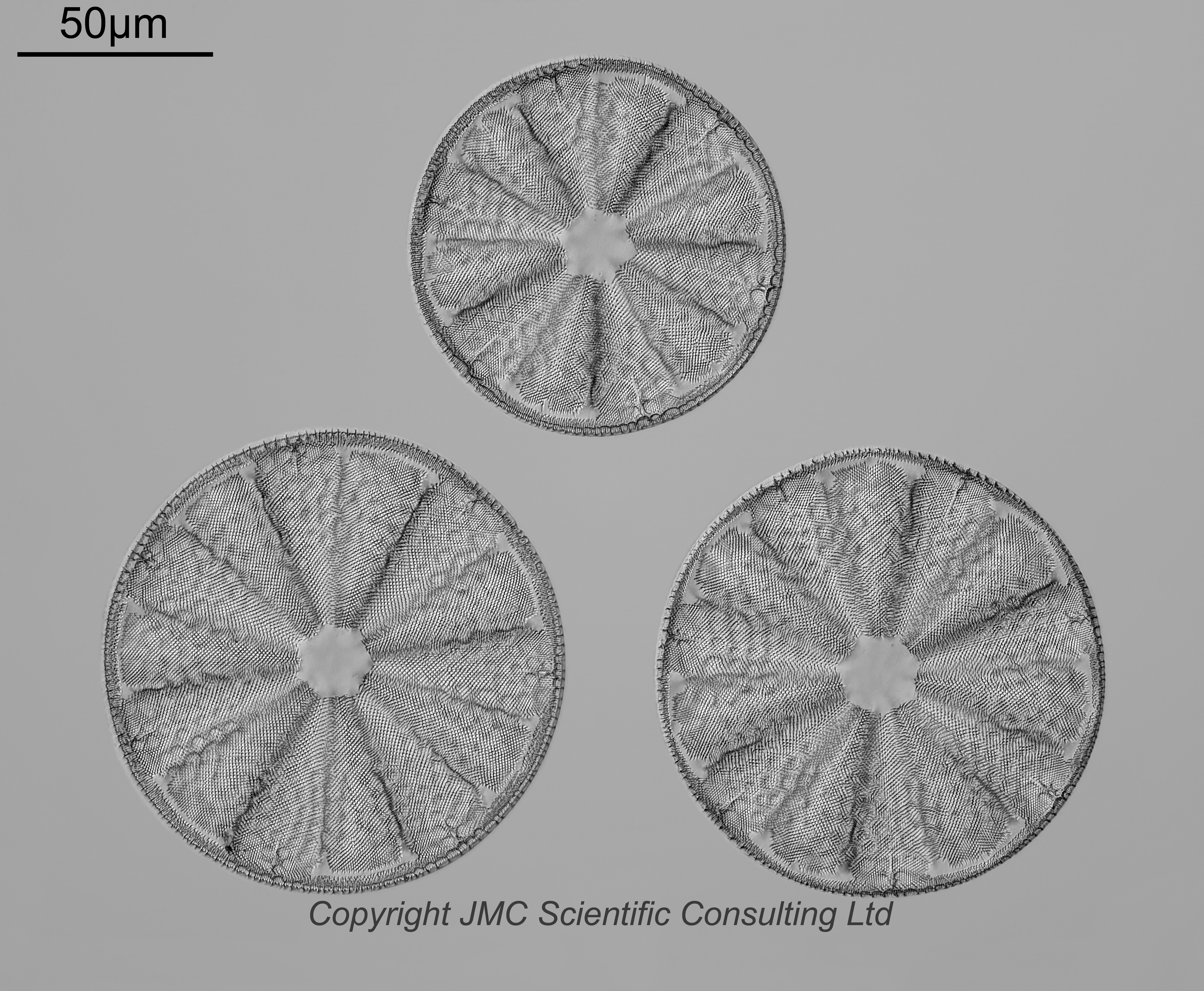
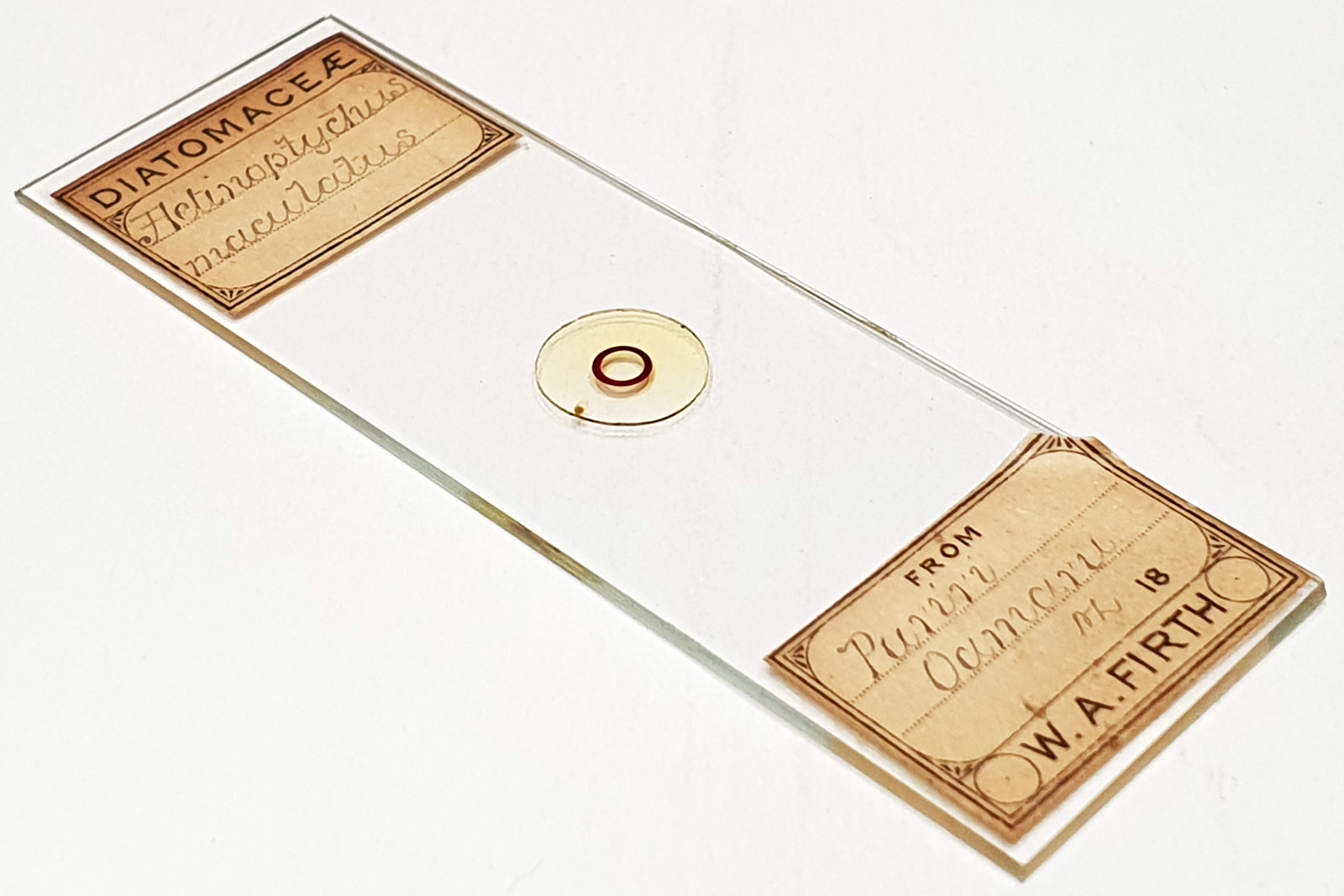
An arrangement of three Actinoptychus maculatus from Puriri, Oamaru, New Zealand (more on this in a minute). Prepared by William Allott Firth. Olympus BHB microscope using 450nm LED light. 40x Leitz Pl Apo NA 1.00 objective, oil immersion. Olympus Aplanat Achromat condenser, oil immersion, oblique lighting. 2.5x Nikon CF PL photoeyepiece. Monochrome converted Nikon d850 camera. 54 images stacked in Zerene (Pmax).
Actinoptychus maculatus A.W.F.Schmidt 1888. Published in: Schmidt, A.[W.F.] (1888). Atlas der Diatomaceen-kunde. Series III: Heft 33-34 [“Heft 29-30”]. pp. pls 129-136. Aschersleben: Verlag von Ludwig Siever. Plate 132, Figures 18-20.
Back to the location. This is written as Puriri, Oamaru. Where is this? A search online shows that the pūriri is a massive, evergreen tree native to New Zealand that is famous for its extremely hard wood. ‘Puriri’ as a place is not a named site for Oamaru. From Google AI; “The Puriri Formation is a sequence of Lower Miocene (Waitakian to Otaian) deep-water, calcareous mudstone, siltstone, and sandstone found in the Kaipara Harbour area of Northland, New Zealand. It is noted for containing large amounts of fresh andesitic material derived from active nearby volcanism. Diatoms (fossilized single-celled, glass-shelled algae) in the Puriri Formation are characteristically poorly preserved due to dissolution, and as a result, they are typically rare and of limited biostratigraphic value in this specific deposit.”. So probably not from this place, and this isn’t Oamaru anyway. Firth has named locations in Oamaru before, but this is the first time I have seen this name written down. So, not sure….