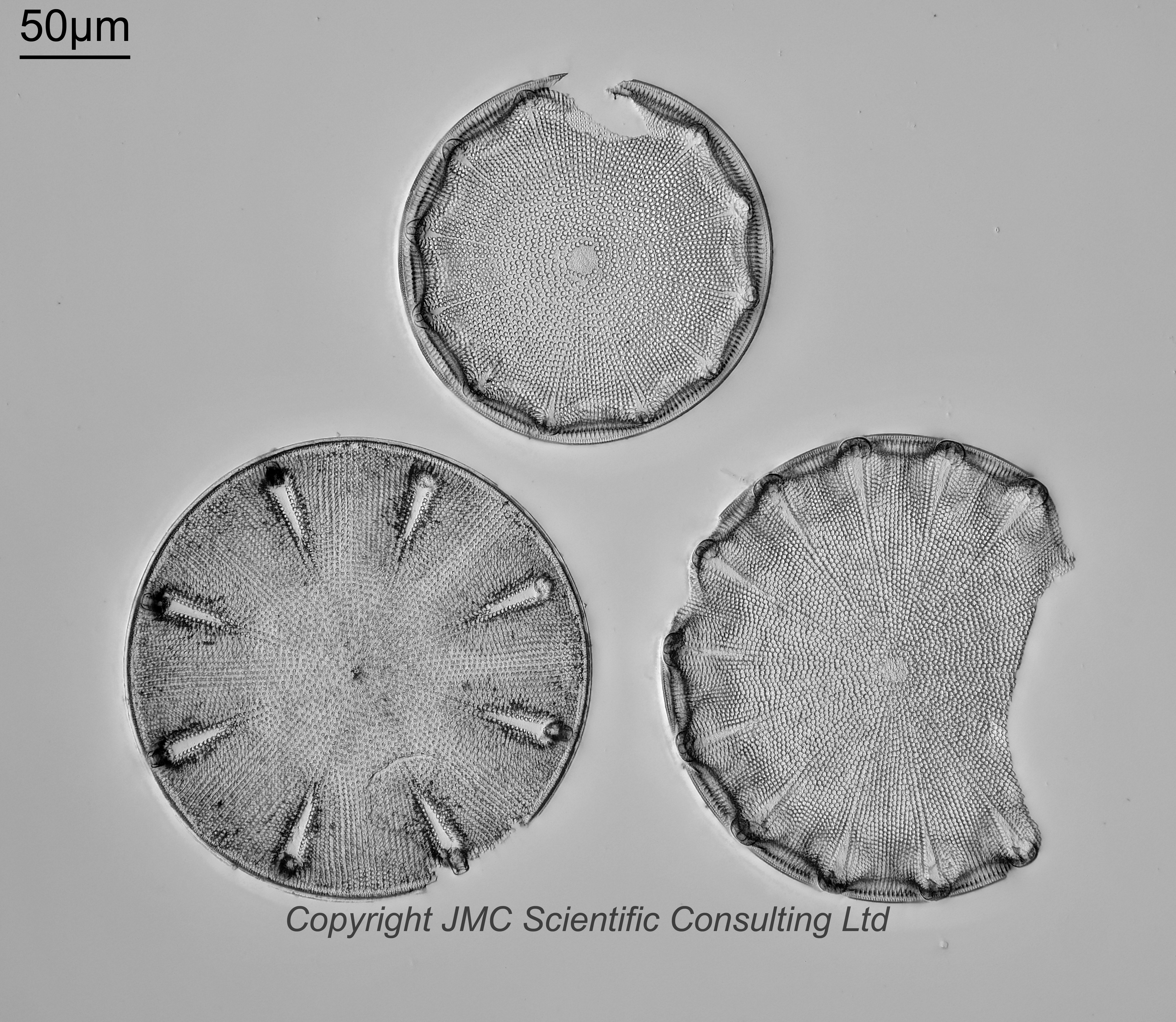
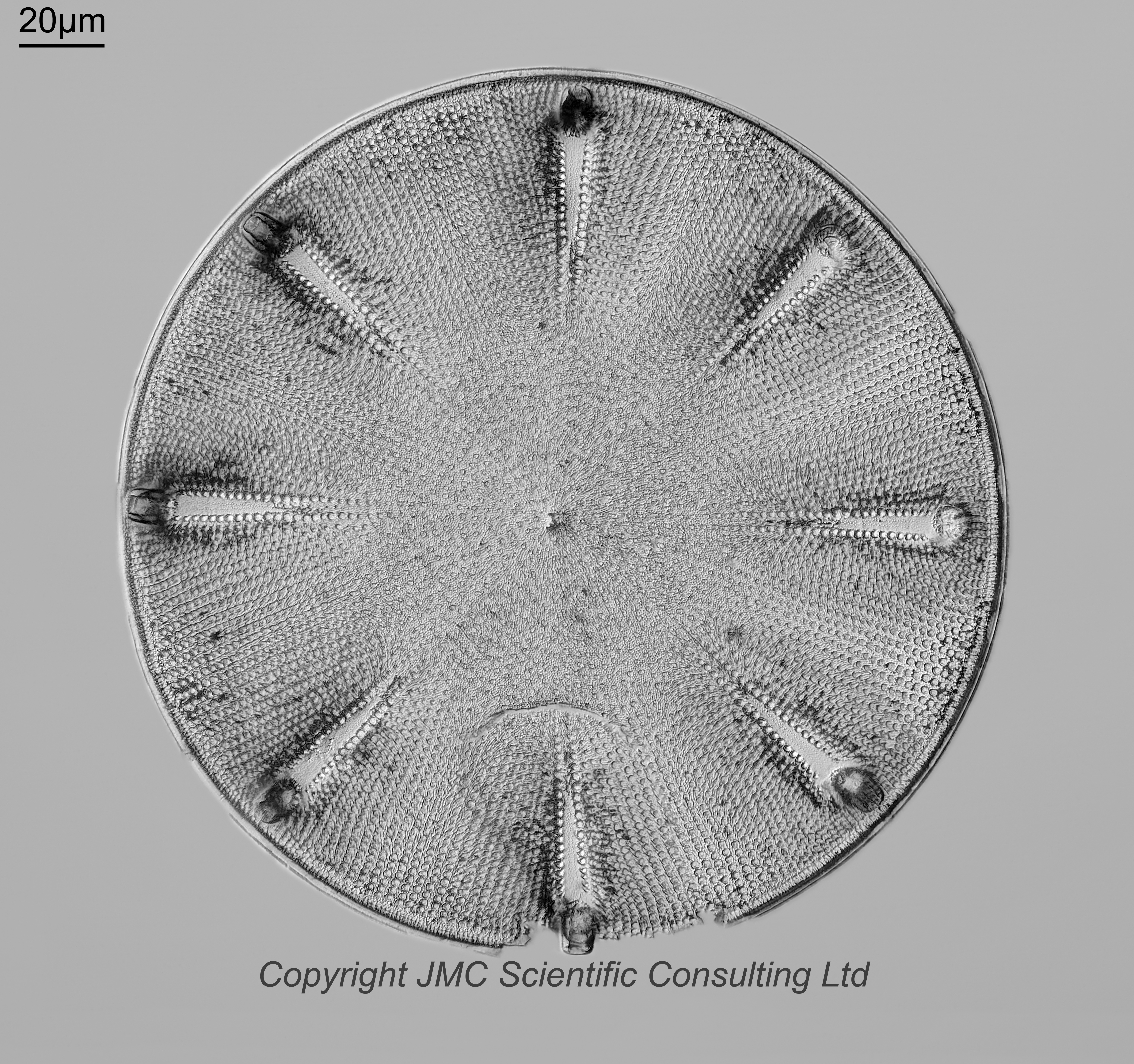
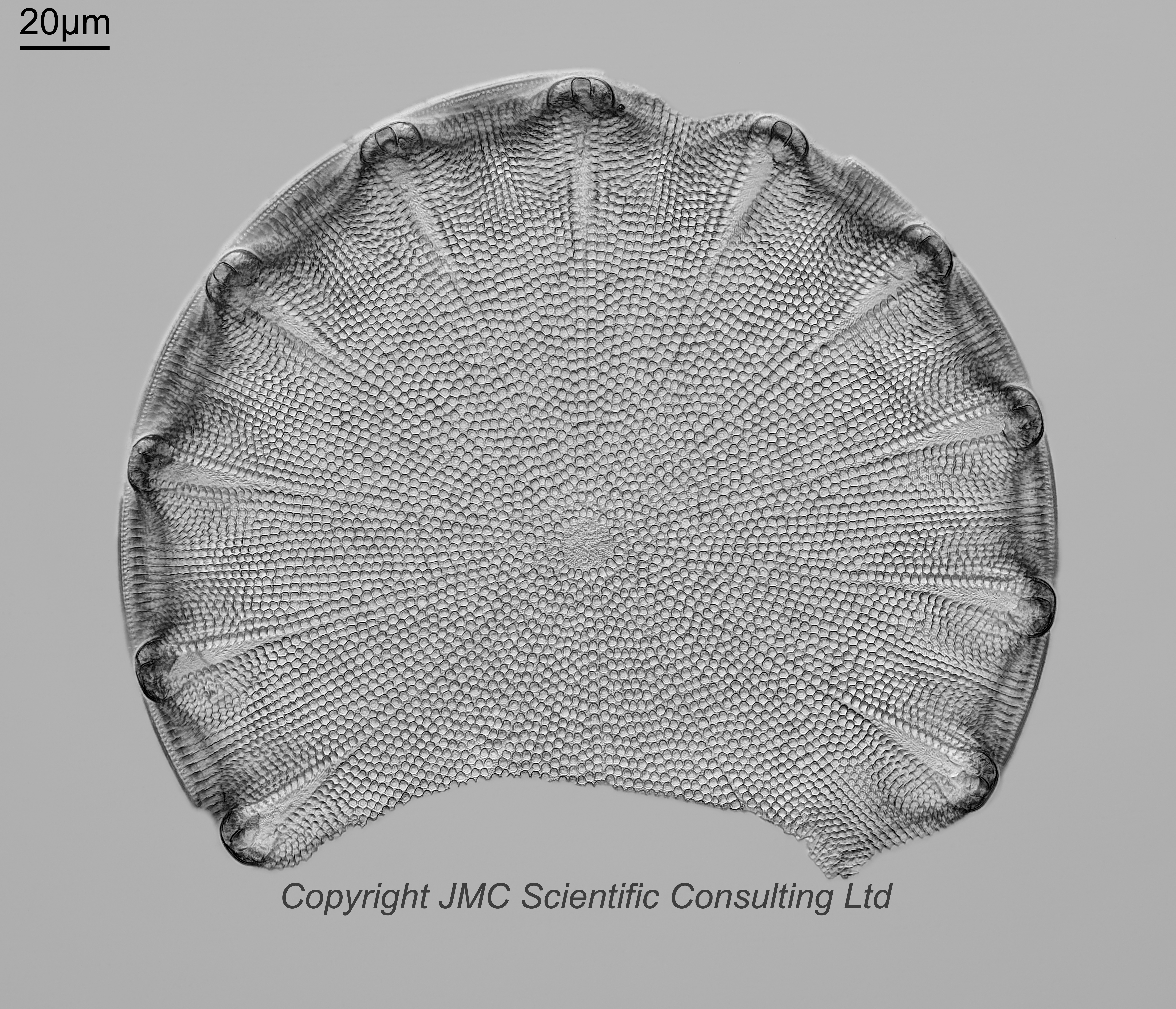
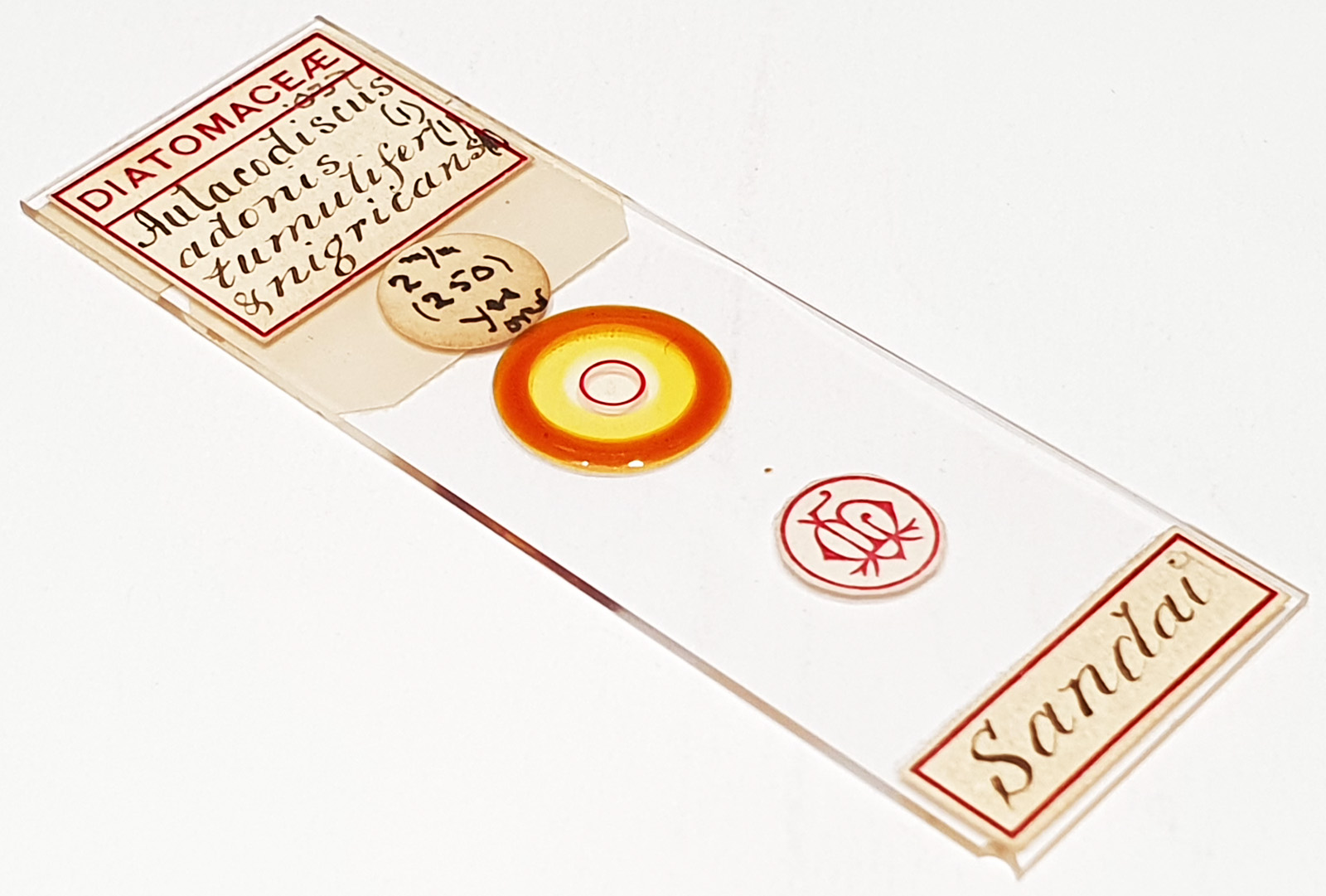

Slide labelled as Aulacodiscus adonis, tumulifer, nigricans from Sendai (written as Sandai on the label), Japan. Prepared by Laurence Miles. Olympus BHB microscope using 450nm LED light. For the arrangement I used the 20x Nikon Plan Apo NA 0.65 objective. Olympus Aplanat Achromat condenser, oblique lighting. 2.5x Nikon CF PL photoeyepiece. Monochrome converted Nikon d850 camera. 41 images stacked in Zerene (Pmax). On the back of the slide there is a label which says “1 valve shows an excellent “(can’t read this)” fracture”.
As well as the arrangement I imaged two of them using the 40x Leitz Pl Apo NA 1.00, oil immersion. Olympus Aplanat Achromat condenser, oil immersion, oblique lighting. 2.5x Nikon CF PL photoeyepiece. Monochrome converted Nikon d850 camera. Image stacks prepared in Zerene (Pmax).
So, what are these? The partial one at the top is I think A. tumulifer. The lower left one could be A. nigricans, and lower right one A. adonis.
Aulacodiscus tumulifer Brun 1891. Published in: Schmidt, A. et al. (1874-1959). Atlas der Diatomaceen-kunde. Leipzig: Aschersleben. Plate 162, Figure 3. Nomen. Homotypic synonym: Tripodiscus tumulifer (Brun) Kuntze 1898. Looks to be a pretty good match.
Aulacodiscus nigricans Tempère & Brun 1889. Published in: Brun, J. & Tempère, J. (1889). Diatomées fossiles du Japon. Espèces marines et nouvelles des calcaires argileux de Sendaï et de Yedo. Mémoires de la Société de Physique et d’Histoire Naturelle de Genève 30(9): 1-75, pls 1-9. Page 20, Plate 4, Figure 1. To me this also looks a bit like Aulacodiscus multispadix, Page 20, Plate 3, Figure 11.
Aulacodiscus adonis Tempère & Brun in Brun & Tempère, 1889. Original description: Brun, J. & Tempère, J. (1889). Diatomées Fossiles du Japon. Espèces marines et nouvelles des calcaires argileux de Sendaï et de Yedo. Mémoires de la Société de Physique et d’Histoire Naturelle de Genève, 30(9): 75 pp., 9 pls. Page 18, Plate 3, Figure 10.
Here’s the translations for A. nigricans (and A. multispadix) and A. adonis from Brun & Tempère, 1889.
“A. nigricans
Diameter 100 to 135µm. Valve flat to half its radius, then sloping gently and evenly to the rim. The grooves (region near the tubuli) and the bases of the tubuli are very prominent, flanked by outwardly directed pinnate striae. Striae widely spaced, 3 per 10 µm, radiating almost to the center; distinct, widely spaced pearls. A few larger and taller pearls are visible in the flat area. Tubuli robust, sometimes blackish, truncated. A line of closely spaced pits borders the entire inner edge. The interlinear surface of the valve is not smooth, but covered with very fine granulation, giving it a matte appearance. Tawny silica, except for the region of the tubercles, which is usually a darker shade and sometimes even blackish.
Sendai limestone.
This species belongs to section 3 radiati of Battray [Rattray?] (Revision of Aul.) and is placed alongside Grev.’s spectabilis (1863. T. M.S. 5. 16), whose tubercles extend beyond the periphery and whose grooves are bordered with pinnate striae to the center; resulting in a very different overall appearance. This Japanese species occupies a middle ground between spectabilis and our aforementioned var. japonica of angulatus.”
“A. multispadix rare
Its diameter reaches up to 280µm. Flat surface sloping downwards towards the edges, between the tubules. The rays to the base of the tubules are at the same level as the center. Striation in radiating lines, widely spaced (3 to 4 per 10 µm), widening into spadixes towards the tubules. These, numbering 8 to 12, are elevated and capitulate. Outer margin of the valve very finely striated. Thin, fragile silica; yellowish, pale in appearance.
Limestone from Sendai and Yedo.
Note: Cannot belong to Aul. decorus as drawn by Greville (1864. T. M. S. 10. 2), but is similar to the unnamed species 105, 8 in the Schmidt Atlas, and called decorus by Rattray (Revis. Aul., page 345). In summary, this species of Japanese limestones is midway between the aforementioned type and Aul. Janischii Gr. and St. (Oamarn. 11. 28) and (A. S. 133. 2).”
“A. adonis (very rare)
Diameter 170 to 210µm. Median surface almost flat, sloping down between the tubules. Radial striations initially, then towards the middle of their course, the rays converge to form a channel. Round, distinct, widely spaced beads, 4 by 10 µm in the center, 7 towards the edges. Tubule rays prominent towards their last third where they form a hyaline, intraconical plateau, bordered by pinnate striations. The tubules themselves are broad and short; often deciduous[?] (as in the illustrated specimen). From their base to the circumference, the valve slopes sharply downward. Thick, robust silica, light in appearance as in Aul. margaritaceus.
Sendai limestone.
Note: As related species to this fine type, we will mention: Aul. spectabilis Grev. (1863. T. M. S. 5. 16) for the pruinose appearance of the rays towards the tubuli; Umbonatus Grev. (1864. T. M. S. 1. 2) for the conical appearance of the hyaline flat at the base of the tubuli and rotulus Ratt. (Revis. of Aulacod.); but neither his drawing 5. 10, nor his description page 348, can entirely coincide with this species.”
For the lower left one, it looks like A. nigricans, but is much larger (208µm diameter) than the description in Brun & Tempère. The size makes it more like A. multispadix, and the image does look similar. But then it looks like the image for A. nigricans as well, and I will leave it as labelled for now.