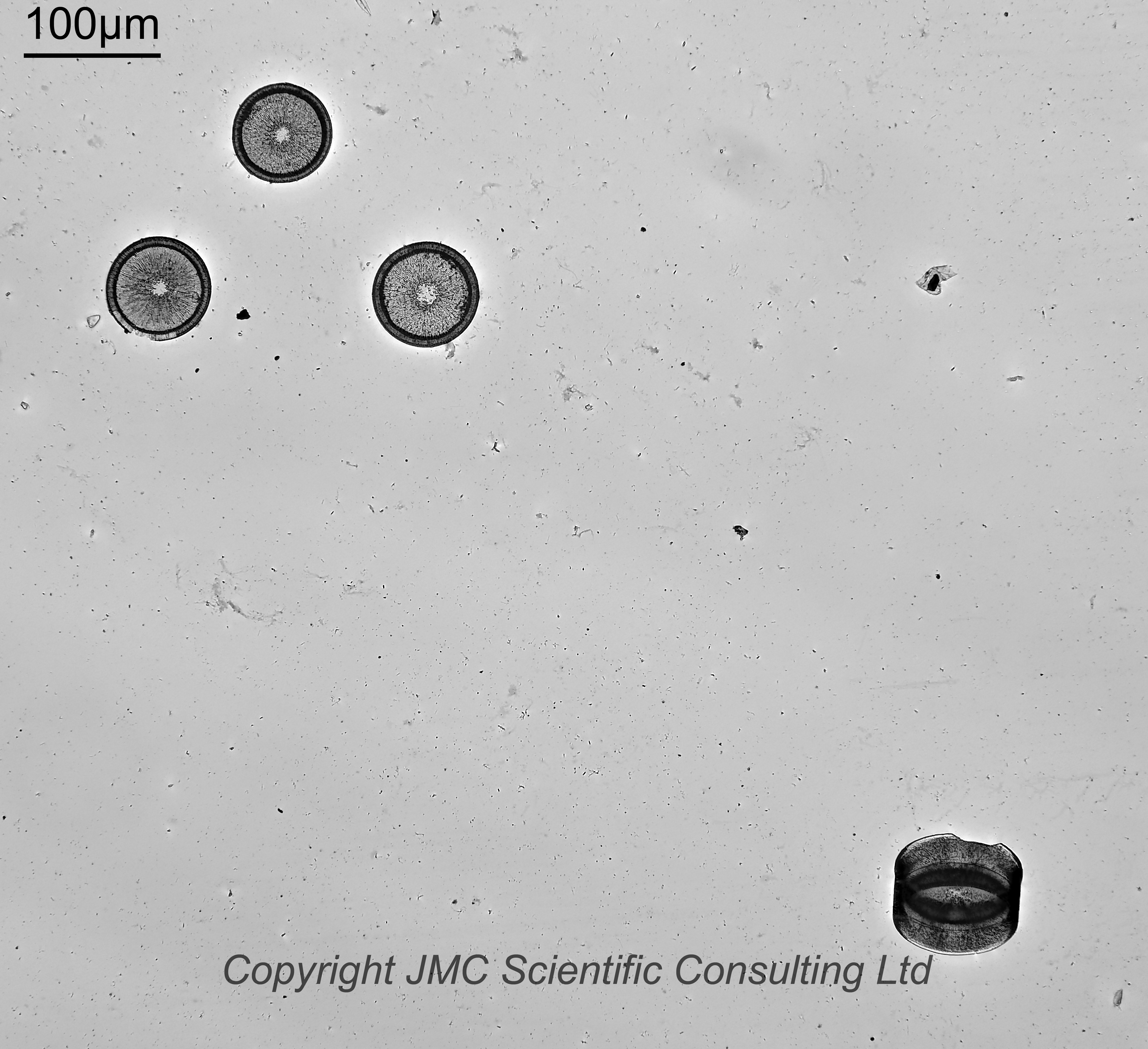
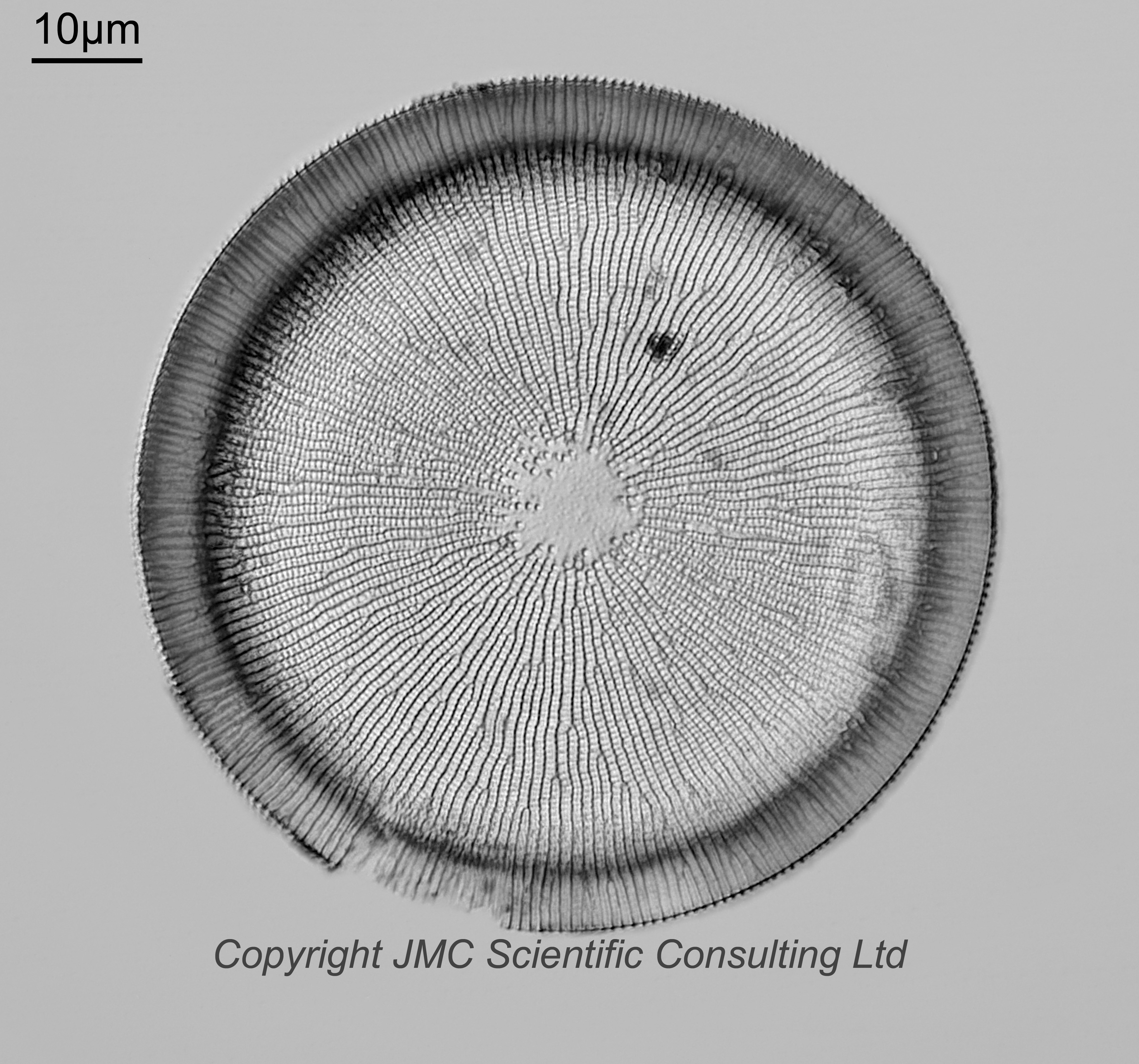
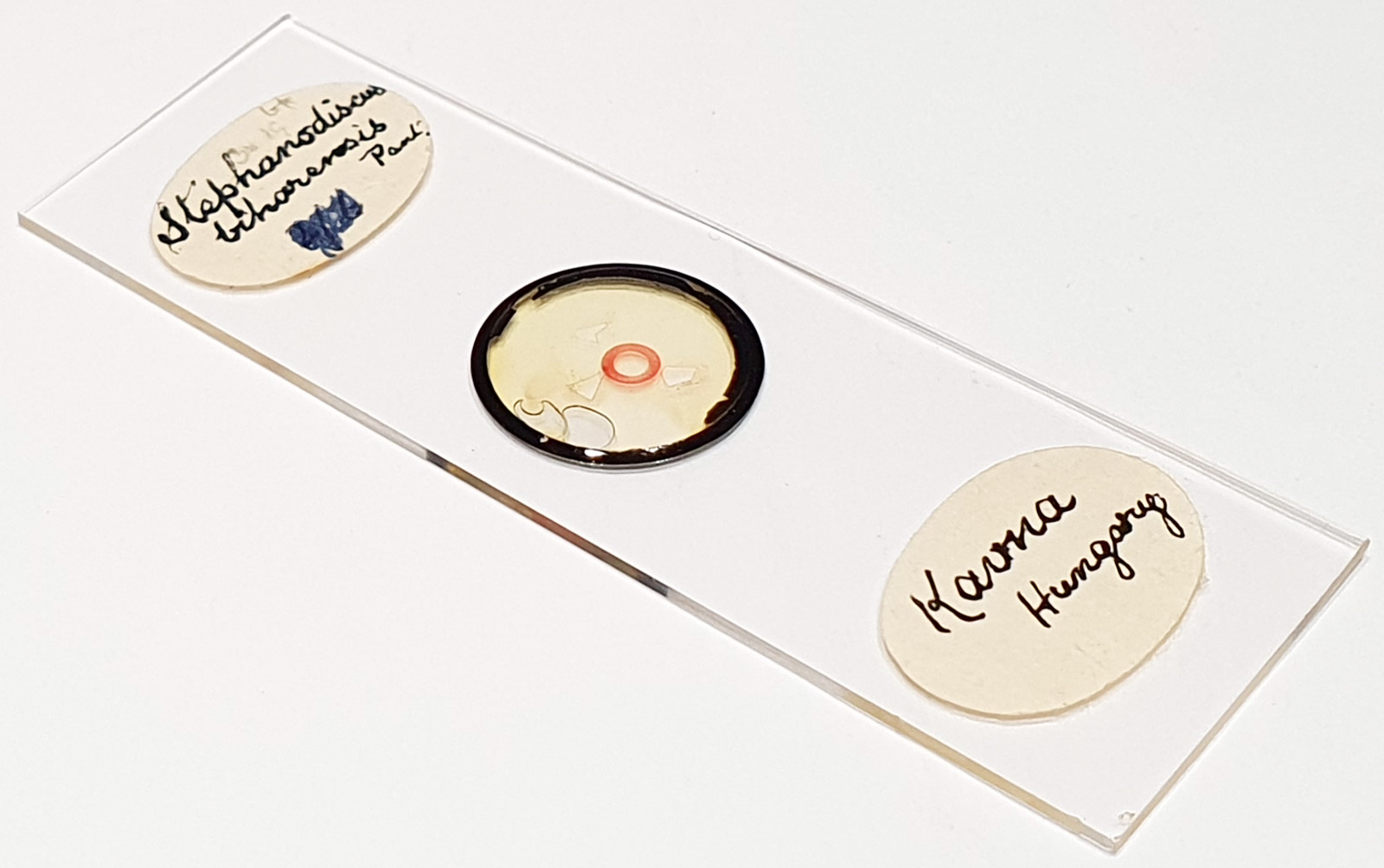
An arrangement of four Stephanodiscus biharensis from Kavna, Hungary. One has presumably moved from its original location and is present on an angle. Three spacers under the coverslip (they look like pieces of coverslip). Prepared by JA Long. Olympus BHB microscope using 450nm LED light. In addition to the arrangement, I imaged the left one with a 63x Leitz Pl Apo 1.4 objective, oil immersion. Olympus Aplanat Achromat condenser, oil immersion, oblique lighting. 2.5x Nikon CF PL photoeyepiece. Monochrome converted Nikon d850. 32 images stacked in Zerene (Pmax). I chose this one to image, despite the damage to it, as it was closest to the coverslip (lowest amount of spherical aberrations).
As for the location. Kavna, Hungary. “Kavna and the Cekeháza in Tokajhegyalja”. Tokaj-Hegyalja is located in northeastern Hungary and southeastern Slovakia. From Hajós , M. 1968. Mátraalja Miocén Üledékeinek Diatomái [Die diatomeen der Miozänen Ablagerungen des Mátravorlandes]. Geologica Hungarica, Series Paleontologica, Institutum Geologicum Hungaricum, Budapestini 37:1-401. Page 8
Stephanodiscus biharensis Pantocsek 1889. Published in: Pantocsek, J. (1889). Beiträge zur Kenntnis der Fossilen Bacillarien Ungarns. Brackwasser Bacillarien. Anhang: Analyse der marinen Depôts von Bory, Bremia, Nagy-Kürtös in Ungarn; Ananino und Kusnetzk in Russland. Vol. 2 pp. [1]-123 , 30 pls. Nagytapolcsány: Julius Platzko. Page 114, Plate 13, Figure 229.