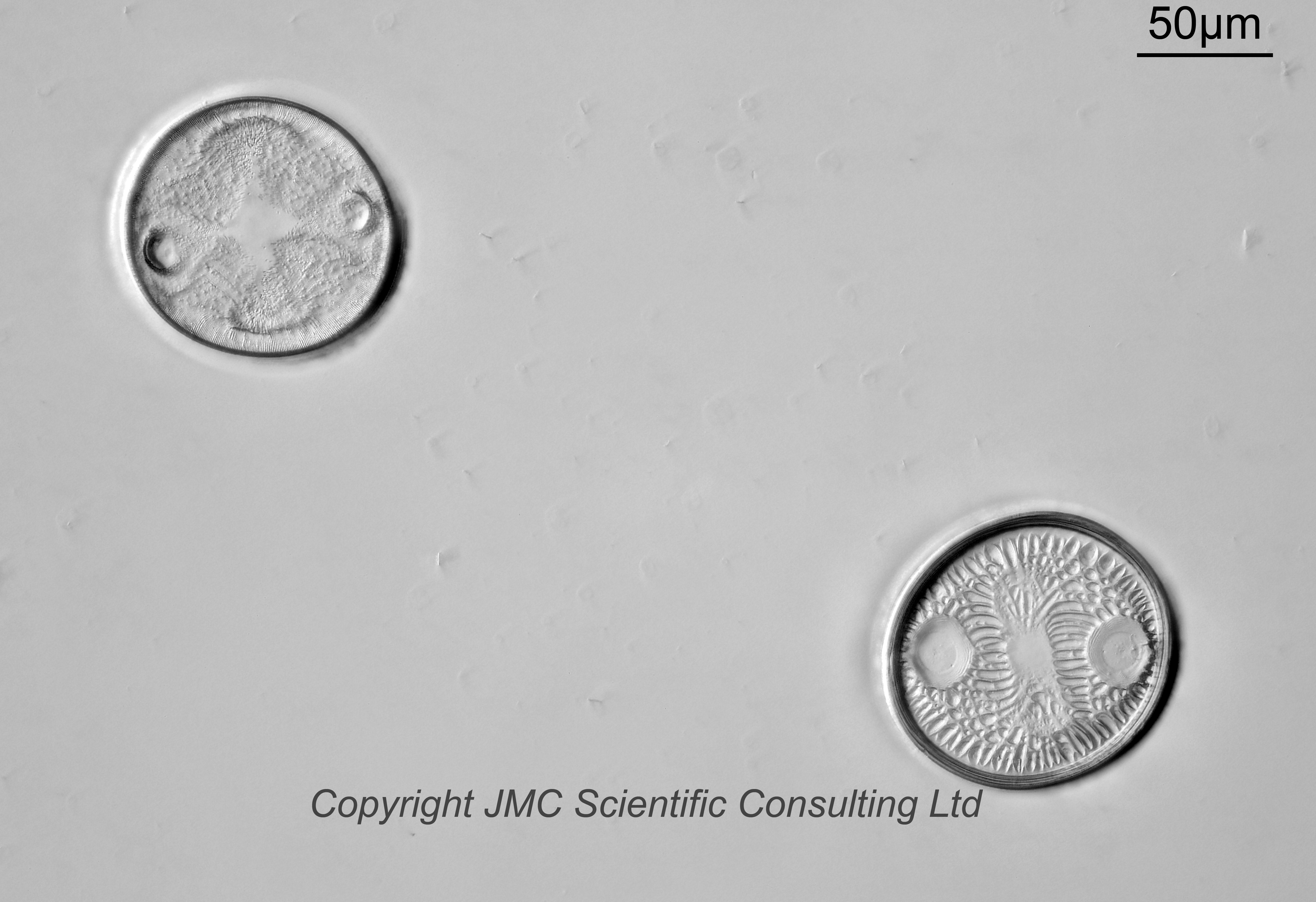
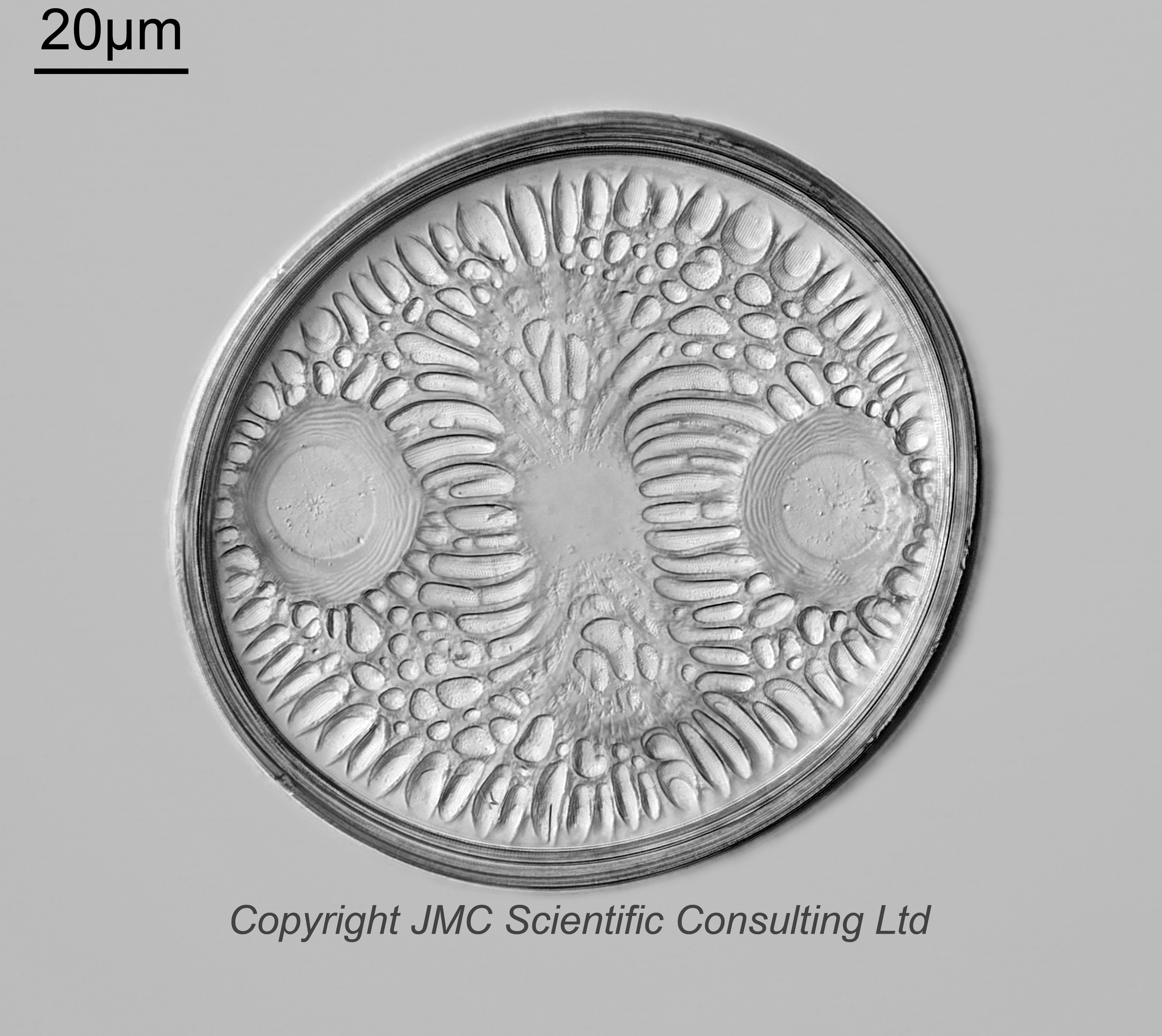
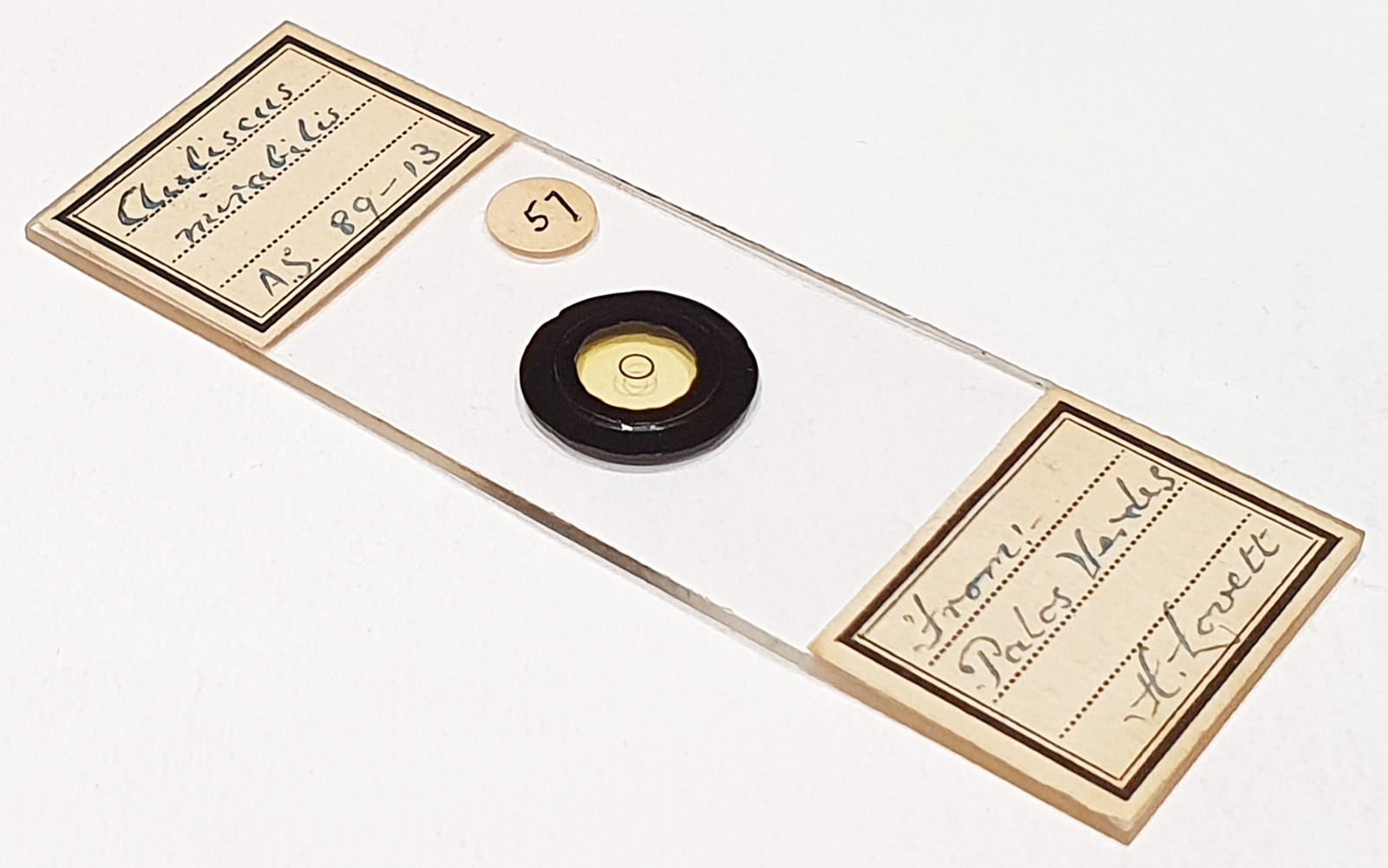
Auliscus mirabilis from Palos Verdes, California, USA. Single example on the slide, mounted rim upwards towards the coverslip (underside view). Another Auliscus on the slide (maybe Auliscus hardmanianus?). Slide says A.S. 89, 13, which refers to it appearance in Schmidt’s Atlas, Plate 89, Figure 13. Prepared by H Lovett. The slide came from the collection of the late Howard Lynk. Olympus BHB microscope using 450nm LED light. 40x Leitz Pl Apo 1.00 objective, oil immersion. Olympus Aplanat Achromat condenser, oil immersion, oblique lighting. 2.5x Nikon CF PL photoeyepiece. Monochrome converted Nikon d850 camera. 50 images stacked in Zerene (Pmax). Frustratingly, I couldn’t get close enough to use the 63x objective for it, as there is some really fine structure which wasn’t fully resolved with the 40x. C’est la vie.
Auliscus mirabilis Greville, 1863. Original description: Greville, R.K. (1863). A monograph of the genus Auliscus. Transactions of the Microscopical Society, New Series, London, 11(3): 36-53, pls II & III. Page 47, Plate 2, Figure 11.
Spelt Auliscus mirablis in Wornardt, Walter W., Jr. 1967. Miocene and Pliocene marine diatoms from California. California Academy of Sciences, Occasional Papers 63:108p. Page 56, Figures 96, 98, 99.
EDIT – I’ve been told his name is Harry Lovett, and he was a member of the Quekett Microscopical Club in the 1940s.