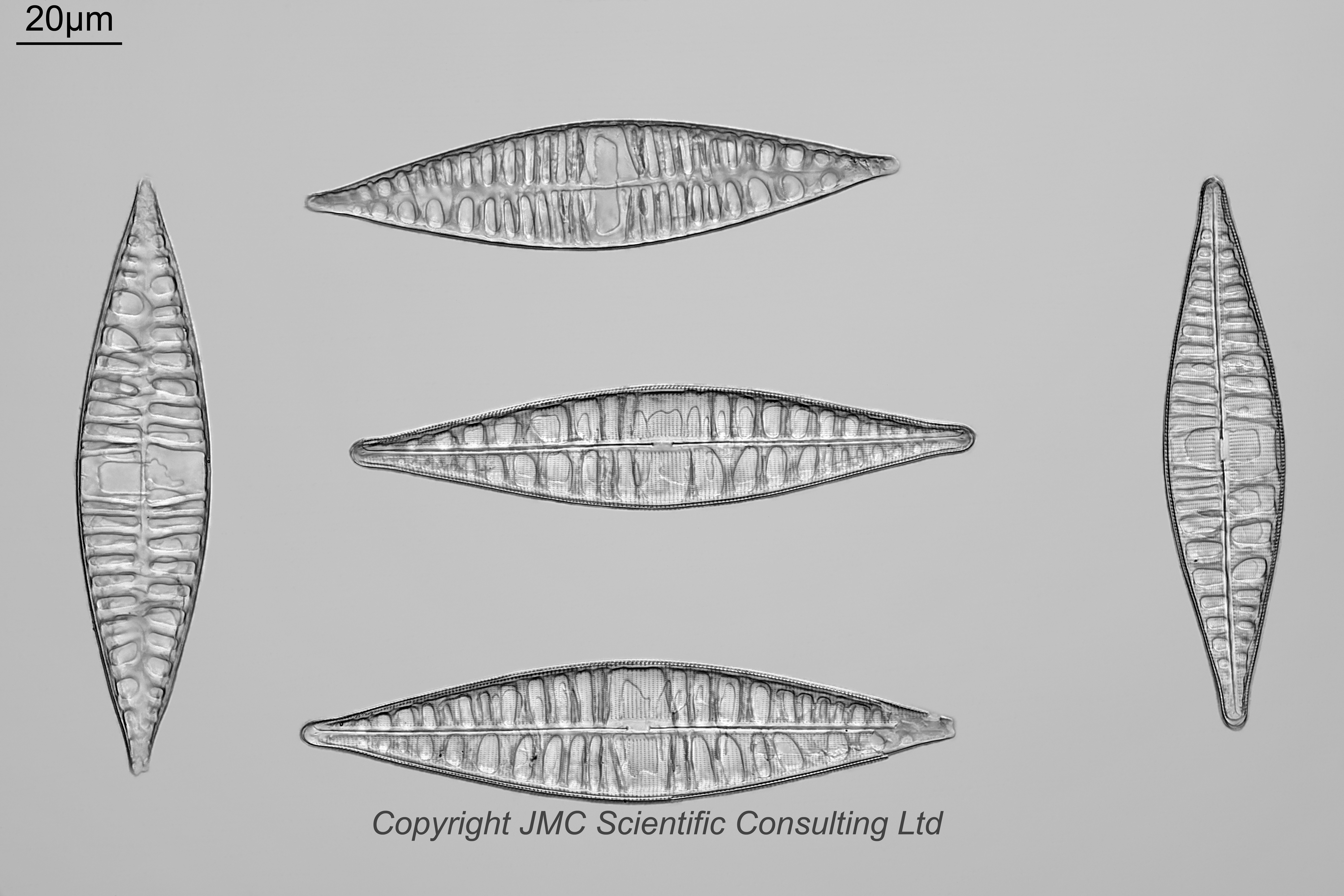
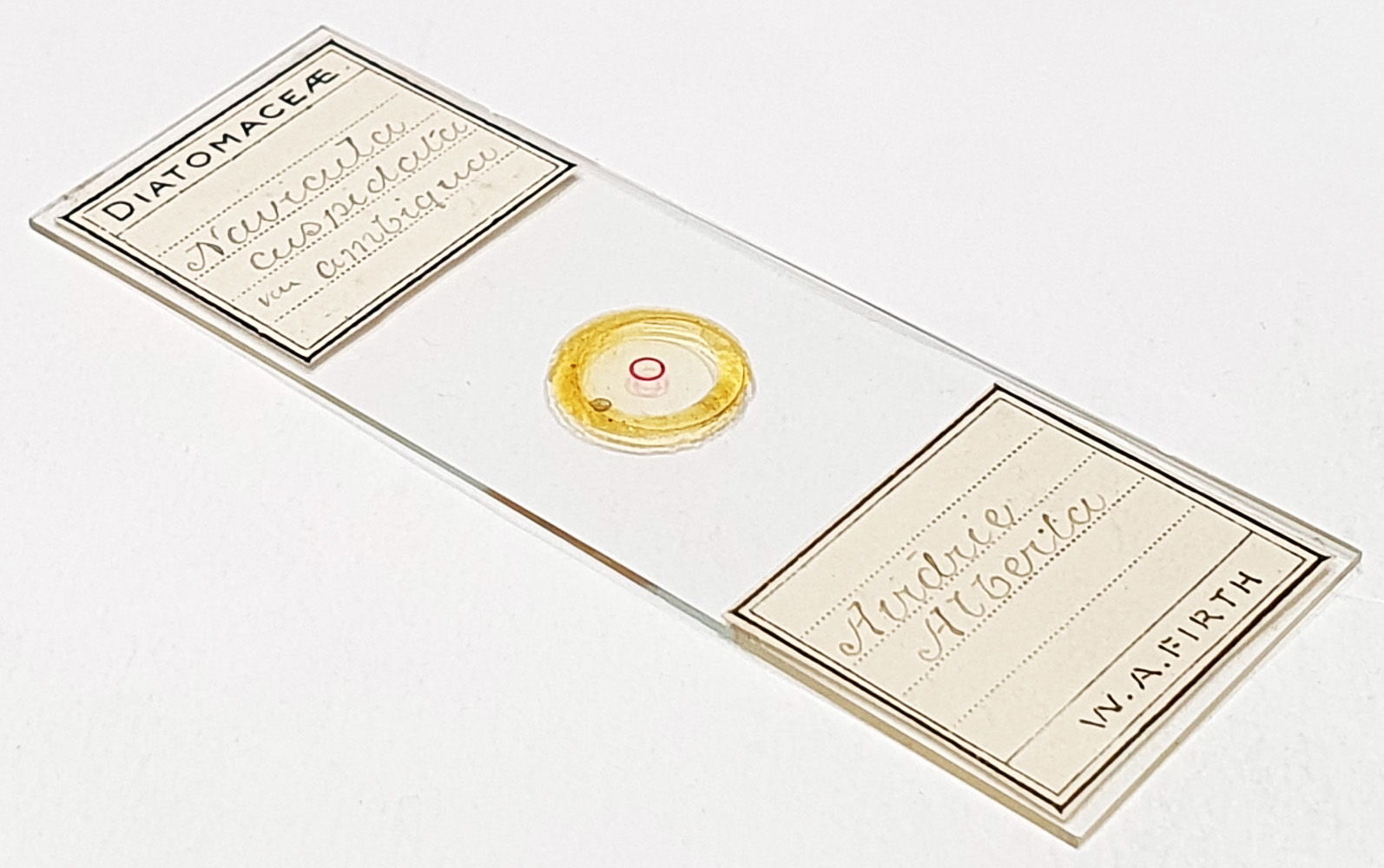
Oooh, this is quite a fun one. An arrangement of five Navicula cuspidata var. ambigua from Airdrie, Alberta. This name is currently regarded as a synonym of Craticula ambigua (Ehrenberg) D.G.Mann. They have an odd look about them, and I’ll explain more on that later. Prepared by WA Firth. Olympus BHB microscope using 450nm LED light. 63x Leitz Pl Apo 1.4 objective, oil immersion. Olympus Aplanat Achromat condenser, oil immersion, slightly oblique lighting. 2.5x Nikon CF PL photoeyepiece. 11mm of extension to the camera removed, so I could with them all in a single stack (the image was the full frame of the camera). Monochrome converted Nikon d850 camera. 37 images stacked in Zerene (Pmax).
Navicula cuspidata var. ambigua (Ehrenberg) Kirchner 1878. Published in: Kirchner, O. (1878). Algen. In: Kryptogamen-Flora von Schlesien. Part 1. (Cohn, F. Eds) Vol. 2, pp. i-iv [vii] 1-284. Breslau: J.U. Kern’s Verlag (Max Müller). Page 178.
The unusual looking valves are what’s known as ‘craticular’ ones (funnily enough linked with the name of the species – ‘Craticula’). Formation of this craticular stage seems to be a fairly rare phenomenon and a response to elevated salt levels in the water. More about this in the following sites;
https://diatoms.org/species/50065/craticula_ambigua
https://diatoms.org/projects/a_closer_look_at_craticula
https://microscopesandmonsters.wordpress.com/2019/02/25/how-craticula-got-its-name/
Also in this article;
Kaczmarska, I., Poulíčková, A., Sato, S., Edlund, M. B., Idei, M., Watanabe, T., & Mann, D. G. (2013). Proposals for a terminology for diatom sexual reproduction, auxospores and resting stages. Diatom Research, 28(3), 263–294. https://doi.org/10.1080/0269249X.2013.791344