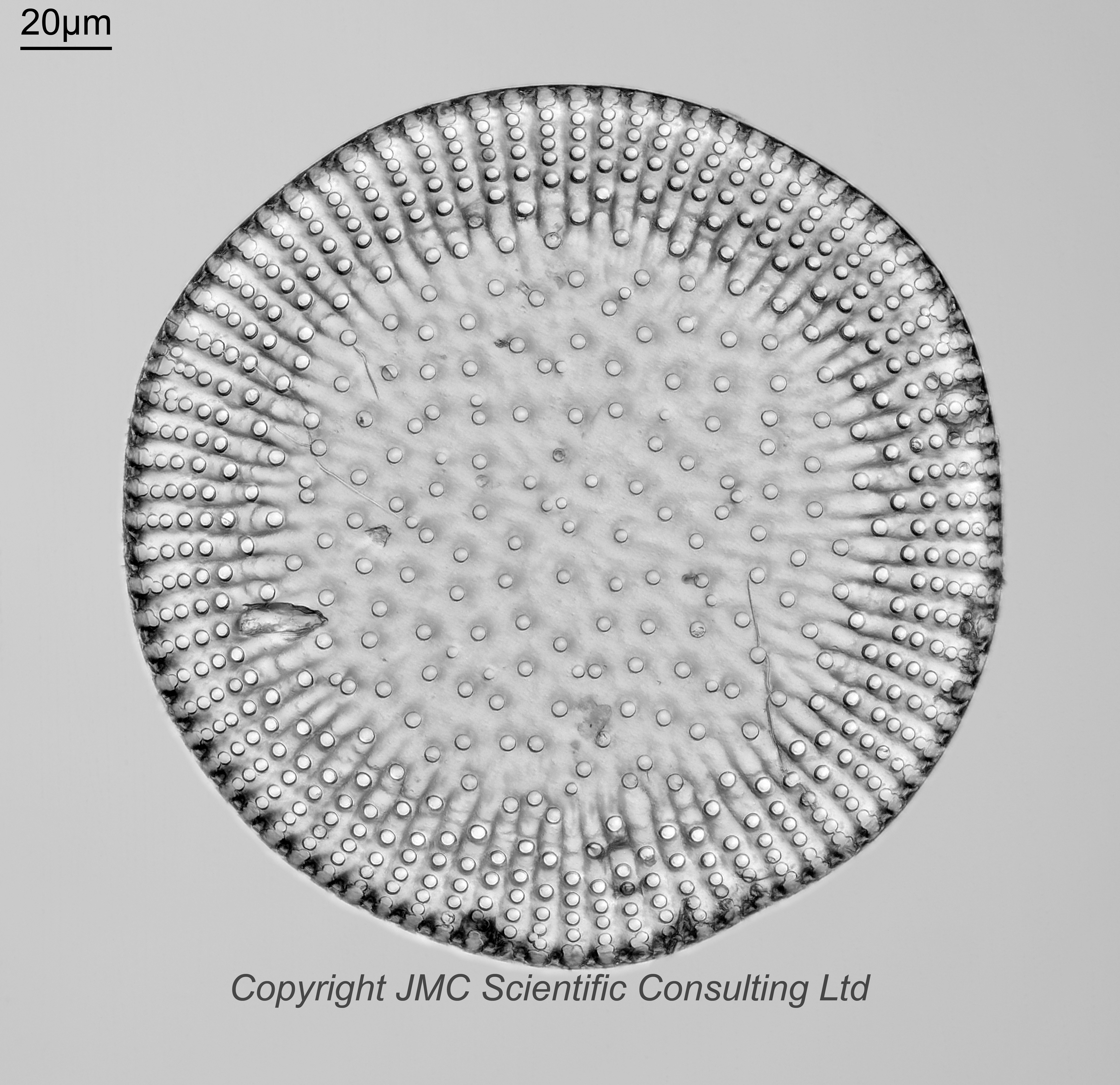
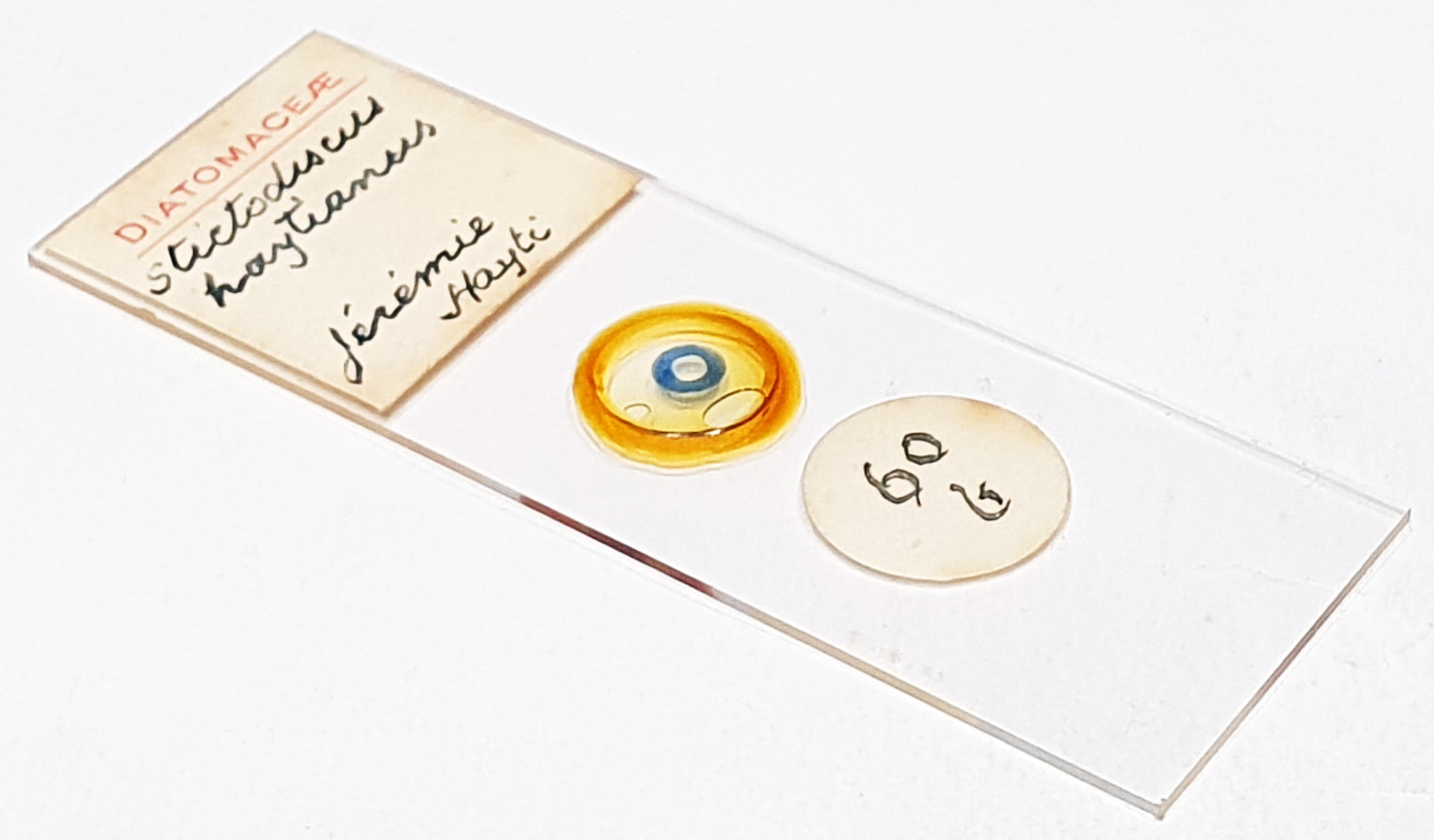
Stictodiscus sp. (labelled as Stictodiscus haytianus) from Jérémie, Hayti [Haiti]. I’m going to come back to the name in a minute. Single example on the slide. No makers name, but prepared by JA Long. Olympus BHB microscope using 450nm LED light. 40x Leitz Pl Apo 1.00 objective, oil immersion. Olympus Aplanat Achromat condenser, oil immersion, oblique lighting. 2.5x Nikon CF PL photoeyepiece. Monochrome converted Nikon d850 camera. 26 images stacked in Zerene (Pmax).
Ok, the name. Stictodiscus haytianus Truan & Witt 1888: 19; pl. IV [4] figs 27, 28, 29. Published in: Truan y Luard, A. & Witt, O.N. (1888). Die Diatomaceen der Polycystinenkreide von Jérémie in Hayti Westindien. pp. [1]–38, incl. 7 pls [I-VII]. Berlin: Verlag von R. Friedländer & Sohn. Page 19, Plate IV (4), Figures 27,28,29.
A translation of that is given below:
“Extremely robust form, with a well-developed, sculpted rim. Folding is weak, radial at the rim, barely noticeable, somewhat stronger and dichotomous in the center. Punctuation is very strong, forming radial rows that are more than half the radius of the shell. Each radial row begins at the rim with a double dot; this is followed by dots, where the formation from two dots is still clearly visible, then elliptical and finally round dots, becoming smaller towards the center. Punctuation in the center is irregular, with a few smaller dots always present in the center.
Frequent. Pl. IV, Figs. 27, 28, 29.
This beautiful form is characteristic of the Jérémie material; it almost always occurs in the round shell.”
Looking at the images in Truan and Witt, it looks closer to Plate 4, Figure 23 to me. This would make it an example of Stictodiscus truani. However I will leave it with a question mark for now. Whatever it is, it is a lovely example of a Stictodiscus from a rare site in Haiti.