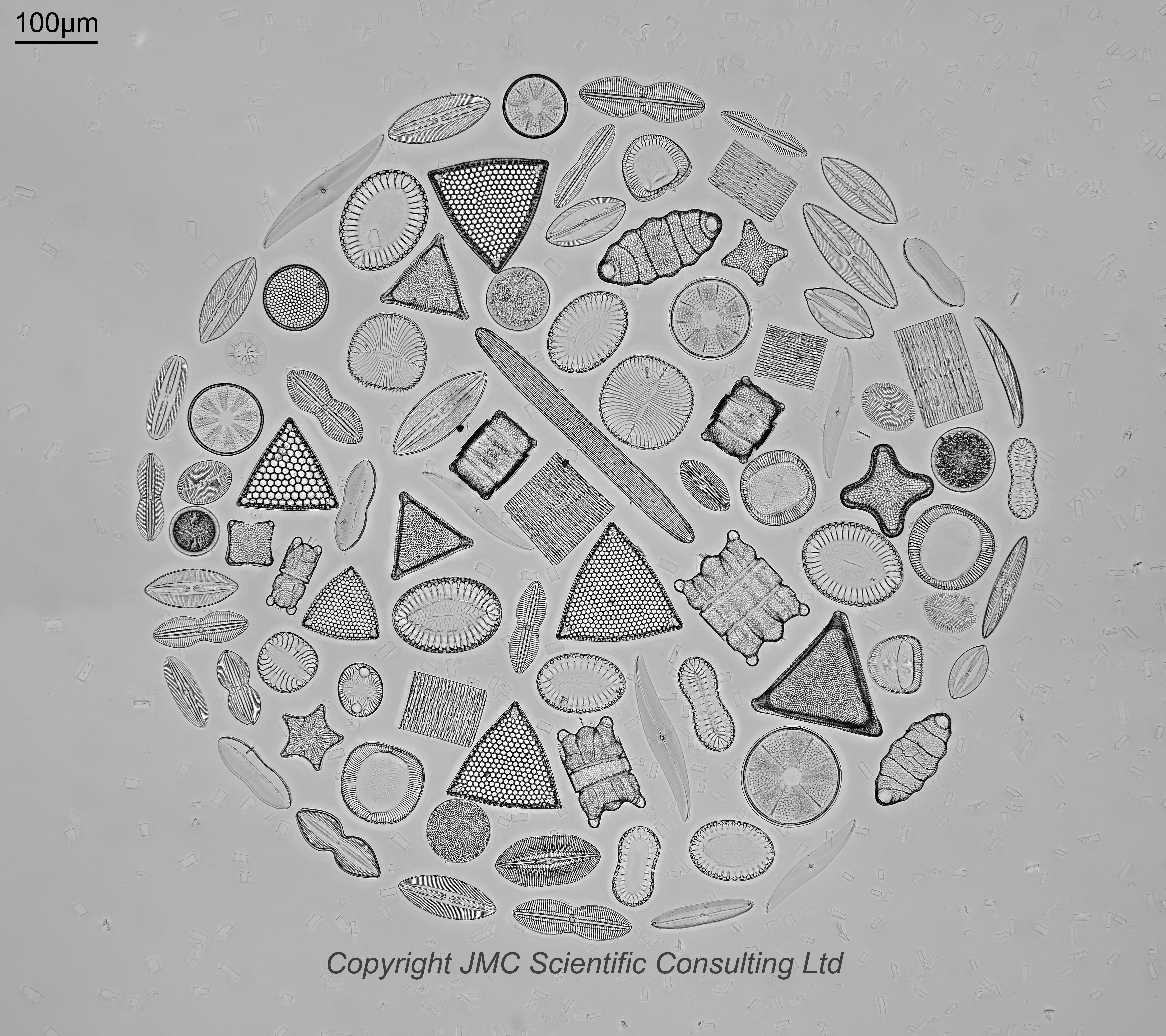
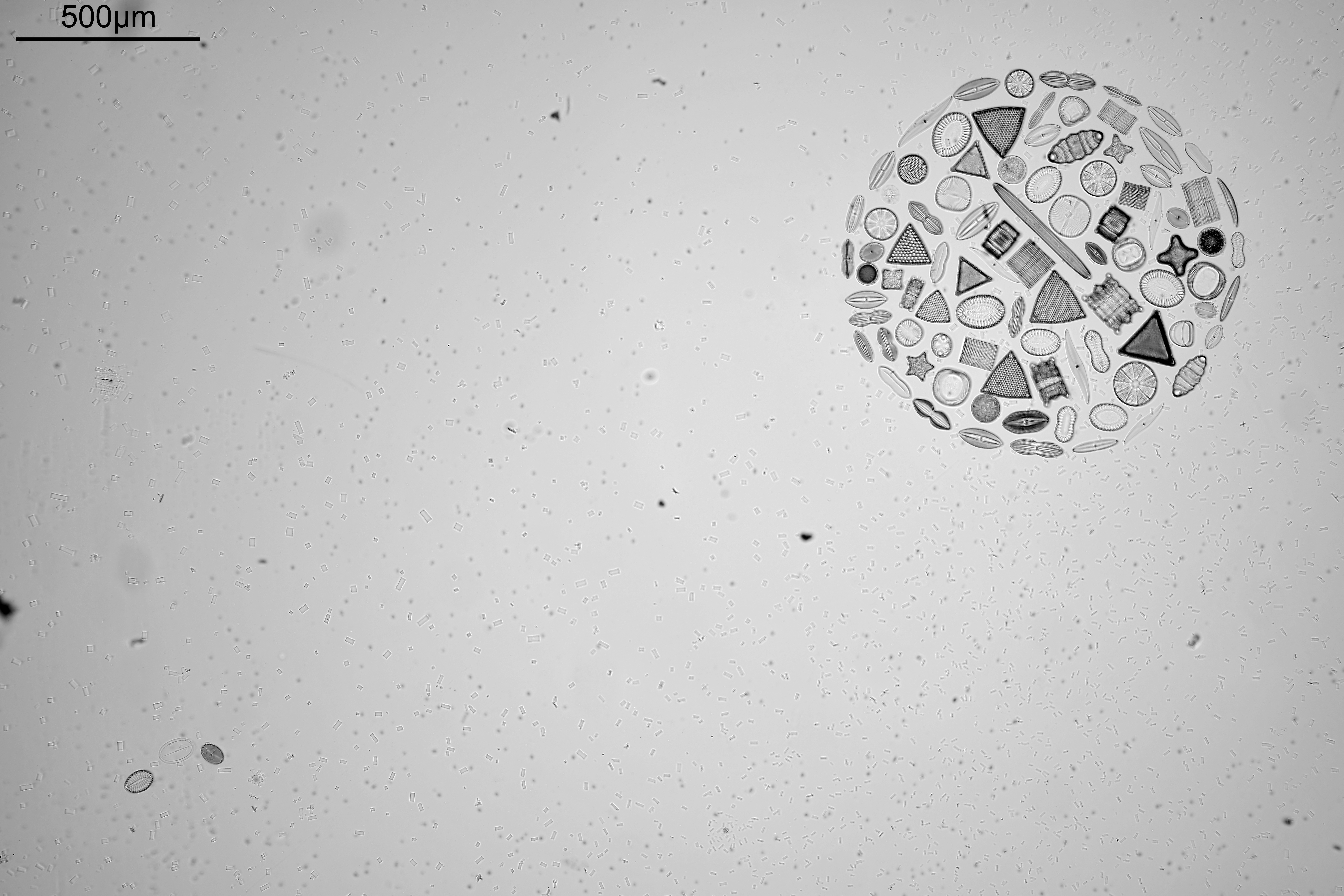
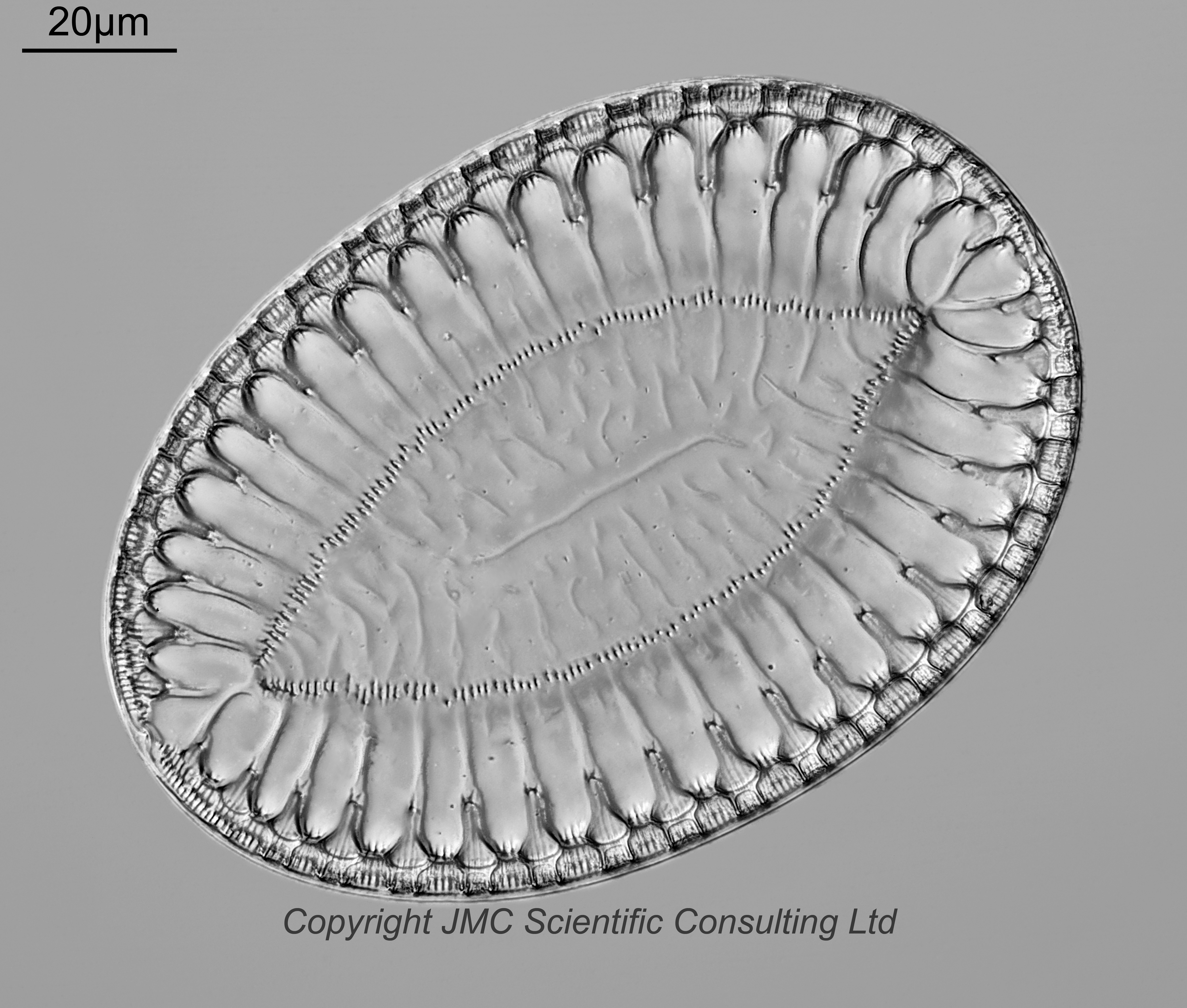
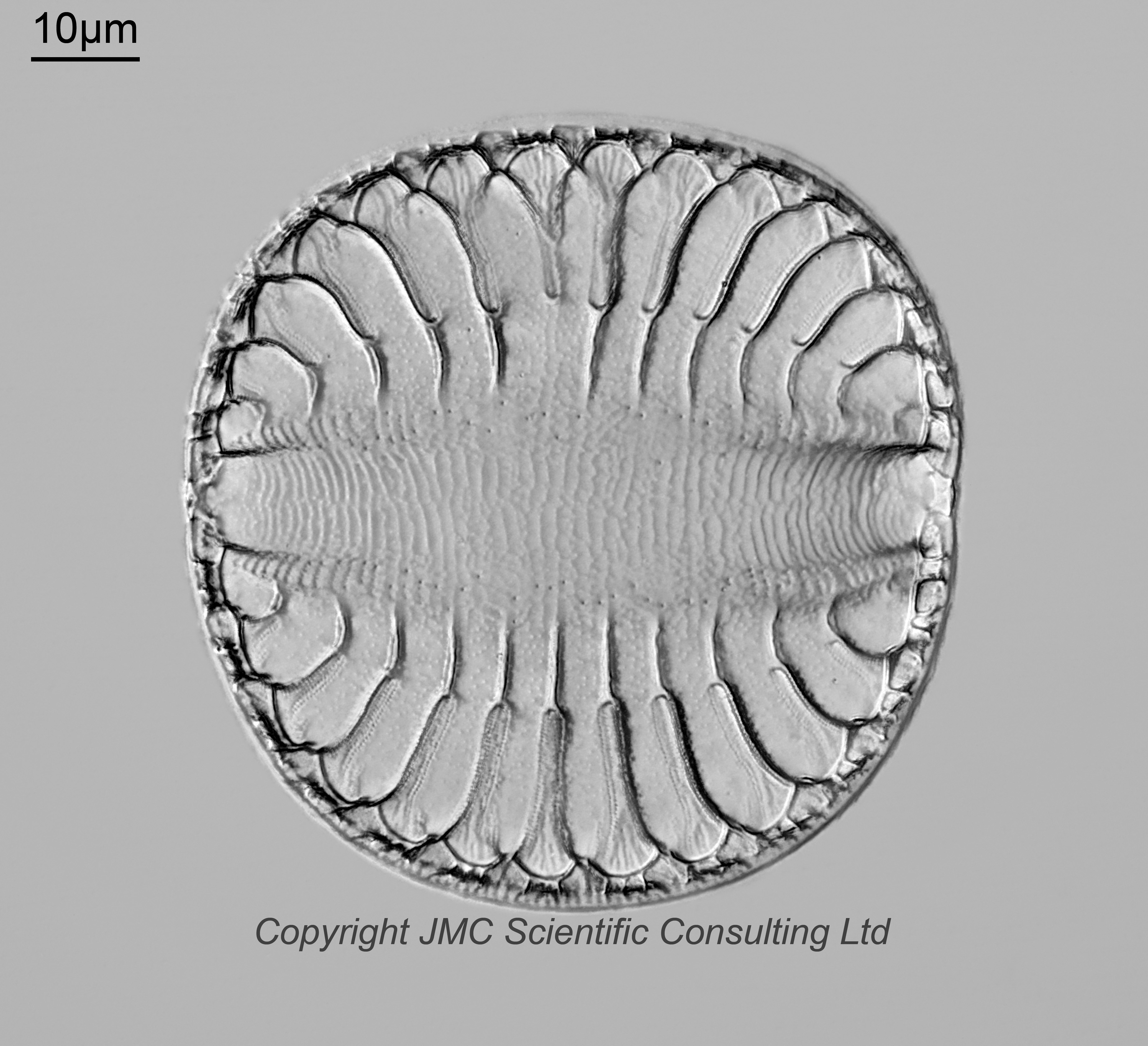
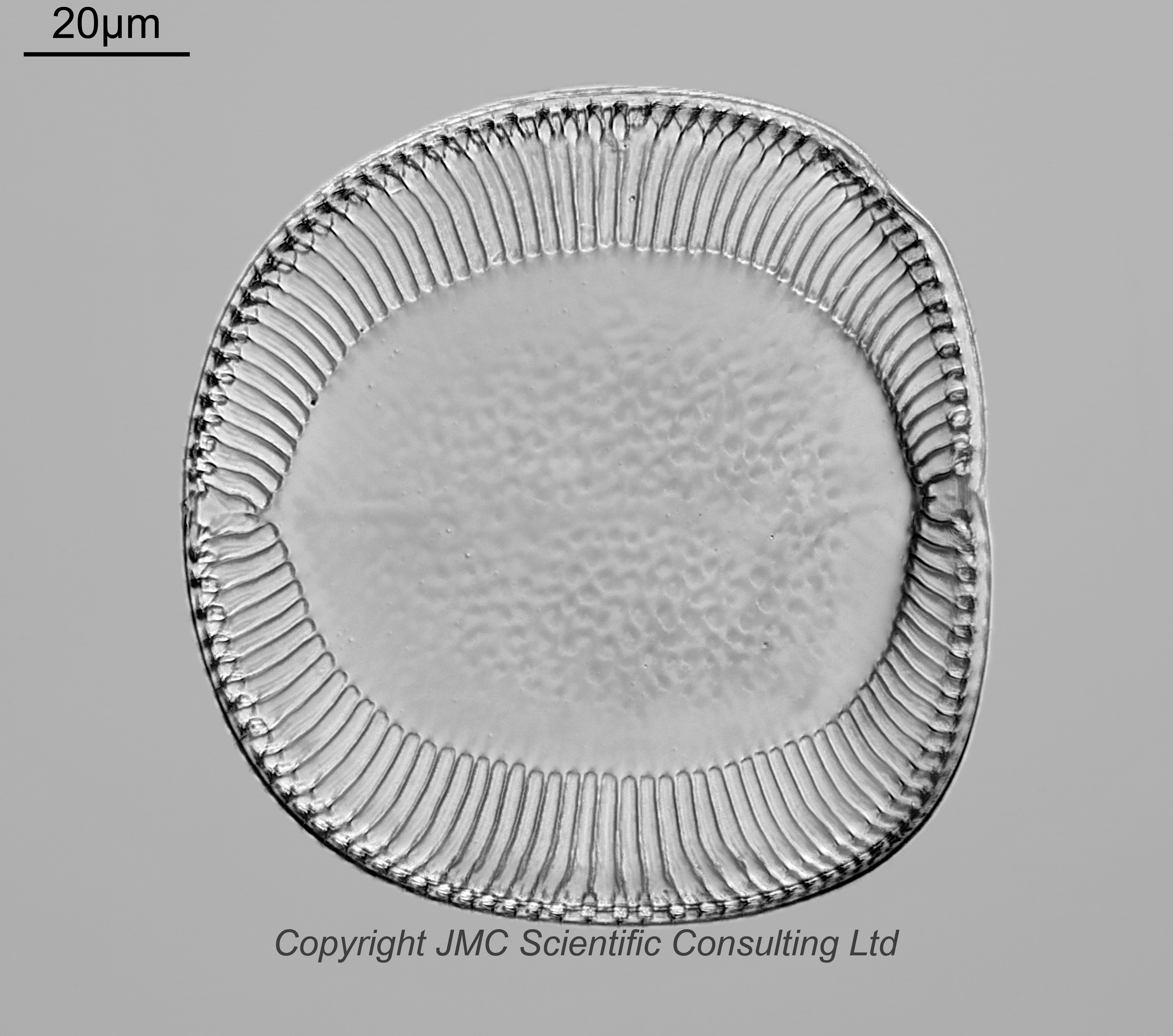
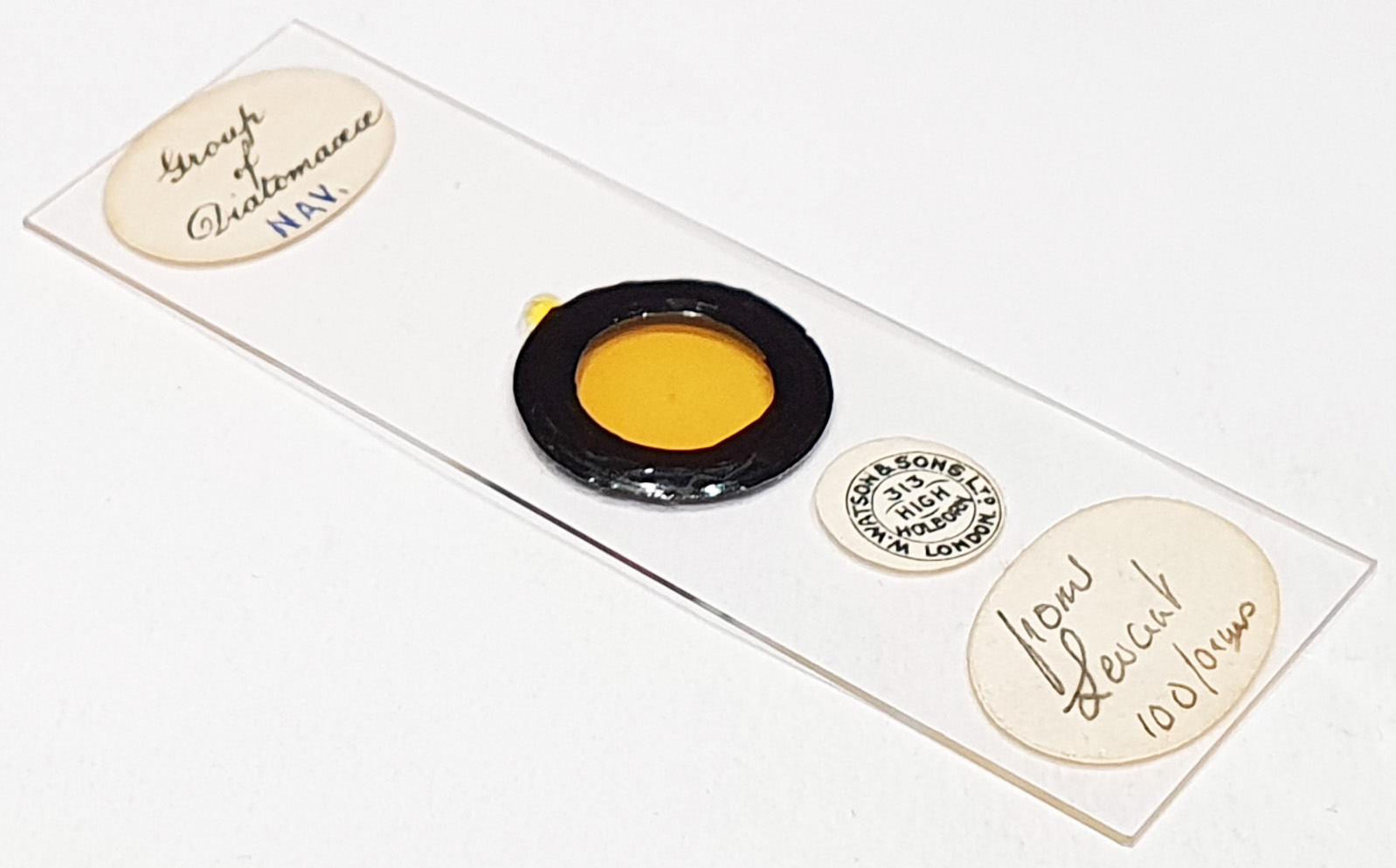
An arrangement of 100 forms from Levant. Prepared by Watson and Sons Ltd. The arrangement looks intact, but there are 3 diatoms to the lower left, clustered together and some distance from it. It don’t think these have migrated over time. Mountant is very yellowed, and has visible crystals throughout. Olympus BHB microscope using 450nm LED light. I selected 3 diatoms for imaging at higher resolution. 63x Leitz Pl Apo 1.4 objective, oil immersion. Olympus Aplanat Achromat condenser, oil immersion, oblique lighting. 2.5x Nikon CF PL photoeyepiece. Monochrome converted Nikon d850 camera. Image stacks prepared in Zerene (Pmax).
Surirella sp. Surirella fastuosa? (maybe one of the variants). 41 images stacked. Underside view. Blocks from the crystals in the mountant visible but edited out.
Campylodiscus sp. C. simulans? 67 images stacked. Pringle shaped. Campylodiscus book, Plate VII, Fig 36. Campylodiscus simulans W.Gregory 1857. Published in: Gregory, W. (1857). On the post-Tertiary diatomaceous sand of Glenshira. Part II. Containing an account of a number of additional undescribed species. Transactions of the Microscopical Society of London 5: 67-88, pl. 1. Page 77, Plate 1, Figure 41.
Campylodiscus sp. C. eximius? 106 images stacked. Pringle shaped. Blocks from the crystals in the mountant visible but edited out. Campylodiscus book, Plate X, Fig 61. Campylodiscus eximius W.Gregory 1857. Published in: Gregory, W. (1857). On new forms of marine Diatomaceae found in the Firth of Clyde and in Loch Fyne, illustrated by numerous figures drawn by R.K. Greville, LL.D., F.R.S.E. Transactions of the Royal Society of Edinburgh 21: 473-542, 6 pls [IX-XIV]. Page 503, Plate XI [11], Figures 54, 54b. Shown in Schmidt’s Atlas Plate 15, Figure 8, and also Plate 207, Figures 19-21. I’ve also been told that it could be Campylodiscus eximius var. briocensis Schmidt in Schmidt et al., 1877, which is shown in Schmidt’s Atlas, Plate 52, Figures 1,2.
The book referred to above is; Deby, J., 1891, Analysis of the Diatomaceous Genus Campylodiscus. Privately published, London.