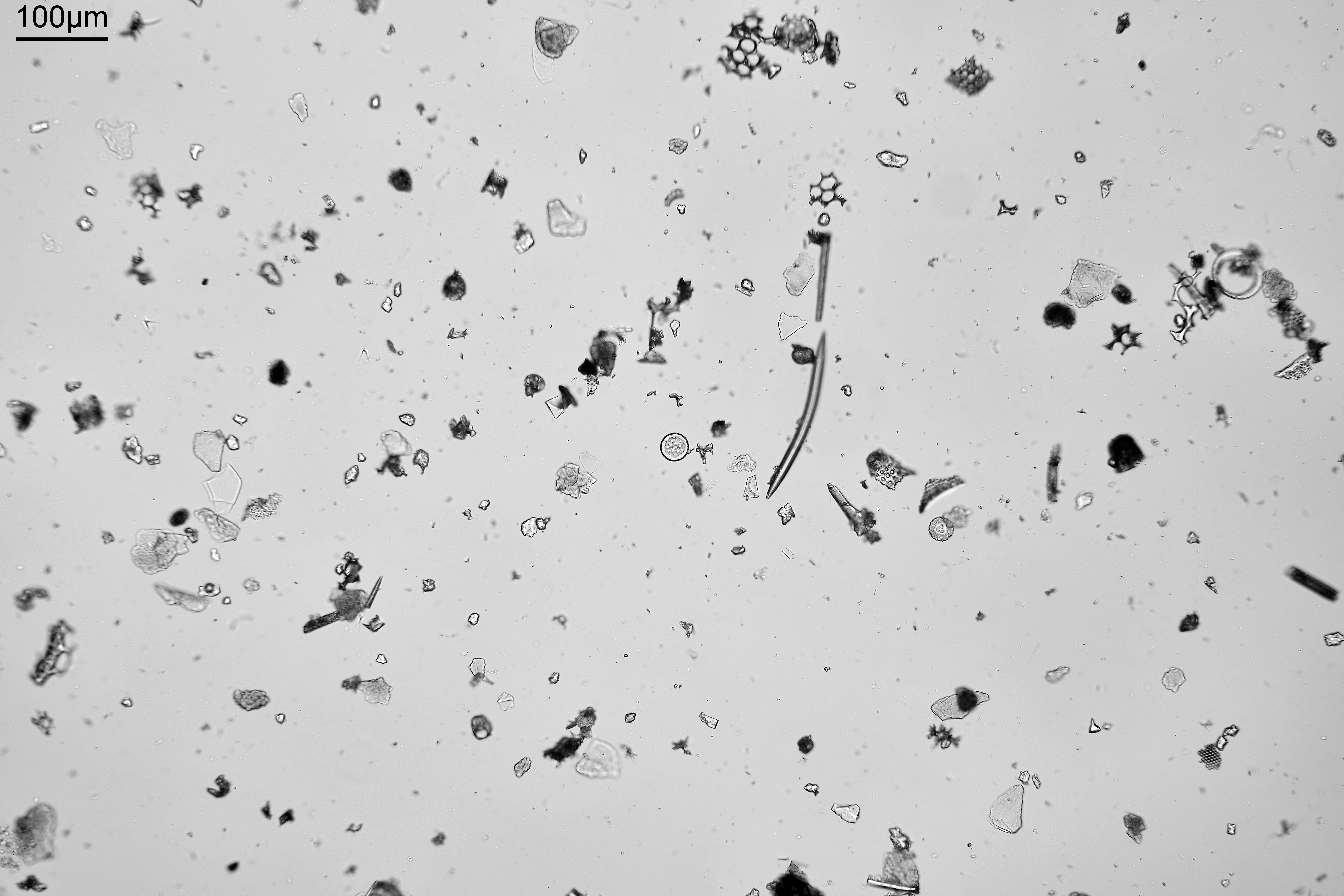
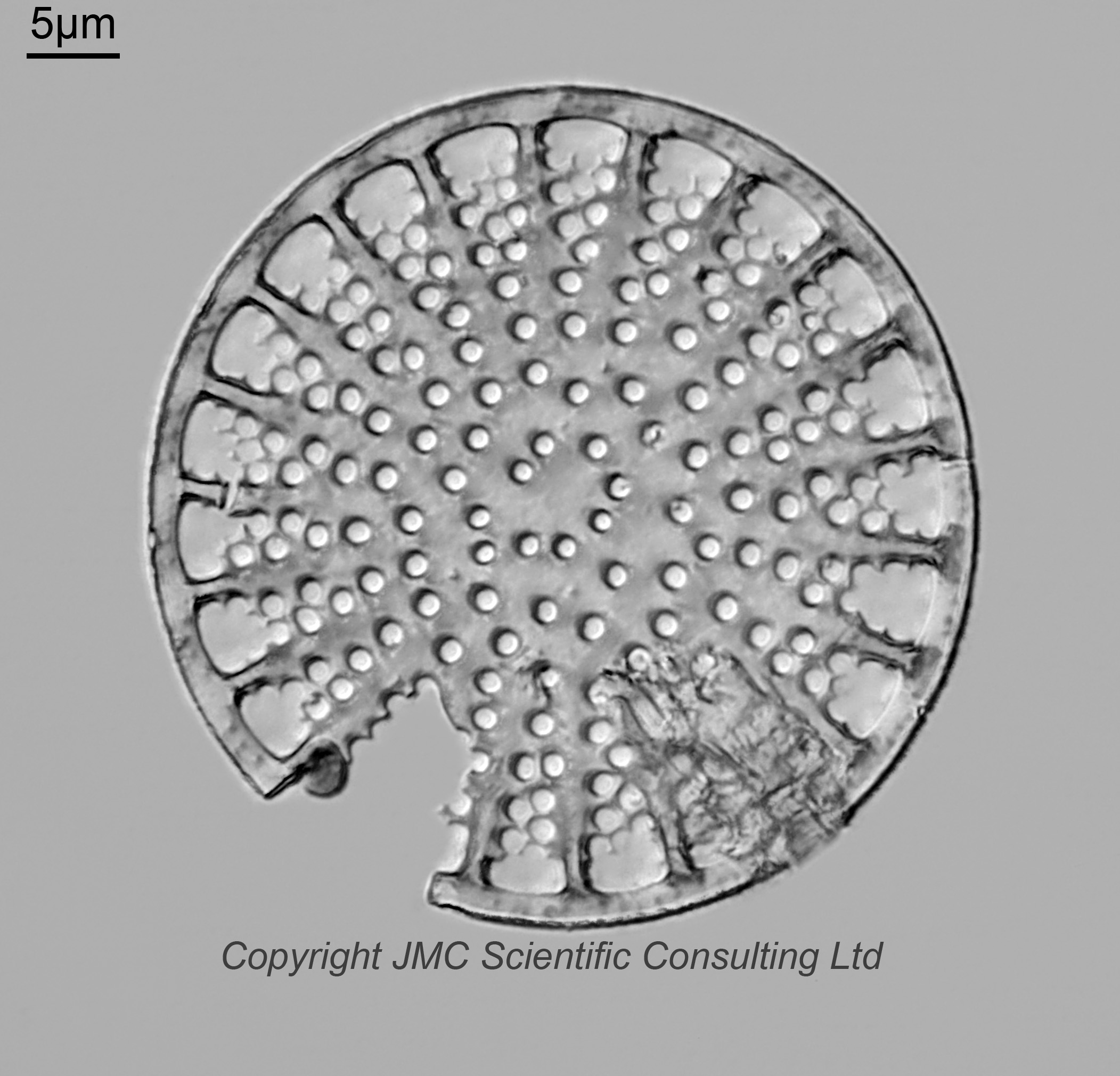
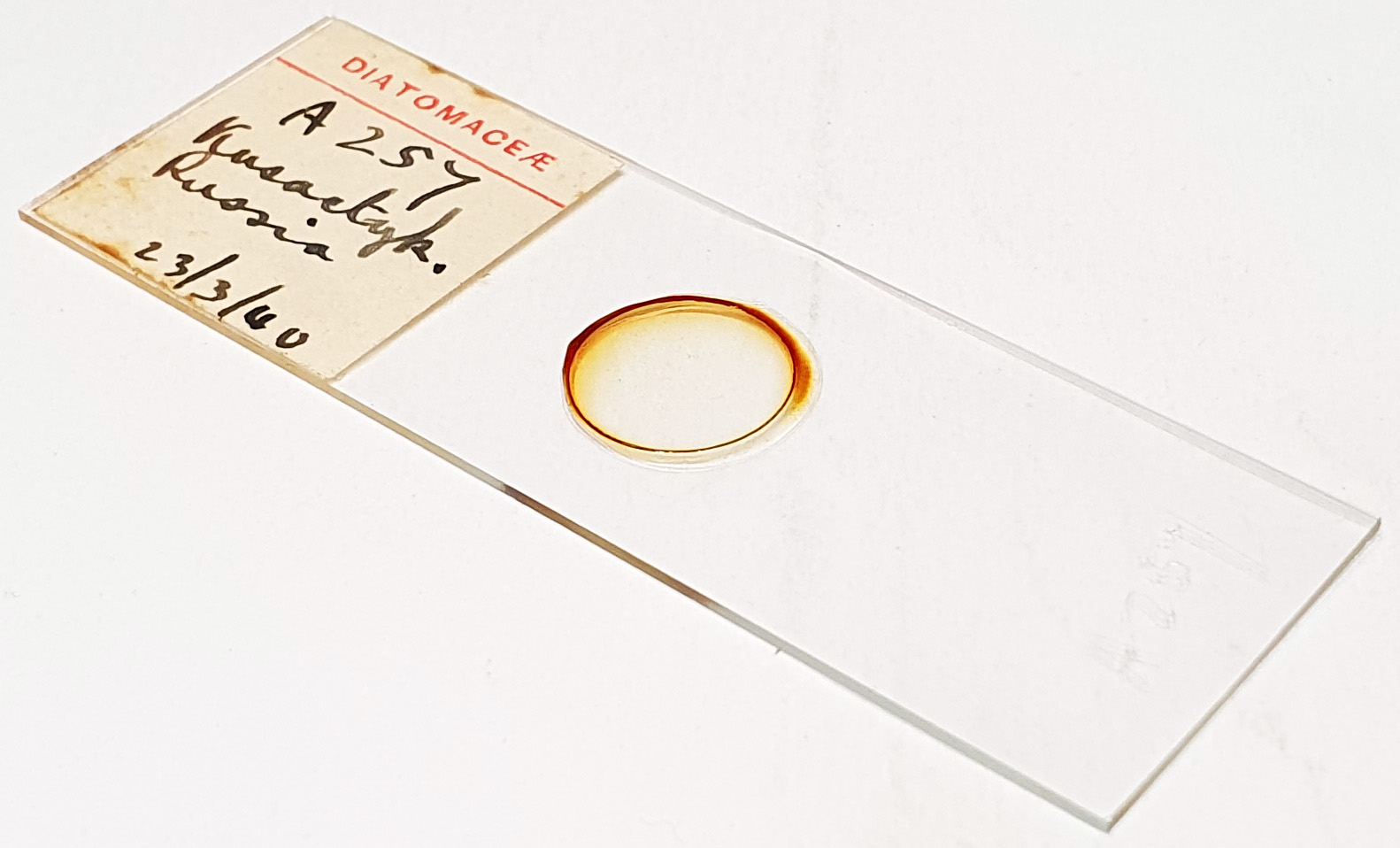
A strew slide labelled as Kusactyk, Russia (more on the name in the minute). Dated 23/3/[19]40. No makers name, but does have A257 written on the label and engraved into the slide. Range of species, but mainly small ones or fragments. Olympus BHB microscope using 450nm LED light. As well as the strew I selected one (again, more on this in a minute) for imaging using the 63x Leitz Pl Apo 1.4 objective, oil immersion. Olympus Aplanat Achromat condenser, oil immersion, oblique lighting. 2.5x Nikon CF PL photoeyepiece. Monochrome converted Nikon d850 camera. 25 images stacked in Zerene (Pmax). Underside view, rim upwards. Some debris over the lower right part.
First the location. I could not find any mention of ‘Kusactyk, Russia’. I think ths could well be Küsnetzk (modern spelling Kuznetsk) which is known for fossil diatoms.
Next, the species. Concentrating on Kuznetsk, I came across Stictodiscus kossuthii Pantocsek, 1892. Original description: Pantocsek, J. (1892). Beiträge zur Kenntnis der Fossilen Bacillarien Ungarns. 3 Teile. Julius Platzko, Nagyy-Tapolcsany. Teil III, Susswasser Bacillarien. Anhang-analysen 15 neuer Depots von bulgarien, Japan, Mahern, Russland und Ungarn. Nagy-Tapolcsány, Buchdrucherei von Julius Platzko, 42 pls., available online at http://www.biodiversitylibrary.org/item/15525 . Page 97, Plate 26, Figure 395. As screen grab of this is shown below, and looks to be a good match.
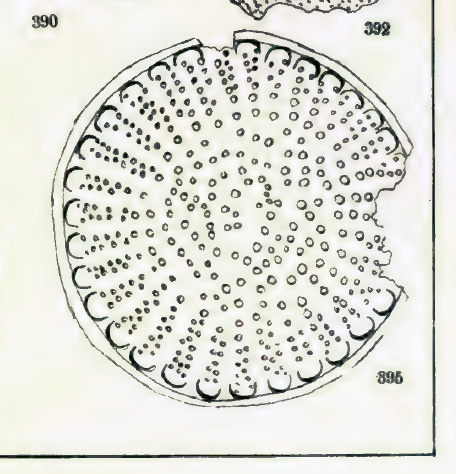
Translation of Pantocsek 1892 for this;
“A circular, flat, and bordered disc. The margin is 1.5 µm wide, hyaline, and encircled by a ring of scales. The structure is punctate. The puncta correspond to the scales and are arranged in short, radiating clusters; towards the center, they are larger and more widely spaced. Valve diameter: 58 µm.
Found in very ancient marine strata near Kuznetsk, Russia; Illustration: *Beitrg.* III, Plate 26, Fig. 395.
I have dedicated this to the illustrious Mr. Lajos Kossuth—formerly Governor of Hungary and a man highly skilled in both public affairs and botany—at Turin.”
The appearance, size and location (Kuznetsk) all point towards this being what Pantocsek is describing.
Interestingly this species is also mentioned in Mann, A. (1925). Marine Diatoms of the Philippine Islands. United States National Museum, Bulletin 100, 6(part. 1): 182 pp., 39 pls. Page 28, Plate 6, Figure 1.
Anisodiscus adeei, new species Quote; “The species clearly belongs with Stictodiscus kossuthii Pantocsek (Hung. Diat., vol. 3, pi. 26, fig. 395) and Actinodiscus Horologium Brun (Le Diat., pi. 23, fig. 13). But no Stictodiscus has the terminal semicircular elevations of the Pantocsek form, and Actinodiscus is especially distinguished by sharp radiating ridges, terminating at the margin in ocelli or pseudonodules ; so that both of these assignments are untenable. My specimens are especially unlike Stictodiscus in not being evenly convex. As no complete frustule was found, the dissimilarity of the two valves, referred to in the generic name, could not be noted. But as several specimens were found showing variation in the radiating lines of beads, this characteristic may be assumed to belong to the present species.”.
When I first looked at it, I thought it was Stictodiscus like, but what I call the ‘vaulting’ just within the rim didn’t look right for that. Mann also mentioned this feature, and that Stictodiscus does not have that.
Overall, while I think this diatom is what Pantocsek named Stictodiscus kossuthii, I suspect that further work on this would bring it out of the Stictodiscus genus and into something else (maybe Anisodiscus as per Mann’s description).